
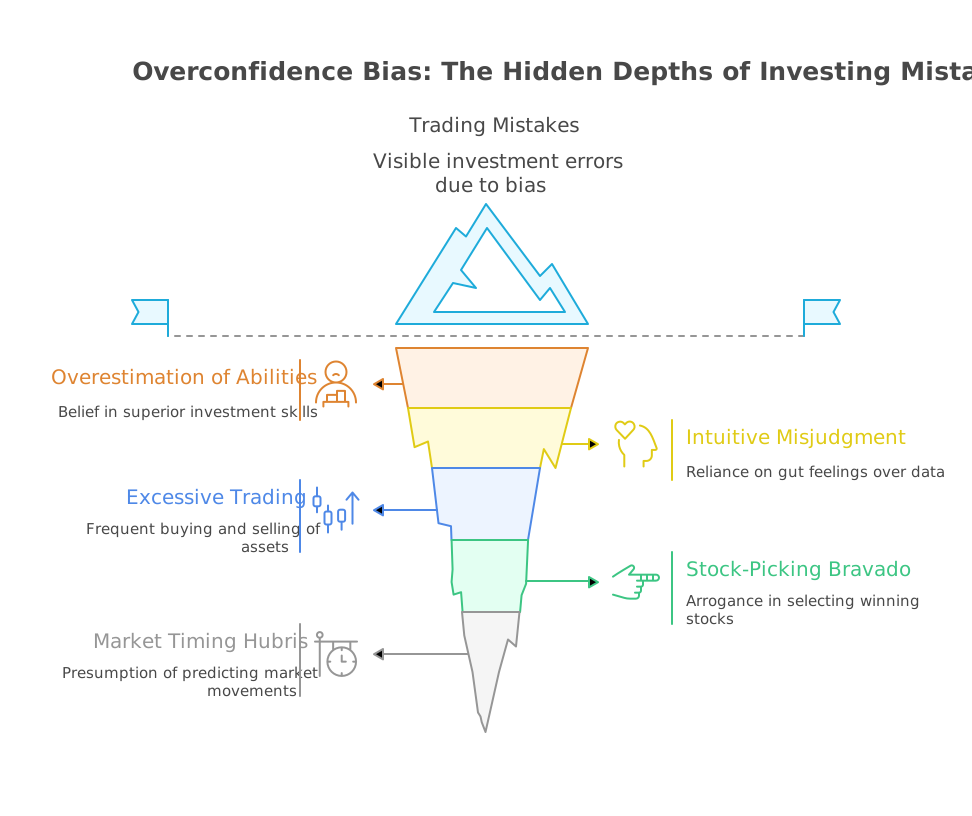
Do you think you’re a better-than-average driver? If so, you’re in good company—most people do. It’s human nature to overestimate our abilities, whether behind the wheel or in other parts of life. While a touch of confidence can be helpful, too much can lead us to make decisions based on pride or instinct instead of facts. In investing, that overconfidence can quietly erode your wealth. In this post, we’ll look at what overconfidence bias is, how it influences investor behavior, and practical ways to avoid common trading mistakes.
What Is Overconfidence Bias (And Why It Matters for Investors)
Overconfidence bias is a psychological phenomenon where we overestimate our abilities, knowledge, or chances of success. In everyday life it shows up when everyone thinks they’re an above-average driver or have an above-average IQ (obviously, we can’t all be above average!). In the context of investing, overconfidence often leads people to believe they can consistently beat the market or pick winning investments, even without much evidence. This bias can cloud judgment and cause investors to disregard data or expert advice . For example, a FINRA study found that 64% of investors rated their investment knowledge highly, yet those who were most confident actually answered fewer questions correctly on a financial quiz . In other words, the people who thought they knew the most tended to know less than they believed.
Why does this matter? Because overconfidence can tempt you into taking risks or making moves that aren’t in your best interest. An overconfident investor might trade too frequently, put too much money into a hot stock tip, or stubbornly hold a losing investment because they “just know” it’s going to come back. Recognizing this bias is the first step in countering it. Next, let’s look at a famous example that shows how even very smart people can fall into the overconfidence trap.
The Monty Hall Problem: A Lesson in Overconfidence
To illustrate overconfidence, let’s step away from the markets for a moment and talk about a classic game show puzzle that stumped even PhDs. It’s called the Monty Hall Problem. Imagine you’re on a game show with three doors: behind one door is a big prize (say, a new car), and behind the other two are goats (booby prizes). You pick Door #1, hoping for the car. The host, who knows what’s behind all the doors, then opens Door #3 – and it reveals a goat. Now the host asks: “Do you want to stick with Door #1, or switch to Door #2?”
Most people instinctively assume it doesn’t matter if they switch or stay. After all, two doors are left, so it feels like a 50/50 choice. Even many math professors believed this. But statistically, the odds aren’t 50/50 – if you switch doors, you actually have a 2 out of 3 chance of winning the car, versus only 1 out of 3 if you stick with your original choice . This answer is highly counter-intuitive, and when it was publicized, it ruffled a lot of proud feathers.
Do we listen to reason when overconfident?
In 1990, Marilyn vos Savant — at the time listed as the person with the world’s highest IQ — answered the Monty Hall puzzle in her magazine column. She advised the contestant to switch doors. Her answer was correct. However, she was subsequently flooded with letters — over 10,000 of them — many from PhDs and even math professors, all confidently telling her she was wrong and didn’t understand basic probability. Imagine that: countless experts, utterly certain of their own analysis, but in reality they were the ones who were wrong. It’s a classic case of overconfidence. Highly educated people had an unjustified feeling that they were right and refused to even consider a solution that “felt” wrong to them.
Lessons from Monty Hall
The Monty Hall saga packs several lessons about overconfidence that apply to investing and decision-making in general:
Intuition Can Mislead
What seems “obvious” can be dead wrong. In the Monty Hall game, it felt obvious to so many people that switching doors wouldn’t matter – but that intuition was misleading. In investing, similarly, a stock tip or market trend might seem like a sure thing based on gut feeling, but reality can be more complex. Our intuitions (“this stock has to go up” or “I just know this will be a winner”) can lead us astray, just like intuition misled those professors on the game show puzzle.
Short-Term Outcomes Don’t Prove You Right (or Wrong)
Suppose you ignored Marilyn’s advice and stuck with your original door – you might still win the car occasionally by pure luck. That doesn’t mean staying was the better strategy; it just means you got lucky. Likewise, if you did switch (the statistically smart move), you could still lose in that one round, even though over many repeats you’d win far more often by switching.
The investing parallel is important: you might get a great result from a poor investment decision, or a bad result from a sound decision, due to short-term chance. An overconfident trader might double their money on a risky bet (a bad strategy that got lucky), or a cautious investor might see a temporary loss despite doing everything “right.” Don’t let a few lucky wins trick you into thinking you have a golden touch. And if a good strategy doesn’t pay off immediately, that doesn’t mean it’s wrong – sometimes even the right choice can have a bad outcome, especially in the short run.
Even Experts Are Human
One striking part of the Monty Hall story is that many experts refused to admit their error, even after the correct solution was explained. Being a PhD or a renowned professional didn’t prevent them from falling victim to overconfidence . In investing, this is a humbling reminder that intelligence or experience doesn’t guarantee immunity from bias. Star money managers, famous economists, billionaire investors – they’re all still human. They can be overconfident and make mistakes, too. As legendary investor Warren Buffett quipped, “If you’ve been in the game 30 minutes and you don’t know who the patsy is, you’re the patsy.” Overconfidence can make anyone the patsy in the market, no matter how smart or successful they are.
The Monty Hall example shows how counterintuitive truths can be—and how our confidence in our own intuition can lead us astray. Now, let’s bring this back to investing and look at how overconfidence bias affects investor behavior and results in real life.

Overconfidence in Action: Trading Too Much & Picking Winners
Overconfidence in investing often shows up in two big ways: excessive trading and stock-picking bravado. In short, people think they can outsmart the market. They trade frequently, chase “hot” stocks, try to time when to get in or out – and usually end up worse off for it.
Excessive Trading (and Why It’s Hazardous to Your Wealth)
Imagine an investor who’s constantly fiddling with their portfolio—buying, selling, reacting to every bit of market news. If you ask them why, they might say, “I have a good feeling about these moves” or “I know what I’m doing; I can time this just right.” That’s overconfidence talking. Decades of behavioral finance research have a blunt warning: trading too much is likely to hurt your returns.
One famous study titled “Trading Is Hazardous to Your Wealth” found that the most active traders (those who traded the most often) earned significantly lower returns than those who traded the least . The more they traded, the worse their results. Why? Because frequent trading racks up costs (even with zero commissions, there are bid-ask spreads and taxes) and because it’s very hard to consistently make the right call on when to buy or sell. Often, overconfident traders end up buying high and selling low, thanks to hype and fear driving their decisions .
Men vs. Women
Overconfidence even has a gender twist: in a well-known analysis of thousands of brokerage accounts, researchers Brad Barber and Terrance Odean found that men traded a lot more often than women, and all that extra trading caused men’s returns to suffer more compared to women’s . In short, men’s greater overconfidence led them to trade too much and underperform. The effect was especially pronounced for single men versus single women. Overconfident investors are often sure about facts or insights that just aren’t true, and they act on them to their detriment.
It’s sobering but true: various analyses show that most day traders lose money over time. You might hear about a neighbor or cousin who struck it rich trading stocks in a volatile market, but those stories are the exception. For each big winner, there are many others who quietly lost. If you string together a few winning trades, it’s easy to attribute that success to skill (feeding the feeling you can do no wrong). But markets have a way of humbling people. Every trade has someone on the other side, and if you’re trading on gut feeling, the person taking the opposite side might be a professional with far more information. Overconfidence lures many into a dangerous game they’re unlikely to win consistently.
Stock Picking & Market Timing: The False Allure of Being “Right”
Maybe you’re not a rapid-fire day trader, but you still believe you can hand-pick the best stocks or predict the next market downturn. This is a subtler form of overconfidence. Unfortunately, the track record of even professional investors at stock-picking and market-timing should give us all pause.
Consider stock picking first. There are thousands of smart analysts and fund managers out there, all searching for the next big winner. If a stock is truly a great bargain or poised to soar, chances are a lot of other people have noticed too. The price already reflects much of that collective wisdom. The overconfident investor might think, “Wall Street hasn’t caught on to this company’s genius, but I have.” That’s a tough bet to make repeatedly and be right. Even most Wall Street pros don’t consistently beat the market averages.
Market timing
How about market timing—getting out of stocks before a crash, then back in at the bottom? This is notoriously difficult even for seasoned experts. You have to make two correct calls (when to sell and when to buy back), and the odds of getting both right, repeatedly, are very low. Research on investor behavior shows that the average individual investor often underperforms the market indices. Why? Because many people buy high during euphoric times and sell low during panics, essentially the opposite of a sound strategy. That’s overconfidence and emotion at work. People often think they can dance in and out of the market, but more often they end up tripping themselves.
Even expert fund managers struggle to beat the market, especially after fees. Each year, S&P Global publishes the SPIVA Scorecard, which compares active mutual funds to their benchmark index. Year in and year out, the majority of active funds fail to outperform their benchmarks. For instance, over a 15-year period, roughly 85–90% of actively managed large-cap stock funds earned lower returns than a simple S&P 500 index fund . In essence, almost all those highly paid fund managers with all their analysis and trading ended up doing worse than a low-cost index that just passively follows the market. The reasons are straightforward: high fees and trading costs eat into any gains, and markets are fiercely competitive. As Vanguard founder John Bogle famously said, “In investing, you get what you don’t pay for.” Every dollar you don’t spend on fees or needless trading is a dollar added to your return.

S and P 500 vs. Hedge funds
Warren Buffett has echoed this point for years. In 2007, he even bet $1,000,000 that an S&P 500 index fund would beat a collection of hand-picked hedge funds over the next decade. Sure enough, ten years later, the index fund won by a wide margin . Buffett’s memorable twist on Newton’s laws of motion says it all: “For investors as a whole, returns decrease as motion increases.” In other words, the more frantically you trade (motion), the more you’re likely to hurt your overall returns.
The takeaway: whether you’re an amateur or a professional, overconfidence in your ability to outguess the market can be hazardous to your wealth. So what can you do about it? The goal isn’t to swing to the opposite extreme of never taking any action, but to find a balanced approach. Let’s look at some ways to keep overconfidence in check.
How to Avoid Overconfidence as an Investor
The good news is that once you’re aware of overconfidence bias, there are concrete steps you can take to prevent it from wrecking your portfolio. Here are some strategies to ensure your confidence stays healthy and grounded:
Know Your Limits and Stay Humble
Honest self-reflection is a powerful antidote to overconfidence. Acknowledge that you don’t know what you don’t know. The markets are complex and often unpredictable; even the savviest investors get things wrong. By recognizing that investing isn’t an arena where anyone can have 100% certainty, you remind yourself to double-check assumptions. Before making an investment, ask yourself: “What if I’m wrong about this?” or “Do I really have information others don’t, or am I just feeling sure of myself?” Admitting uncertainty isn’t weakness – it’s the mark of a rational investor who understands the difference between calculated risks and gambles.
Stick to a Plan (Write It Down!)
A powerful way to avoid impulsive, overconfident investment decisions is to create a written investment plan. This plan should outline your target asset allocation—how much you’ll invest in stocks, bonds, and other assets—along with your risk tolerance, so you’re less likely to abandon your strategy when markets fluctuate. Include clear guidelines for rebalancing, which will help you maintain discipline over time. With a plan in place, you’re less swayed by short-term market noise or enticing “hot tips.” For instance, if your plan caps any single stock at 5% of your portfolio, it can prevent you from going all-in on a “can’t-miss” idea shared at a dinner party. Think of your plan as a roadmap: it keeps you on track and shields you from the sway of overconfidence or fear.
Diversify and Keep Costs Low
Rather than trying to pick the next Apple or time the exact top or bottom of the market, focus on broad diversification and low investment costs. Diversification means spreading your money across many investments (e.g. using low-cost index funds or ETFs that give you exposure to hundreds or thousands of stocks and bonds). This ensures that no single bet (no matter how confident you feel about it) can blow up your wealth. It’s a built-in check against overconfidence, because you’re not putting all your faith in one idea.
Keeping costs low is equally important: high fees and frequent trading can act like a leech on your portfolio, sucking away returns. By contrast, a humble, passive approach – say a simple portfolio of index funds with minimal trading – lets you capture the market’s returns without overconfidence getting in the way. It might not be glamorous, but over the long run it tends to outperform the fanciest overconfident bets. Remember the saying: investing is like soap – the more you handle it, the smaller it gets.
Seek Second Opinions and Advice
Before making a big financial move, pause and talk it through with someone you trust. This could be your spouse, a friend with financial savvy, or a professional financial advisor. The act of explaining your reasoning to someone else can quickly reveal if your idea is based on sound logic or just overconfident impulse. An outside observer might gently ask, “Have you considered this risk?” or “Why do you believe you’ll succeed where most others haven’t?” Those kinds of questions can be invaluable. If you find yourself avoiding input from others (“I just know I’m right; I don’t want to hear criticism”), that’s a red flag that overconfidence might be in play. Even the best investors have mentors or colleagues to keep them grounded. Encourage a culture of constructive skepticism in your financial life.
A handy exercise here is the “premortem.” Instead of only envisioning success, also imagine that your investment decision turned out badly and ask, “What could go wrong?” Maybe you’re considering investing heavily in a new tech startup. In a premortem, you might imagine, “It’s three years later and this investment tanked – why? Perhaps a bigger competitor emerged, or the product didn’t catch on.” By visualizing possible failures, you counteract the natural overconfidence that only imagines winning scenarios.
Learn from Mistakes (Yours and Others’)
No investor bats 1.000. Even the greats like Buffett have made mistakes (he readily admits to many). The key is to learn from them. When a trade or investment doesn’t go as expected, resist the temptation to blame it all on bad luck or to double down because of ego. Instead, take a step back and analyze honestly: Were my assumptions wrong? Did I risk too much on one idea? Did overconfidence or wishful thinking lead me to ignore something important? This post-mortem analysis will make you a better investor over time.
Likewise, pay attention to the lessons from others’ mistakes. Market history is full of episodes where overconfidence led to disaster – from the dot-com bubble where investors were sure earnings didn’t matter, to hedge funds like Long-Term Capital Management run by geniuses who took on too much risk because they were certain their models were right. By studying these, you can more readily spot when you might be telling yourself a potentially overconfident story.
Finally, remember that investing is as much about controlling your own behavior as it is about picking the right assets. Being aware of overconfidence (and other biases) doesn’t mean you eliminate them, but it does mean you can catch yourself and take a breath: “Am I doing this because it’s wise, or just because I’m feeling very sure of myself?” At the end of the day, the goal is to be confident but not cocky. You want the optimism and courage to invest for your future, balanced with the humility to know the future is uncertain and to prepare accordingly.

Conclusion
Overconfidence is often called the “mother of all biases” because it can give birth to so many other investing mistakes. It’s the voice that says “I’m different, I know what I’m doing” – tempting you to trade too much, take on too much risk, or ignore good advice. For many wealthy individuals and families who are experts in their own fields (doctors, engineers, entrepreneurs, etc.), it’s natural to approach investing with the same confidence that served you well in your career. But the stock market is a great equalizer – it doesn’t care about your PhD or success in business. In fact, as we saw, some of the most educated people made the worst calls on the Monty Hall problem due to overconfidence. The same can happen in investing.
The antidote is not to be afraid of investing, but to be aware of our human pitfalls. By recognizing overconfidence in yourself, you can take steps to prevent it from harming your financial health. That might mean doing a bit less – trading less, shouting your opinions a little less loudly – and diversifying more. It might mean keeping an investing journal to check yourself, or simply reminding yourself that if an investment is truly great, it will still be great tomorrow (no need to rush in today). In the long run, avoiding the overconfidence trap can lead to better performance and, just as importantly, fewer sleepless nights.
Investing is a marathon, not a sprint. The goal is to reach the finish line of your financial goals intact, not burn out in a burst of misguided bravado. With a dose of humility, a solid plan, and maybe a trusted advisor in your corner, you can invest with confidence – the right kind of confidence – and leave overconfidence bias at the door.