

Picture meeting two new companies: one, a flashy tech startup led by a charismatic founder; the other, a century-old utility firm. Which would strike you as the better investment? Many of us might instinctively gravitate toward the startup—it feels more like the success stories we know. That instinct comes from a mental shortcut known as a heuristic. Heuristics let our brains make quick judgments by spotting familiar patterns—like an autopilot for decision-making. They can be helpful, but they don’t always steer us in the right direction.
Overview
In this post, we’ll uncover a common mental shortcut that can mislead investors: the representativeness heuristic. We’ll start by breaking down heuristics in simple, easy-to-grasp terms, then look closely at representativeness—how it works, why our brains are drawn to patterns, and how this bias can quietly influence your investing choices. Along the way, you’ll see relatable examples from everyday life and recent market events, where investors have mistaken patterns for certainty or leaned too heavily on recent trends—especially after dramatic market highs or lows. Most importantly, we’ll share practical strategies to help long-term investors spot and avoid these traps. By the end, you’ll understand why your mind might shout, “This stock looks just like a winner I know!”—and, more importantly, how to pause, think critically, and make confident financial decisions.
What’s a Heuristic?
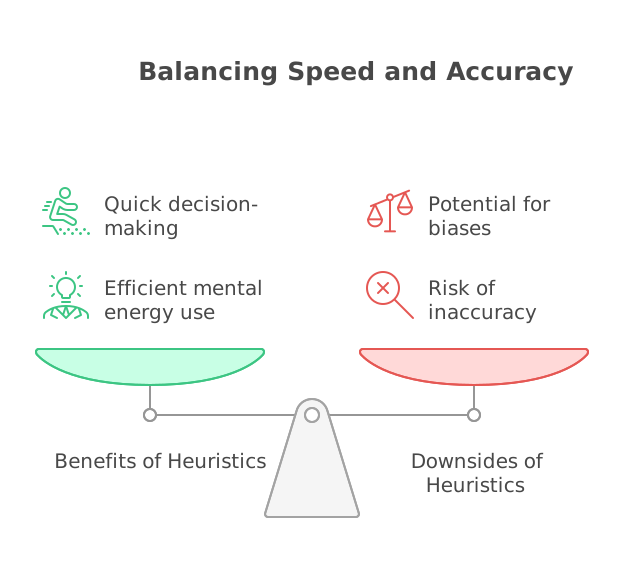
A heuristic is a fancy word for a mental shortcut – basically, a rule-of-thumb your brain uses to make decisions quickly. Think of it like this: if you’re leaving home and see dark clouds, you might grab an umbrella without overthinking. You didn’t calculate the exact chance of rain; you just used a shortcut: “Dark clouds mean rain.” In everyday life, these shortcuts save time and mental energy. Our brains are constantly processing tons of information, so heuristics act like your brain’s automatic filters, helping you get to a “good enough” decision fast .
Benefits
Heuristics can be really handy. For example, a doctor might recognize a common illness in seconds by recalling a familiar pattern of symptoms – that’s a heuristic at work. Similarly, as an investor, you might have a quick rule like “invest in companies I know and trust” to simplify choices. It’s like saying “I’ve seen something like this before, so I’ll base my decision on that.” In fact, behavioral finance theory shows that investors and professionals use heuristics to speed up analysis and decisions.
Downsides
However, there’s a catch: these mental shortcuts aren’t perfect. They’re fast, but they can sometimes be wrong. We might ignore important details or make a bad call because the shortcut oversimplified things. In other words, heuristics can lead to biases – systematic errors in our thinking . That’s what this article is about: one very common bias born from a heuristic.
The Representativeness Heuristic: Why We Love Patterns
A Classic Example: The Gambler’s Fallacy in Disguise
In 18th-century France, a “brilliant” gambling strategy emerged that came to be known as the Martingale Strategy. The premise was simple: bet on a fair 50/50 outcome—such as a coin toss—and double your wager each time you lose. When you eventually win, you recoup all prior losses and gain a profit equal to your original bet.
What does that mean?
Let us consider the following example: Suppose a gambler bets $1 and loses, then doubles the bet each time:
– Bet 1: $1 – lose
– Bet 2: $2 – lose
– Bet 3: $4 – lose
– Bet 4: $8 – lose
– Bet 5: $16 – win
The total lost before the win is $31, and the win yields $32 (double the $16 bet), leaving a $1 profit.
If you had infinite money and no table limits, this method might seem foolproof—you would almost certainly win eventually. But in reality, several problems make it risky and impractical.
The Downside to the martingale bet
- First, no one has unlimited resources, and losing streaks can be longer than you’d expect. Losing 10 times in a row has odds of 1 in 1,024; losing 11 times is 1 in 2,048. While those probabilities look small before play begins, they are coldly irrelevant once you’re in the middle of a streak—the chance of losing the next toss is still 50%, regardless of prior outcomes. This common misconception, known as the Gambler’s Fallacy, is part of why casinos flourish.
- Even worse, the required bets grow exponentially during a losing streak. After 15 losses, your next bet would be $32,768—on top of $32,767 already lost—just to make a $1 profit. Theoretically, you might believe you could “stick it out,” but when faced with such astronomical stakes and mounting losses, most people find it impossible to carry on.
The Martingale may seem like a sure path to winnings, but in reality, it’s often a shortcut to financial disaster. Investors can fall into a similar trap. When a stock keeps dropping, it’s tempting to expect a rebound—or fear an endless fall—but the truth is it can go either way. Likewise, when a fund is surging, it’s easy to believe the rally will continue. Both reactions arise from the same mental bias: assuming streaks will follow a predictable script, whether of reversal or momentum. Like gamblers chasing patterns, investors who follow these impulses often take on far more risk than they recognize.
So What is the representative heuristic?
The representativeness heuristic is our mind’s habit of judging a situation by how much it resembles something we’ve seen before. In other words, we instinctively ask, “Does this feel familiar?” If the answer is yes, we tend to assume the outcome will be the same—mistaking similarity for likelihood.
Think of it like making decisions by stereotype. If you see a person in a lab coat, you might instantly think “doctor” because they fit the image (even though they could be a scientist or an artist in a quirky outfit). Your brain matches them to the closest prototype it recognizes. Likewise, if you hear about a company that’s a garage startup with two college kids, you might recall the story of Apple or Facebook and feel optimistic about its future. The similarity triggers that feeling.
Examples
Let’s look at a classic example psychologists often use: You meet John, a quiet, shy man who loves reading. Which is more likely—John is a librarian or a salesperson? Many people choose librarian because he fits the stereotype. But in reality, there are far more salespeople than librarians, so statistically, John is more likely a salesperson. By focusing on how well John matches our mental image of a librarian, we overlook the base rates—the actual probabilities. This is the representativeness heuristic at work: our brains favor a tidy story (“He seems like a librarian, so he must be one”) over the messier truth of the numbers.
In everyday life, the representativeness heuristic helps us make quick judgments, often landing close to the truth—like assuming dark clouds signal rain. But it can also lead us astray, fueling stereotypes or distorting our sense of probability. A classic example is the gambler’s fallacy: after flipping five heads in a row, many believe the next flip is more likely to be tails to “balance” the pattern, even though the odds remain 50/50 each time. Next, we’ll explore how this instinct for patterns and prototypes plays out in the investing world—and how it can lead to costly mistakes.

Representativeness in Investing: Seeing Patterns That Aren’t Really There
Investing is full of uncertainty, and our brains desperately seek patterns to make sense of it. The representativeness heuristic is like a comfort blanket – if a new situation resembles something we’ve seen before, we assume the same outcome will happen. Here’s how that can trip up investors:
Chasing “Hot” Stocks and Funds
Imagine an investor, Alice, reading about a stock that’s doubled in the last year. She thinks, “This looks just like that other company that exploded in value – I bet it will keep going up!” Alice is using representativeness: the stock’s recent success represents a winner in her mind, so she buys in expecting the trend to continue. Investors often flock to assets that have been doing extremely well, assuming they’ll stay winners simply because they look like winners now. In behavioral finance, research shows this bias can lead people to purchase hot stocks based on recent performance and glowing narratives . They’re matching the current pattern to past success stories, often overlooking whether the price has become overinflated or the situation has changed.
For example, during the big tech boom of 2020–2021, many investors poured money into any stock remotely related to e-commerce, electric vehicles, or “the next big app.” Why? Because those stocks felt like the next Amazon or Tesla – they fit a successful prototype. If a company had buzzwords like “AI-powered” or “blockchain-based”, it ticked the mental box of a future superstar. This representativeness-driven hype contributed to some stocks soaring far beyond what their earnings justified. It’s the classic “looks like a rocket, so it must fly like one” thinking. Unfortunately, buying something just because it has been going up (or resembles something that went up) often means buying high. If expectations prove wrong, the fall can be hard and fast.
Shunning “Losers” and Overreacting to Recent Drops
Consider Bob, who checks his portfolio and notices that his international stock fund is down 30% for the year. Remembering a similar fund he once owned that never bounced back, he quickly decides to sell, thinking, “It’s a loser—I should get out before it gets worse.” In doing so, Bob assumes that recent poor performance means the investment is permanently flawed. Many investors fall into this trap, shunning stocks or sectors that have struggled because they now feel like bad bets. It’s another form of representativeness bias: just as we’re tempted to chase winners, we often abandon investments that seem like losers—sometimes at precisely the wrong moment.
In reality, a stock that’s fallen a lot might be undervalued and due for a rebound, or it might indeed be troubled – but the recent drop alone doesn’t guarantee future failure. By equating short-term performance with long-term fate, investors can end up selling at the bottom. It’s like assuming a student who got a couple of D’s will never get an A again – maybe they had a rough semester, but things could change. In investing, if you sell only because the price fell (and not because your needs changed or you need to rebalance), you might be letting a heuristic panic you.
A word on Recency Bias
Representativeness is closely tied to recency bias – giving more weight to what just happened. After a market high, our brains say “this feels just like the boom times we know,” and we expect the good times to roll on. After a market crash, everything suddenly reminds us of prior crises, and we expect more pain. Let’s break down these scenarios:
After Big Highs (Extrapolating Trends):
After several years of steady market gains, it’s easy for investors to believe the upward trend will continue indefinitely. Recent performance feels familiar, recalling other bullish periods, and that familiarity can be reassuring. But markets, like trees, don’t grow to the sky. A string of 20%+ annual returns in the S&P 500 doesn’t guarantee the same outcome year after year. This is representativeness bias at work—projecting recent patterns into the future—and it can leave investors unprepared when reality takes a different turn.
After Big Lows (Gloom or a “Due” Rebound)
On the flip side, when markets plunge, the mood can swing to extreme pessimism. During a steep downturn (say the market drops 30% in a short time), investors often feel “This downturn reminds me of 2008 – everything is going to collapse!” In early 2020, for example, the rapid COVID-induced crash led some to fear a Great-Depression-level collapse because it looked like the 2008 freefall on charts. Many sold off holdings in panic.
But the 2020 crash, though sharp, was very short-lived – by the end of the year the market had largely recovered, proving the doom forecasts wrong. Those who sold at the bottom because the situation resembled 2008 missed one of the fastest rebounds in history.
There’s also the gambler’s fallacy twist in down markets: sometimes investors think “stocks have fallen five days in a row, so a rebound is due because things should balance out.” This is representativeness playing a different trick – assuming random sequences must look random. Just as a gambler might bet on red after a streak of black numbers in roulette (thinking the streak can’t continue), an investor might prematurely buy a falling stock expecting an automatic bounce. That bounce may not come if there’s no real catalyst. In both cases, the error is believing that short-term patterns are reliable guides. Whether it’s expecting continuation or reversal of a trend, the common thread is a focus on patterns rather than concrete analysis.

Beware of “I’ve seen this before”
The representativeness heuristic basically makes market patterns into a kind of Rorschach test – we see what we want or expect to see. If we’re feeling optimistic, we find signs that this boom = past boom (so full steam ahead!). If we’re scared, we find signs that this crash = past crash (so brace for disaster). In reality, each market cycle has unique factors. It’s not that history is useless – understanding past cycles is very valuable – but no two events are exactly the same. Relying on surface similarity (“it looks just like last time”) can lead us astray if we ignore deeper differences.
Let’s look at how this bias concretely affects investors’ decisions and perceptions of risk.
How Biases Skew Portfolio Choices and Risk Perception
Why does all this matter? Because falling for the representativeness heuristic can seriously mess with your investment strategy and how you judge risk. Let us explore a few key impacts.
Buying High, Selling Low
The most immediate impact is that investors often end up buying assets at elevated prices—drawn in by strong recent performance or a compelling story—and selling them at depressed prices when recent results look poor. This runs counter to the timeless “buy low, sell high” principle. For instance, an investor influenced by the representativeness bias might pour money into a hot tech fund after it has already surged, believing it’s a sure winner, only to sell during a downturn when it appears broken. This pattern of behavior, known as performance chasing, frequently leads to subpar results. Research shows that by chasing winners and abandoning losers, many investors inadvertently underperform the very funds they invest in—largely because mistimed entries and exits, driven by bias, erode returns.
Distorted Risk Perception
Representativeness bias can distort how we judge risk. When an investment has been stable or steadily rising, it’s easy to assume it’s safer than it really is—essentially thinking, “Nothing bad has happened recently, so how risky can it be?” This false sense of security can lead to overconcentrating in that asset.
For example, a tech stock that has climbed every quarter for two years may feel like a “safe bet” because of its consistent pattern, yet it could still be volatile or overvalued, with risks hidden behind the reassuring trend. Conversely, when an investment has fallen or been volatile, we may see it as “too risky” and avoid it, even if much of the bad news is already priced in. In early 2023, for instance, many investors shunned bonds after their rare, sharp decline in 2022. The drop felt like a warning sign, making bonds seem unusually dangerous, even though new bonds were offering higher yields and arguably lower risk of further large losses. In both cases, focusing on recent patterns can lead to overestimating or underestimating the true level of risk.
Overconfidence in Predictions
The representativeness heuristic can give both amateur and professional investors a misleading sense of certainty in their forecasts. When current conditions resemble a memorable past scenario, it’s tempting to assume the same outcome will follow—while overlooking how circumstances might differ this time.
For example, at the start of 2023, the U.S. yield curve (which plots interest rates against bond maturities) had inverted, with long-term rates falling below short-term rates—a pattern that historically has often preceded recessions. Because this mirrored past pre-recession periods, many forecasters treated a downturn as inevitable. Some models even put the odds at 100%, prompting investors and fund managers to adopt highly defensive positions. Yet, as late 2023 turned into 2024, the expected recession had not arrived and the economy performed far better than anticipated. Those who were overconfident in the analogy may have missed out on gains or made unnecessary adjustments. The takeaway: relying too heavily on a single familiar pattern can cause you to overestimate your predictive abilities and ignore alternative outcomes.
Portfolio Imbalance and Herding
When a large group of investors share the same representativeness-driven belief, the effects can ripple across the entire market. Take, for example, the notion that “Tech stocks are the future, just like in the 1990s.” Such sentiment can trigger massive inflows into the sector, inflating valuations and concentrating market weight in a handful of companies.
By mid-2025, Wall Street’s reliance on a few high-flying tech giants had reached record levels. This “just like the ’90s boom” mindset helped those stocks dominate the S&P 500. The risk, of course, is that if the pattern breaks, the reversal can be swift and painful, as history has shown. The same bias can fuel herding during downturns, when investors rush to sell because conditions “look like” a past crisis, often driving markets lower than fundamentals justify. In both rallies and selloffs, our tendency to act collectively on perceived patterns can intensify the extremes. The reality is we just don’t know what the future holds!
Ignoring Base Rates and Diversification
When you focus too closely on the story or pattern of a single investment, it’s easy to overlook the base rate—the broader statistics and probabilities that truly shape the odds. Imagine a venture capitalist meeting a young, brilliant, hoodie-wearing founder who feels like the next Mark Zuckerberg. Excited by the resemblance, the investor might pour in capital, convinced they’ve found the next Facebook. But in reality, the chances of any startup reaching that level of success are vanishingly small. By focusing on the similarity, the investor risks ignoring just how rare such outcomes are. The same bias can creep into personal portfolios—overweighting a single stock or a hot trend while forgetting the value of diversification. Even if something shares traits with a past winner, most similar ventures still fail. Overlooking those base rates is a classic representativeness mistake.
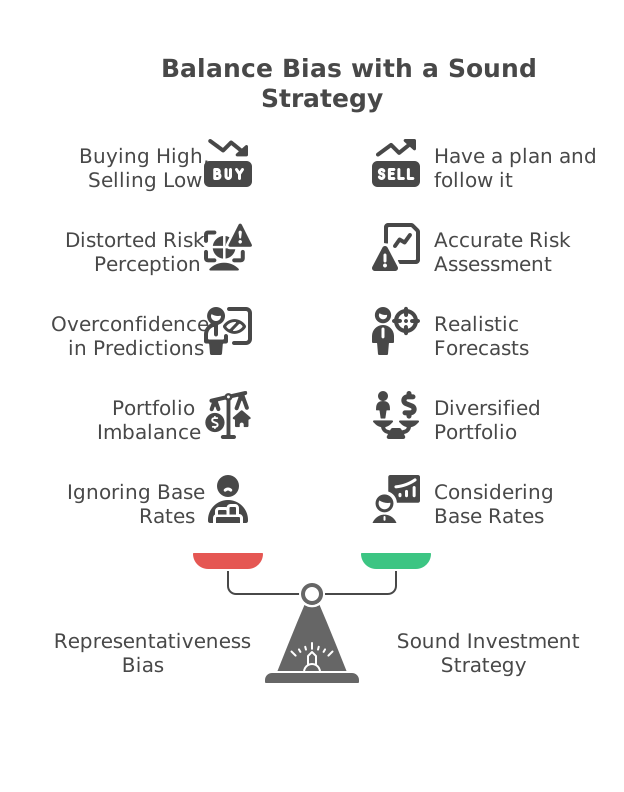
In short, the representativeness heuristic can lead investors to concentrate too much in what looks familiar or successful, trade too emotionally on recent outcomes, and generally deviate from a sound long-term strategy. It’s like driving while looking only in the rear-view mirror – you’re steering based on where you’ve been, not where you’re going. Now, let’s ground this in some real-world scenarios from the past few years to see how these biases played out and what we can learn from them.
Recent Real-World Examples (2020–2025) – Lessons in Bias
It’s been an eventful few years in the markets, providing plenty of examples of investors leaning on patterns – sometimes to their detriment. Here are a few notable cases:
The Pandemic Crash and Rebound (2020)
When COVID-19 hit and markets plummeted in March 2020, the speed of the crash was breathtaking. Many investors panicked. It felt like 2008 all over again – a global crisis, markets in freefall – so the natural reaction for a lot of people was sell everything, expecting a drawn-out collapse. Indeed, by late March 2020, some were likening it to the Great Depression.
But then an unexpected thing happened: thanks in part to massive stimulus and other factors, the market bottomed in late March and began a rapid recovery, recouping losses quickly. Those who assumed the crash pattern guaranteed a multi-year downturn missed one of the quickest rebounds ever. The representativeness heuristic led many to overestimate the duration of the crash (“this looks like a long nightmare, so it will be”), when in fact the situation, while dire, wasn’t a repeat of 2008’s protracted financial seize-up. Lesson: Even if two crises share some similarities, the outcomes can differ vastly. Staying flexible and staying true to a long term plan often helps.
Meme Stock Mania (2021)
In early 2021, “meme stocks” like GameStop and AMC captured headlines as their share prices soared, driven by social media buzz and waves of enthusiastic retail investors. GameStop’s meteoric rise from around $20 to $400 inspired many to search for “the next GameStop,” assuming that any stock with high short interest and a devoted online following would follow the same trajectory.
In some cases, shares of struggling companies spiked simply because people declared, “This one’s just like GameStop—let’s jump in!” This was representativeness bias in action, amplified by confirmation bias and herd behavior. While a few of these stocks enjoyed brief surges, many quickly fizzled, leaving latecomers—who bought in solely because a stock looked like a meme stock—facing steep losses when market fundamentals reasserted themselves. The lesson is clear: even if two companies share surface similarities, each stock has its own unique story, and outcomes can be very different.
Tech Bubble Fears vs. “This Time is Different” (2021–2023)
By the end of 2021, tech stocks had been on a tear. Then 2022 brought a harsh bear market, especially for tech and growth stocks. Coming into 2023, there were two competing narratives among investors, both influenced by representativeness in different ways.
Narrative 1: “Tech is in a 2000-like Bubble”
After seeing speculative fervor in crypto, electric vehicle startups with no profits, and meme stocks, some veteran investors said “we’ve seen this movie before” and expected a dot-com style crash. They pointed to companies with sky-high valuations and no earnings as evidence. Indeed, as interest rates rose in 2022, many high-flyers did crash hard. By mid-2023, however, the market, especially big tech, started recovering. Companies like Apple, Microsoft, and NVIDIA hit all-time highs again, propelled by excitement around artificial intelligence. This led to new bubble warnings: headlines asked if the AI boom was the next dot-com bubble . The similarity was hard to ignore – soaring tech valuations, frenzied investor enthusiasm. Investors who assumed a perfect repeat of 2000 might have stayed out of the market entirely in 2023, missing significant gains, as the anticipated collapse did not mirror the past exactly.
Narrative 2: “This Time is Different – Tech Can’t Fail”
On the flip side, some investors, especially newer ones, saw giants like Apple and Google as unbeatable and viewed the 2022 dip as a buying opportunity much like every dip in the 2010s had been. To them, the script was: “After every pullback, tech comes roaring back even stronger.” By mid-2023, this camp felt vindicated as Nasdaq rallied. However, by late 2024 into 2025, questions arose whether the market was overly complacent. Optimism that “it’s not like 2000, because companies now have real earnings” (which is true to an extent) might lead to ignoring genuine risks (like high valuations or overreliance on a few stocks).
While many fundamentals differ from 2000, thinking massive tech growth will continue without hiccups is exactly the kind of complacency that has hurt investors before . Whether you lean towards doomsday analogies or rosy “new era” narratives, recognize those are both pattern-based stories. Reality can land somewhere in between. It’s wise to keep an open mind – maybe it’s not a 2000 repeat, but that doesn’t guarantee smooth sailing either.
Each of these examples shows how easy it is to get swept up by a compelling pattern or analogy. We’re all human – even economists and fund managers fall prey to these biases, because recognizing familiar shapes in the chaos is comforting. The key takeaway is that similarity isn’t certainty. As investors, we need to continuously remind ourselves to test the story (“Is this situation truly the same as that past one? What’s different?”) and to base decisions on evidence and broad data, not just one or two resemblances.
A note on Randomness
As human beings, we have a natural aversion to randomness. We crave patterns and meaning, often searching for connections that don’t actually exist. This tendency drives us to sift through data—sometimes obsessively—in the hope of finding evidence that past events had a clear cause. For example, you might track every news headline and monitor the stock market daily, convinced that a pattern will emerge to guide your decisions.
The problem is that patterns can appear purely by chance, especially when looking at short periods of time. Consider flipping a coin and getting 10 heads in a row. It might be tempting to think heads are now “due” or more likely on the next toss—but in reality, the odds remain 50-50. This is the essence of hindsight bias: seeing meaning in a pattern after the fact and mistakenly believing it holds predictive power for the future.
This same thinking appears in investing. We’ve all heard of bubbles—the dot-com bubble, the housing bubble—where prices soared, then crashed. While it’s easy to spot the pattern after it happens, that doesn’t mean you can use it to reliably predict what comes next. Similarly, slot machine players often assume that after many losses, a win is “due”—the same flawed logic as expecting heads after a streak of heads.
In investing, this bias can cause people to sell winning stocks too soon out of fear, yet cling to losing ones in the hope they’ll rebound—sometimes with the opposite outcome. The reality is that not every pattern carries meaning; those born from random chance offer no insight into the future. Recognizing this truth is key to making smarter, more disciplined decisions.

Don’t just stand there… do something? or Just stay with your plan!
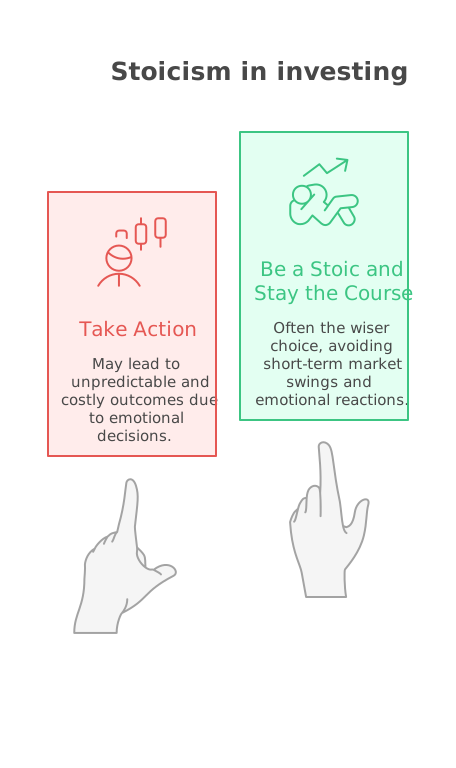
Another common behavioral bias is known as action bias—the tendency to prefer doing something over doing nothing, even when inaction might be the wiser choice.
Think about driving on the highway. Have you ever felt your lane was moving too slowly, so you switched lanes to get ahead—only to realize you didn’t actually get there any faster? Research by Donald Redelmeier found that lane-switching often doesn’t improve travel time and can even increase the risk of an accident. Still, waiting patiently behind a slow car can feel uncomfortable because we dislike prolonged inaction. That itch to “do something” can push us toward decisions that aren’t beneficial.
This behavior shows up in other fields too. In a fascinating study, researcher Michael Bar-Eli analyzed 286 soccer penalty kicks. The data showed that goalkeepers had the best chance of saving a shot by staying in the center of the goal. Yet, over 93% of the time, they jumped to one side—driven by the instinct to act, even when stillness was more effective.
The same principle applies to investing. Often, the smartest move is to do nothing and remain calm. Acting on short-term market swings or unpredictable events usually leads to unpredictable—and costly—outcomes. The real challenge is emotional: watching friends or neighbors get rich from a lucky investment can tempt you to follow the crowd. But this “herding” behavior can be disastrous. Even Isaac Newton fell victim to it, losing a fortune in the South Sea Bubble. Reflecting on the experience, he famously remarked that he could “calculate the motion of heavenly bodies, but not the madness of people.”
In the next section, we’ll highlight that any investor can slip into this cognitive trap – and then we’ll arm you with concrete tips to counteract it.
Different Investors, Same Bias (Who Can Fall for It?)
No matter how smart or experienced you are, the representativeness heuristic can sneak into your decision-making. Here’s a look at how various types of investors might fall prey to this bias:
New Investor(e.g. busy professional new to markets)
Relies on recent performance as a guide. For example, after seeing a stock fund return +30% last year, assumes it’s a “winner” and will keep performing well, so they pile in. Conversely, avoids investments that have recently dropped, labeling them “bad” without further analysis. Essentially, they judge investments by short-term success or failure, since they have little else to go on.
Seasoned Investor(investing for years)
May become overconfident in patterns they’ve seen before. For instance, an experienced investor might say “This looks just like the 2008 crisis; I’m getting out now,” possibly too early or in the wrong areas, because they’re fighting the last war. Or if they had great success with a certain strategy (say, buying Silicon Valley tech stocks in the 2010s), they might keep doing so in the 2020s – assuming the old pattern of success still holds.
Trend Chaser(momentum trader or fad follower)
Explicitly uses representativeness: they jump from one hot trend to another. If solar energy stocks are surging, they’re in – because “solar is the new oil, just like tech was the new finance!” If last quarter’s best-performing sector was healthcare, they rotate into healthcare, basically chasing whatever has a winning pattern. Their portfolio might lack any anchor because it’s constantly mimicking last month’s success stories. This approach can work for short bursts but often ends up buying high and selling low when the momentum shifts.
Contrarian or Value Investor(bargain-hunter who goes against the crowd)
You’d think contrarians are safe from this bias – they intentionally go opposite of trends – but they have their own version of it. A contrarian might assume a stock must rebound because it reminds them of past overreactions. For example, “Stock XYZ fell 40% in a market panic, just like Stock ABC did last year; ABC bounced back 50%, so XYZ will too.” This is representativeness in the sense of expecting a mean-reversion pattern just because it happened before. If XYZ’s fundamentals are truly broken, it might not come back, and the contrarian could be catching a falling knife. In essence, they stereotype all sell-offs as overreactions, which isn’t always true.
Conservative Investor(e.g. near-retiree protecting wealth)
May become too hesitant after seeing scary market patterns. For instance, if they lived through a crash, they might see any minor downturn as the start of another big crash and drastically cut exposure to stocks. Say a retiree saw the market drop 10% – they recall 2008, get nervous that “this looks like the beginning of a meltdown,” and move a large chunk to cash. The market might recover the next month, and they’ve locked in a loss and missed the rebound. Their long-term plan gets derailed by short-term pattern anxiety.
Professional Fund Manager or Analyst
Even with lots of data and models, they are still human. A fund manager could stick with a losing investment too long because it fits their thesis of a turnaround (they’ve seen similar companies turn around before, so they expect this one to follow the script – sometimes called confirmation bias, related to representativeness). Or an analyst might issue a bold forecast – “We’re definitely heading into a high-inflation era like the 1970s” – because certain indicators resemble the ’70s, leading them to position their portfolio for that scenario and possibly miss out when the future turns out different. Professionals also face pressure to “not miss out” on trends clients are excited about, so they might buy popular stocks mainly because everyone else is (a bit of herd mentality fueled by representativeness: “we should own this, it’s what a successful portfolio looked like last year”).

As you can see, no one is immune. Biases are part of being human. The key is not to feel bad about having these instincts, but to recognize them and put speed bumps in place so you don’t automatically act on them. Next, let’s talk about those speed bumps – concrete ways to catch yourself and make better investing choices despite what your gut might be screaming at you.
Overcoming the Representativeness Heuristic: Smart Strategies for Investors
Knowing about a bias is a great first step – you’re already ahead of many investors just by being aware of the representativeness heuristic and how it operates. Now, how can you counter it? Here are some practical, friendly tips to keep your brain’s pattern-love in check:
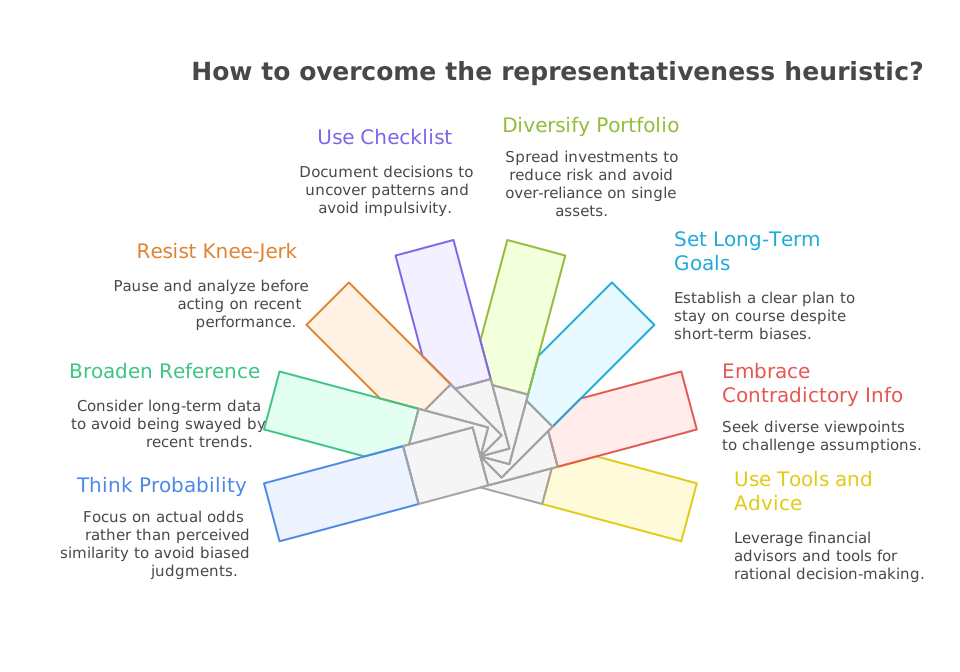
Think “Probability” Not “Similarity”
Train yourself to ask, “What are the odds really?” instead of “What does this remind me of?” For example, if a biotech stock reminds you of “the next Moderna” because it’s working on a hot new vaccine, step back and research: how many biotech startups actually achieve that kind of success? (Answer: very few.) This doesn’t mean you can’t invest in the exciting stock; it means you do so with a realistic understanding that the base-rate probability of matching that success is low.
When you catch yourself making a quick judgment based on resemblance, follow up with data. The more you can quantify things – even roughly – the better you can resist a rosy or gloomy narrative that isn’t justified. Remember, a coin coming up heads five times in a row is rare but possible; the probability of heads on the next toss is still 50%. In investing terms, a stock doubling in one year is unusual, and doing it again next year might be just as unlikely, no matter how much it feels like “a rocket ship.”
Broaden Your Frame of Reference
One sneaky effect of representativeness is that it narrows our focus to the most salient example (recency bias). Counter that by deliberately looking at a wider set of information. If a particular stock or fund has had stellar returns lately, look at at least its 10-year track record if available (even 30 years in short in investing…). Often you’ll find that performance reverts to the mean over time. In short, zoom out. A pattern that’s clear on a short timeline might disappear or reverse on a longer timeline. By widening your view, you might discover, for instance, that the “stellar” fund that beat the market for three years actually lagged in the previous seven, so its long-term performance is just okay. Such context prevents you from placing too much weight on a short streak.
Avoid Knee-Jerk Decisions on Recent Trends
This is easier said than done, but incredibly important: resist the urge to immediately act on recent performance alone. If you find yourself thinking, “I’m going to buy X because it’s been going up (or sell Y because it’s been going down),” put a pin in that decision. Take a day to revisit why the asset has moved. Sometimes there are valid reasons (fundamental news, changes in outlook), but other times it’s just noise or temporary sentiment. A good practice is to write down your reasoning (more on diaries in a second) or articulate it to someone: “I’m considering selling this fund because it dropped 15% this year.” Even just hearing that out loud might spur you to add, “…but I’m investing for 20 years, and 15% swings happen.”
Oftentimes, doing nothing is the right move when the only impetus is short-term performance. Markets are volatile; that’s normal. Don’t let every bump tempt you into a reaction. Consider setting rules for yourself: e.g., “I only rebalance or adjust my portfolio on a set schedule or if my investment thesis fundamentally changes, not just because of performance.” This structured approach can guard you against being swayed by the latest pattern.
Use a Checklist or “Investment Diary”
Think of this tip like flossing: everyone knows it’s good for you, but few actually do it—yet the benefits can be significant. Take a moment to write down the reasons behind each investment decision, especially when buying or selling. Keep it simple: jot a few bullet points on why you’re taking the action, what you expect to happen, and what would make you change course. Include how you feel—are you excited because the stock is making headlines, or uneasy after a bad earnings report? Over time, this record will uncover patterns in your behavior.
You might notice, for example, that chasing the latest “hot” stock rarely paid off. Seeing that in black and white can be a powerful reminder not to repeat mistakes. This habit also forces you to pause, do your homework, and reflect before acting—helping you avoid impulsive decisions. Documenting your thinking and later comparing it to results builds accountability and sharpens your judgment. If keeping a diary feels like too much, try a quick pre-trade checklist: Have I researched this? Am I acting on fundamentals or just a trend? Does it align with my goals? Even this brief step can help keep your investing thoughtful and disciplined.
Diversify and Rebalance
Boring? Perhaps. Effective? Mostly! . Diversification is often called the only free lunch in investing – by spreading your money across different types of assets (stocks, bonds, real estate, etc., and across different industries and regions), you reduce the impact of any one bet going wrong. It also implicitly guards against representativeness bias because you won’t have all your eggs in the basket that was just glittering with recent gains. If you were 100% in tech stocks in 2021, you had a great year then a rough 2022. A diversified portfolio wouldn’t have soared as high, but also wouldn’t have fallen as hard. More importantly, diversification forces you to think in terms of a whole portfolio, not individual winners or losers. It’s easier to avoid obsessing over patterns in one stock when you’re managing a collection of assets that balance each other.
Set Long-Term Goals and Stick to a Plan
Having a clear investment plan can act as your North Star when short-term biases try to push you off course. If you determine, for example, that given your age and risk tolerance, you should be invested about 70% in equities (stocks) and 30% in fixed income (bonds), and within stocks you want a mix of, say, 50% U.S., 30% international, 20% emerging markets – then you have a framework to refer back to. When the next hot thing comes along, you can ask: “Does this fit my plan or am I just chasing shiny objects?” It doesn’t mean you can’t ever alter the plan – plans should be revisited if your life circumstances or fundamental market assumptions change – but it prevents whimsical shifts based on passing trends.
Learn and Embrace Contradictory Information
One way to combat any bias is actively seeking information that challenges your assumptions. If you’re feeling very certain that a current trend will continue, try to find analyses or opinions that say it won’t, and vice versa. For example, if you’re convinced “XYZ industry is the future; it can’t fail,” look up historical cases of booming industries that later busted, or find a skeptic’s take on XYZ. Not to be a downer, but to ensure you’re seeing the full picture. By exposing yourself to different viewpoints, you reduce the risk of echo-chamber pattern confirmation. It can be as simple as following a few investors or analysts with a variety of perspectives. If you predominantly read bullish takes, also read a bearish one occasionally (and vice versa). Sometimes the truth is in between, but you won’t see it if you’re only looking one way.
Use Tools and Advice, but Stay Self-Aware
If you work with a human financial advisor, a big part of their job (though it’s not always advertised) is being a behavioral coach – stopping you from making rash decisions and keeping you aligned with your plan. Don’t hesitate to lean on that expertise. Just remember, ultimately you call the shots for your money, so it’s wise to cultivate your own awareness. When you find yourself rationalizing a decision heavily (“It has to work because it’s just like that other success…” or “I’m sure this will fail because we’ve seen this story before…”), pause and label that thought: “Am I falling into the representativeness trap here?” That little check – mentally calling out the bias by name – can snap you into a more analytical mode.
By applying these strategies, you create a crucial pause between your first instinct and your final decision. Think of it as installing an extra circuit breaker in your mind—when a surge of “This looks like X, so I’ll do Y!” hits, it trips and prompts you to reconsider. Over time, this habit not only leads to more rational decisions but also builds confidence in your approach. You’ll start to say, “I recognize that feeling, but I’ve double-checked my facts and plan, so I’m confident in my choice.” That’s a powerful position to be in as an investor.
Conclusion: Patterns vs. Principles
Human brains are pattern-recognition machines. It’s one of our greatest strengths – it helped our ancestors identify edible plants, predict weather changes, and avoid dangers. In the investing arena, recognizing patterns can sometimes lead to profit (like spotting an emerging industry early). But as we’ve explored, it can also lead us into illusion – seeing certainty where there is none, and making decisions on autopilot when we really should be hitting the brakes and engaging manual control.
Representative heuristic- a double edged sword
The representativeness heuristic is essentially a double-edged sword. It gives us quick intuition by comparing to what we know, but it also can deceive us. A stock isn’t guaranteed to be the next Apple just because it reminds you of Apple. A market downturn isn’t guaranteed to become the next lost decade just because a few metrics look similar. History rhymes more often than it repeats verbatim. Small sample sizes, recency, and vivid examples can mislead our judgment of what’s likely.
For you, as a long-term investor (whether you’re a physician, an engineer, a PhD, or an entrepreneur – a busy professional making important financial decisions), the key message is: be aware of your brain’s shortcuts. You don’t need to become a psychologist, but recognizing “Ah, I feel strongly about this investment because it resembles something familiar” is a powerful insight. That’s your cue to step back and verify. Rely on principles, not just patterns. Principles like diversification, patience, and attention to fundamental value might not be as exciting as chasing the latest trend, but they have a much better track record of preserving and growing wealth.
Also, don’t beat yourself up for having these biased impulses. We all have them. The difference between a rash investor and a wise investor isn’t who has fewer biases (we all have them), but who has strategies to manage them. Think of it like sailing: you can’t eliminate the wind (sometimes it’s with you, sometimes against), but you can adjust your sails. By learning about behavioral finance biases, you’re effectively learning to trim the sails of your investing approach so you can navigate through calm and storm alike.
What the future holds…
As of 2025, markets continue to evolve in unexpected ways – there will be new manias, new panics, new “unprecedented” scenarios, and then everyone saying “we’ve seen this before” or “this time is different.” When you hear those phrases, smile to yourself, because now you know the trick your mind is trying to play. Instead of jumping with the crowd or running with fear, you can approach each decision with a balanced perspective. In practice, that means making sure your portfolio aligns with your goals and risk tolerance, rebalancing periodically, and not getting swept away by each new story the market tells.
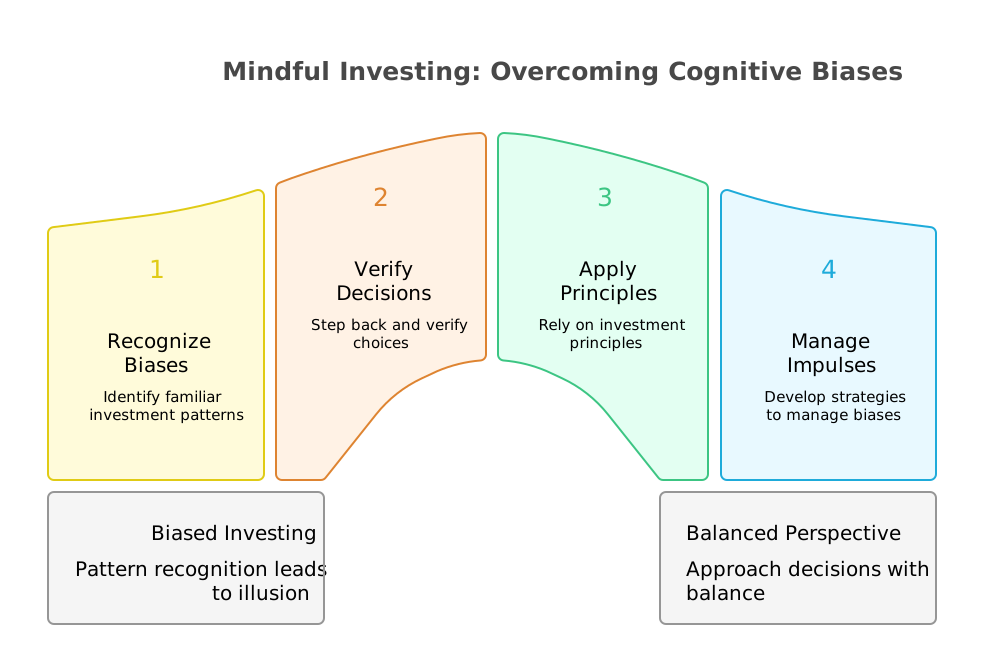
In the end, successful investing often feels boring. It’s sticking to a plan, not checking your portfolio every hour, and not reacting to every headline. And it turns out, boring beats exciting but erratic in the long run for most people. So, the next time your gut insists “This investment feels right because I recognize the pattern,” give your gut a polite nod, then double-check with your brain, your plan, and maybe that investment diary entry you wrote. You’ll be glad you did.
Happy (and mindful) investing!