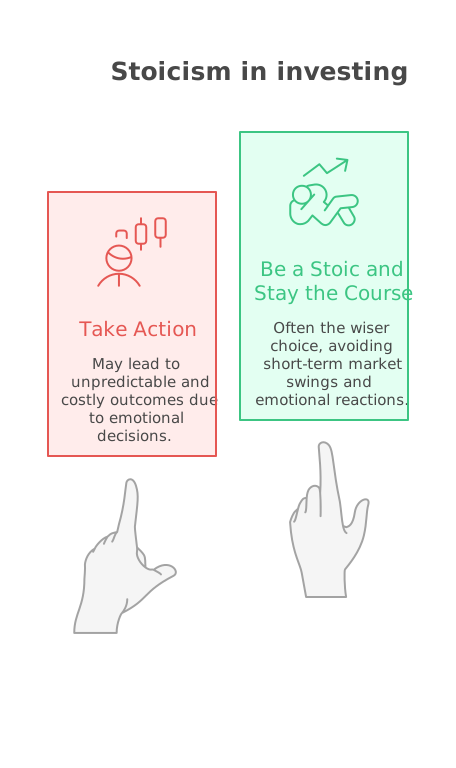
Many bright, accomplished people find themselves caught in financial inertia—that quiet drift of doing nothing when action is needed. Even highly educated professionals—doctors, engineers, PhDs, entrepreneurs—sometimes delay important money decisions. This isn’t about laziness or a lack of intelligence. It’s simply human nature to cling to the status quo, especially when the topic feels complex or uncertain. In personal finance, this inertia—a blend of procrastination and avoiding decisions—can feel safe in the moment. But beneath that comfort, it often hides real, long-term costs that quietly erode opportunity and security.
Picture a heavy boulder resting on a hill. In physics, an object at rest stays that way until something moves it. Your money works much the same way—without a deliberate push, it tends to remain exactly where it is.
Doing nothing often feels easier than confronting big financial choices. We tell ourselves we’ll “get to it later” or cling to familiar habits. Meanwhile, weeks turn into years, and opportunity quietly slips away.
This tendency, known as financial inertia, can limit your ability to grow, protect, and enjoy wealth over time. In the sections ahead, we’ll look at what financial inertia really is, why smart, capable people often fall into it, how it can erode long‑term potential, and most importantly, practical steps to break free—so your money works as intentionally and effectively as you do.
What Is Financial Inertia?
Financial inertia is the tendency to do nothing or keep things exactly as they are, even when change could help. Psychologists call this status quo bias—a built‑in preference for the familiar and a resistance to action. In everyday terms, it’s the habit of delaying or avoiding financial decisions simply because staying put feels easier. You’ve likely seen this in your own life: leaving savings in cash for years because you “never got around to investing.” While comfort in familiarity is natural, unchecked inertia can quietly cost you opportunities. Recognizing it is the first step toward making thoughtful, intentional progress with your money.
This inertia often shows up as quiet complacency. You might:
put off updating an investment portfolio
delay signing up for a retirement plan
ignore that nagging reminder to buy insurance.
Why? Because doing nothing is the path of least resistance. Maintaining the familiar course feels safe. However, staying on autopilot can come at a cost, which we’ll discuss later.
But first, let’s unpack why inertia happens. Humans aren’t irrational for hesitating – there are psychological reasons we cling to the status quo. Understanding these reasons is the first step to breaking free.
Why We Stick to the Status Quo
Fear of Regret and Change
Change invites uncertainty. Many people subconsciously fear that if they make a new move with their money, it could be the “wrong” move. By doing nothing, we avoid the risk of regret. We tend to feel more regret over bad outcomes from actions we took than from bad outcomes caused by inaction. We won’t blame ourselves as much if things go wrong when we didn’t actively choose a change. This fear of the unknown and potential regret feeds our status quo bias, keeping us frozen in place. The familiar path might not be perfect, but at least it’s predictable. As a result, we often avoid anything that might rock the boat—even when that boat is quietly taking on water.
Comfort in the Familiar
Our minds are naturally drawn to comfort and routine. You’ve worked hard to build your life—it’s normal to prefer the familiar. Sticking with what you know can feel like control, even protection. If nothing changes, nothing can “go wrong,” or so we tell ourselves.
This is a common emotional bias—favoring the known over the new, even when change might lead to better results. For example, you might hold onto an underperforming investment or an outdated savings approach simply because it’s familiar. It’s the classic “if it isn’t broken, don’t fix it” mindset.
The truth is, in finance, something can appear fine yet still be far from optimal. Familiarity is powerful, and breaking that pattern takes effort.
Overwhelmed by Choices
Ever sat down at a restaurant, opened the menu, and instantly felt overwhelmed? Money decisions can feel the same way. Choosing between investment options, insurance policies, or retirement plans can be exhausting—especially when every choice feels complex. Psychologists call this decision paralysis—when the weight of too many choices makes us avoid choosing at all.
Instead of reviewing alternatives or making changes, we postpone. We default to what’s familiar, even if it’s not ideal. Research shows that when faced with a dizzying list of investment options, many people stick with the default. In real life, this might mean actions such as leaving excess cash in a low-interest accounts.
When confusion meets complexity, inertia wins.
Filing important decisions under “later” often becomes “never.” The cost isn’t just missed opportunities—it’s lost momentum toward your bigger goals.
Living in the Now (Present Bias)
One of the quiet forces keeping us stuck is our tendency to live in the now. We’re wired to prefer immediate comfort or rewards over future benefits—a mental shortcut psychologists call present bias. Managing money often demands short-term effort:
creating a budget
saving consistently
learning about investments, etc. in exchange for long-term rewards.
No wonder procrastination slips in. It’s easy to think, “I’ll review my 401(k) next month” or “I’ll invest when work slows down.” Meanwhile, something less demanding takes priority. For busy professionals, postponing financial steps feels justifiable—there’s always an urgent meeting, patient, project, or trip. But this short-term mindset fuels inertia.
In reality, avoiding a little discomfort today comes at the expense of your future self. As research on retirement savings shows, delaying increases the risk of missed growth opportunities. “Later” often feels easier than “now”—and that’s exactly why nothing changes.
By recognizing these drivers – fear, comfort, overwhelm, and present-focused thinking – we can start to see why inertia is so common. It’s essentially human. The trouble is that while we sit in neutral, life keeps moving. Next, let’s look at what staying on the sidelines can cost us over time.
The Hidden Cost of Doing Nothing
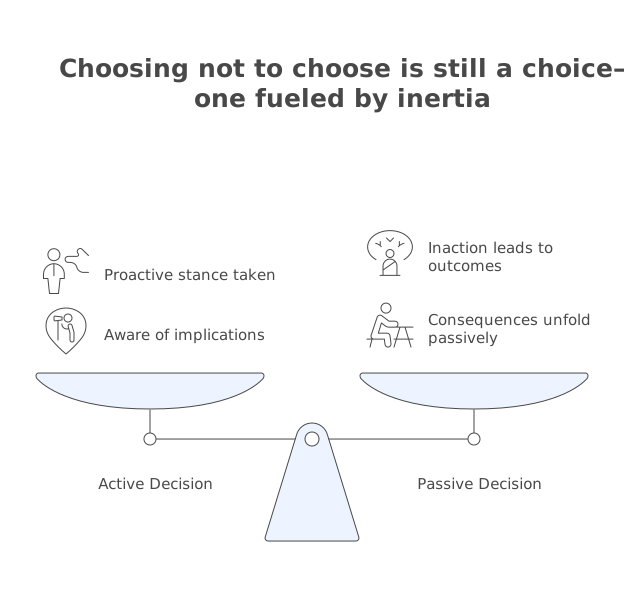
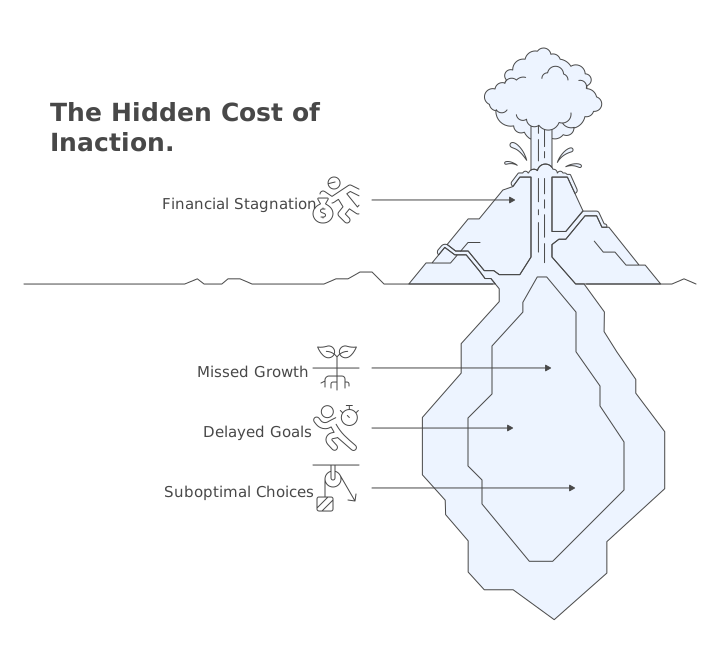
Remaining financially still can feel safe—even wise—in the moment. If nothing changes, nothing can go wrong… or so it seems. Yet doing nothing is still a choice: it’s deciding to keep your money on its current path, whether or not that path serves you. Over months and years, this quiet inaction can slowly erode the wealth and future you’ve worked so hard to build. What feels like avoiding risk may, in fact, be creating it. Here are a few ways sticking with the status quo can hurt:
Missed Growth Opportunities
Inertia can mean missing out on potential growth. A classic example is keeping large amounts of cash in a checking or savings account for years because you never got around to investing it. The result is that your money earns little to nothing, losing ground to inflation and forfeiting the magic of compounding. Those “later” investments that never happen are lost opportunities – years when your money could have been working for you. The cost isn’t immediately visible, but it accumulates. You may end up with a far smaller nest egg than if you had invested appropriately. Similarly, failing to adjust your investments over time can hurt. If inertia keeps you in an outdated portfolio (say, too much in one stock or sitting in a low-risk fund through your 30s), you might be forgoing better returns or proper diversification. The bottom line: doing nothing might feel safe, but it often carries an opportunity cost. Your wealth may grow much slower – or not at all – compared to if you took prudent action.
Delayed (or Derailed) Financial Goals
Procrastination has a quiet way of gaining momentum. The longer you put off a financial goal, the more ground you’ll need to make up later. In some cases, you may never fully close the gap. Each year of delay makes the climb a lot more steeper!
Many people in their 40s or 50s suddenly realize they’ve set aside far too little—not because they couldn’t save earlier, but because inertia kept them on the sidelines in their 20s and 30s. The myth of “plenty of time later” is dangerous, robbing you of the one thing money can’t buy: time for compounding—the snowball effect of earnings generating more earnings.
Inertia doesn’t only cost money; it can trigger last-minute scrambles. Rushing to fund college, pay off debt, or get retirement-ready often means more stress and fewer choices. Worse, some goals get completely derailed. Skip updating your insurance or estate plan, and an unexpected event can create financial havoc that smart, early planning could have prevented.
In short: waiting on important financial moves doesn’t just slow progress—it can push you further behind, making the destination harder, if not impossible, to reach.
Staying with Suboptimal Choices
Inertia doesn’t just prevent new actions — it can quietly lock us into outdated or poor decisions. It’s easy to “set and forget” things like banks, service providers, or even financial advisors. Automation works well for certain investments. However, it can be harmful if you never check whether your choice is still your best option. For instance, you may keep a bank account with low interest and high charges because switching feels inconvenient. The same is true for portfolios left unbalanced over time — your mix of stocks, bonds, and other assets (i.e., your asset allocation) might no longer fit your age, goals, or risk comfort.
By not making an active decision, you’re still making one — just often a costly or risky one. Over years, that comfort with the familiar can erode your financial wellbeing.
In summary, inertia can be a silent wealth killer. It’s easy to underestimate the cost of “nothing changed” because the effects are often invisible until much later. But savvy observers note that standing still can be just as risky as moving forward – you just don’t feel it immediately. The good news? Once you recognize inertia’s costs, you can take steps to protect yourself. Breaking out of inertia doesn’t require drastic leaps; even small nudges can set positive change in motion. In the next section, we’ll look at how to get things moving in a comfortable, sustainable way.
Overcoming Financial Inertia: Getting Unstuck
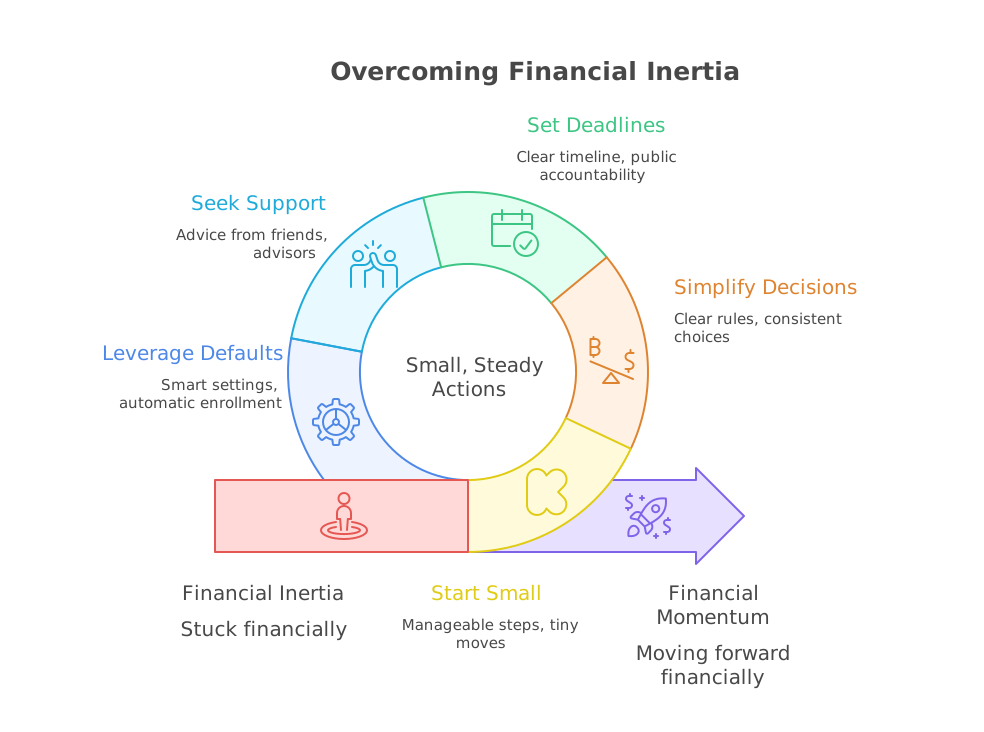
The other side of inertia is momentum. Once something is moving, it takes far less effort to keep it going. The hardest part is often that first push—overcoming hesitation or the habit of putting things off. In personal finance, that can mean facing decisions you’ve delayed or taking the first step toward a plan. The good news? You don’t need an overnight transformation. Small, steady actions can spark confidence and turn inertia into your ally. With the right starting moves—your “default settings”—momentum begins to work in your favor. Here’s how to start shifting your financial life out of neutral and into forward motion.
Start with Small Steps
Big projects feel far less daunting when you break them into small, manageable steps. If you’ve been putting off a financial task, begin with just one tiny move. For example, instead of overhauling your entire financial plan—an intimidating goal—try something simple, like setting up a modest automatic transfer from each paycheck into an investment account.
Automation is a quiet but powerful ally. Once set, it works on autopilot, keeping your progress going without extra effort. As behavioral economists Cass Sunstein and Richard Thaler note, our natural “default settings” can be used for good—automation turns inertia into a positive force. Set bills, savings, or investments to run automatically, so even passive moments move you forward.
You might also schedule a single, non‑negotiable hour to review your finances, as you would a doctor’s appointment. Each small win builds momentum—step by step, procrastination loses its hold.
Simplify Decision-Making
Complex decisions often lead to delays. To break the cycle, start by simplifying how you make financial choices. Clear, consistent rules remove the need to debate every decision. For example, commit to investing a set percentage of your income each month—no exceptions. This turns action into a habit, not a question.
Too many options can stall progress. Narrow them. Instead of analyzing dozens of investments, consider a basic three-fund portfolio. The goal isn’t perfection—it’s taking a reasonable, timely step forward.
If you tend to overanalyze, set firm boundaries:
limit your research to a few choices or a set amount of time.
Lean on simple guidelines such as “save 20%” or “keep six months’ expenses in reserve.”
Reducing complexity cuts mental friction. Done is better than perfect—and the simpler the path, the faster you’ll move ahead.
Set Checkpoints and Deadlines
One reason financial inertia is so common is that there’s rarely an immediate deadline. No one is chasing you to update your will, review your investments, or choose a new insurance plan. Without a clear timeline, “later” can quietly become never. The solution? Set your own deadlines. Decide, for example, that by the end of this month you’ll finalize your insurance choice. Put it in your calendar like any other important meeting.
Public accountability helps too. Tell your spouse or a friend, “I’m refinancing my student loan by next week.” Knowing someone else expects a result adds gentle, motivating pressure.
Finally, schedule a recurring financial check‑up—yearly or quarterly works for most people. Treat it like routine maintenance. These checkpoints keep tasks from disappearing off your radar. They turn overwhelming projects into small, manageable steps that build long-term momentum.
Get an Outside Force (Advice and Support)
In physics, an object at rest needs an external force to get moving. In your financial life, that outside force can be people. Seeking support—whether from a financially savvy friend or a trusted advisor—can help you overcome inertia. A skilled financial advisor can spot where you’re stuck, offer clear next steps, and keep you accountable. When you know someone will follow up, you’re far more likely to follow through.
Accountability doesn’t have to be formal. An “accountability buddy”—a partner, friend, or family member—can be just as effective. Share specific goals (“I’ll consolidate my old retirement accounts this month”) and have them check in. The goal is to avoid that uncomfortable “not yet” answer.
Education can also spark momentum. A personal finance course or insightful book may inspire action. The takeaway: don’t fight inertia alone. Like a personal trainer for your money, the right guidance can get you moving—and keep you going.
Leverage Positive Defaults
Make inertia work for you by building smart default settings into your finances. This goes beyond simple automation—it means structuring things so that doing nothing still keeps you on track. For example, many employers automatically enroll workers into retirement plans like a 401(k). Why? Because people rarely opt out, and participation soars when saving is the default.
You can use the same principle. Set your mortgage or savings to auto-increase each year, so your contributions grow without extra effort. Use tools that enable automatic rebalancing in your investments so your portfolio adjusts itself. Even small tweaks—like routing part of every paycheck directly to savings—make not saving the harder choice.
You might also set “windfall rules,” such as automatically directing 50% of any bonus or tax refund into investments. By pre-deciding these actions, your money follows guided rails toward your goals—keeping you moving forward, even on autopilot.
Conclusion
Newton’s first law tells us that objects in motion stay in motion. The hardest part is simply getting started. Once you take that first step, the next one feels easier. Each positive action builds confidence, replacing bad inertia—staying stuck—with good inertia—staying on a smart financial track without constant effort.
Financial inertia can quietly keep you in the same place for years. Doing nothing often feels safe, but it’s usually the most expensive choice in the long run. If you’ve been putting off a financial decision or avoiding your portfolio, know this: it’s a common human bias, not a personal flaw. The cure is action—any action. Open that account. Move that money. Automate that transfer. Small steps break the stalemate and get you moving in the right direction.
You don’t need perfect timing or flawless plans. Wealth grows from momentum, time, and good habits, not from hesitation. Every year you wait can cost more than you think decades from now. You can adjust your course anytime, but you can’t win a race you never start. The best time to get your money working was years ago. The next best time—is today.
Have you ever caught yourself focusing only on news that matches your views? Or seeking advice that supports a money decision you’ve already made? That’s confirmation bias at work—a common mental shortcut that makes us favor information that confirms what we believe while quietly dismissing anything that challenges it. It’s a natural and even comforting tendency, but it can subtly distort our judgment in both life and finance.
What is Confirmation Bias?
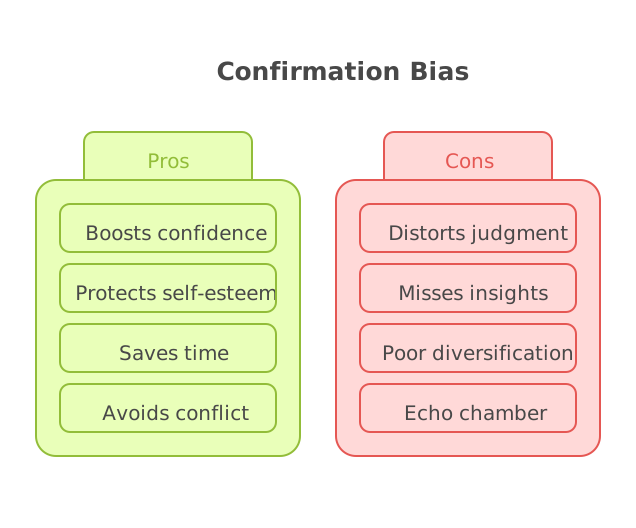
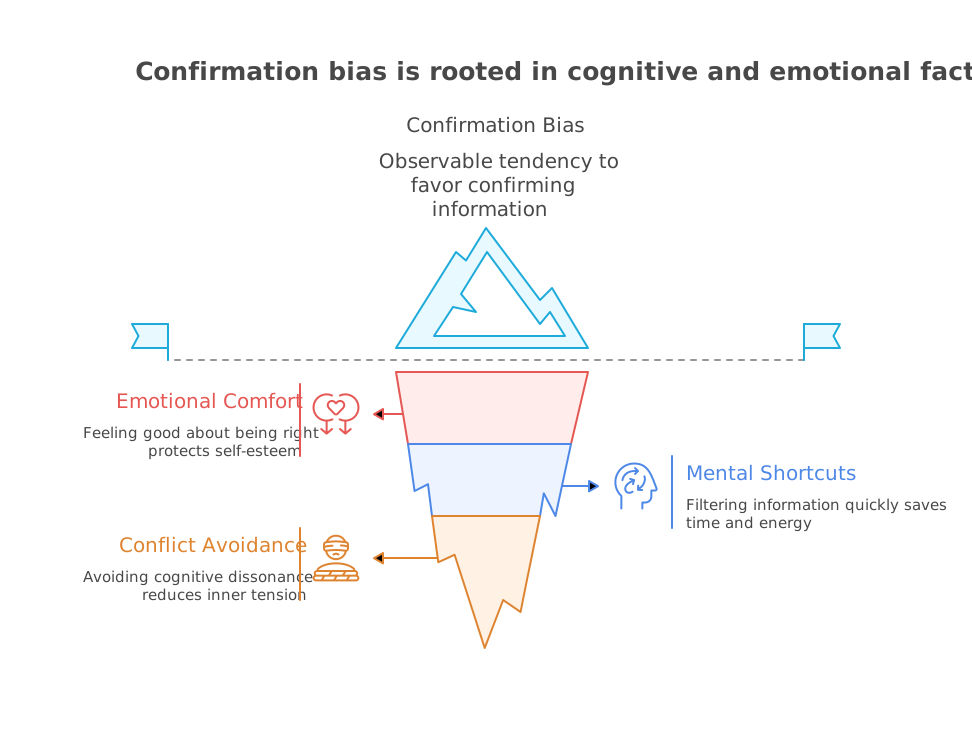
Confirmation bias is a simple idea with a fancy name: we tend to see what we want to see. We notice and trust information that supports our existing beliefs, while ignoring or minimizing anything that challenges them. Psychologists classify it as a cognitive bias—in everyday terms, it’s our brain’s habit of cherry‑picking facts. For example, if you’re certain a particular stock is a winner, you might focus only on glowing headlines and positive reports, while brushing past any negative analysis entirely.
This bias often occurs without us even noticing. Once we form an opinion, our mind instinctively searches for evidence to confirm it—like having a friendly inner voice that keeps whispering, “You’re right,” even when you might not be. While this tendency can boost confidence, it can also prevent us from seeing the full picture.
Why Do We Seek Confirmation?
Why do smart people still fall into the trap of confirmation bias? The answer lies in how our brains manage information and safeguard our emotions. It simply feels good to be right. Few of us enjoy discovering we were wrong—especially about something that matters. Our egos naturally resist that sting to our pride. By zeroing in on evidence that supports our existing beliefs, we’re really protecting our self-esteem. It’s our mind’s way of giving us a quiet pat on the back and sidestepping the discomfort of being proven wrong.
Second, our brains are naturally wired to take mental shortcuts. In today’s world of constant information overload, it’s impossible to analyze every detail with perfect logic. To save time and energy, our minds filter information quickly, favoring details that confirm what we already believe. This instinct once served our ancestors well: If a hunter believed a rustle in the bushes meant “predator,” it was safer to focus on evidence that confirmed danger. Acting quickly on that belief — even if sometimes wrong — could prevent becoming prey.While this confirmation bias improved survival by tilting decisions toward caution, it comes with a cost. By screening out so much “noise,” we also risk missing valuable insights that could challenge and expand our understanding.
Another reason is avoiding conflict and stress. Hearing information that clashes with our beliefs creates an inner tension known as cognitive dissonance. It’s that uncomfortable feeling when reality doesn’t line up with our expectations. To dodge that discomfort, we often stick our heads in the sand of agreeable information. For instance, suppose you believe your investment strategy is perfect. If you start seeing data that suggests otherwise, it can cause stress. To avoid that feeling, you might simply stop looking at the conflicting information.
Real-Life Examples of Confirmation Bias
Confirmation bias isn’t just a finance or psychology buzzword – it shows up in everyday life in relatable ways.
In Personal Life & Relationships
Think back to the early days of a new relationship. When you’re swept up in excitement, you tend to see the other person through rose-colored glasses—focusing on every sweet gesture and positive trait that reinforces the belief, “This person is amazing.”
After a painful breakup, the lens flips. Suddenly, the flaws and frustrating moments take center stage, and you may even wonder, “How did I miss those red flags?” The truth is, they were likely there all along. When you were infatuated, your mind filtered in the good and filtered out the bad. Once things ended, you did the reverse—spotlighting the negative to validate that the breakup was the right choice.
In both cases, your brain was cherry-picking memories to match the emotions you felt in the moment.
Confirmation bias also appears in friendships and personal beliefs. If you firmly believe a certain diet is the healthiest, you’ll likely read only things that support that belief. It’s not that you’re doing this on purpose. Your mind is just selectively gathering “evidence” for what you want to believe.
In Marketing and Brand Loyalty
Ever wonder why companies pour millions into creating a dazzling first impression for a new product? It’s because they understand confirmation bias. Win someone over early, and their mind often takes care of the rest.
If your first impression is that Brand X makes the best smartphones, you’ll naturally notice every glowing review or clever ad that supports that belief. Each positive piece of information strengthens your conviction that you chose the superior product. And when a friend points out a flaw in the latest model? You might dismiss it as a one-off. Instead of weighing all the evidence, you’ll seek out details that confirm how great Brand X is — and quietly tune out the critics.
This is confirmation bias in the consumer world. In reality, all brands have pros and cons. Our bias, however, makes us focus only on evidence that supports “our team.” Companies love this phenomenon, of course. Once you’re loyal, you might even pay a premium for a product because you’re convinced it’s the best. You’ll likely stick with that belief unless something huge proves you wrong.
There’s a cost to being blindly brand-loyal, though. If you never consider alternatives, you might miss out on something better. Yet many of us will happily gloss over negative reviews of a product we already love. We do this just to keep believing we made the right choice.
In News and Information
News and search platforms frequently amplify confirmation bias—and it’s no accident. Their business models thrive on capturing your attention. The longer you stay, click, and scroll, the more ads you see—and the more revenue they earn. To keep you engaged, algorithms study what you already like and serve up more of the same.
Say you search “best investments right now.” If you’ve previously clicked on optimistic takes, the platform will likely show you upbeat stories first. Soon, your feed is filled with similar content, reinforcing the idea that markets are thriving—while articles warning of potential risks get buried out of sight.
In today’s media environment, it’s easier than ever to settle into a comfortable bubble of like-minded information. We follow channels, accounts, and communities that align with our views, and unfollow anything that challenges them. This creates an echo chamber—a stream of content that constantly tells you “you’re right” and rarely urges, “consider another perspective.”
This pattern is another everyday display of confirmation bias. Two people with opposite viewpoints can read the same news story but walk away with totally different interpretations. Each will see the facts that confirm their stance. It’s comfortable to consume agreeable news, but it can also distort our understanding. We might become overconfident in our views. Or we grow too skeptical of any information that isn’t aligned with what we “know” to be true.
Confirmation Bias in Financial Decisions
Nowhere is confirmation bias more dangerous than in money matters. Wealthy individuals and seasoned investors aren’t immune to this bias. In fact, it can be even trickier for them because the stakes feel high and emotions run strong.
How do investors miss the obvious?
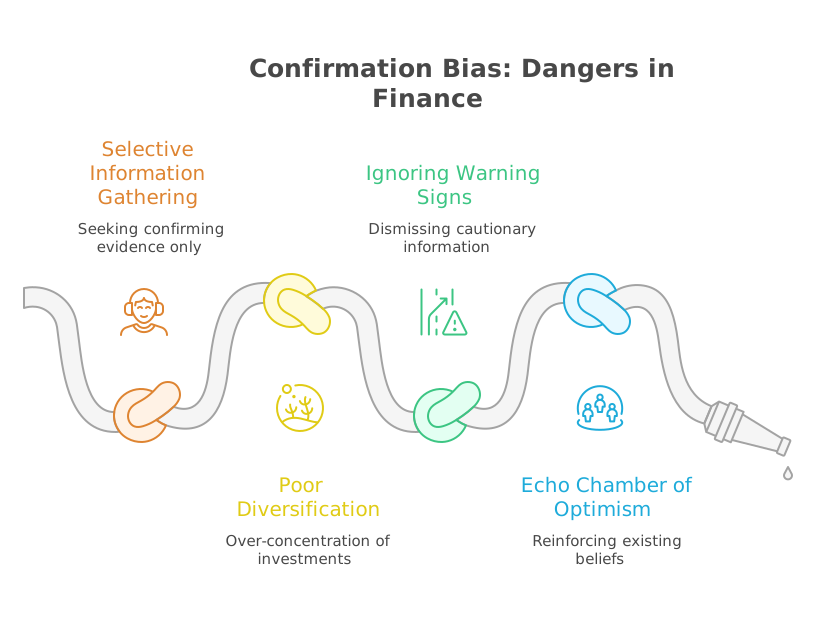
Imagine an investor who’s convinced that a certain stock is a guaranteed winner. He did some initial research and the stock went up, bolstering his confidence. From then on, he eagerly seeks out positive news about that company – new product launches, upbeat earnings reports, etc. Essentially, he latches onto anything that confirms his belief that he made a great pick. At the same time, if a headline hints at trouble, he might skim past it. He could dismiss bad news as “just short-term noise.” This investor may even join online forums where everyone else is optimistic about the stock. That habit further amplifies the one-sided optimism.
What’s the harm in this? He could ignore warning signs that his investment is riskier than he thinks. If the company starts slipping, he might hold on too long because he’s only paying attention to the rosy predictions. Many investors have fallen into this trap of selective hearing – celebrating the wins they expected and tuning out hints of losses. It’s why a friend at a dinner party might brag about that one stock that doubled in value. Yet they conveniently won’t mention the five other picks that sank. In the bragger’s mind, he focuses on information that says, “I’m a savvy investor.” He brushes aside anything that suggests otherwise.
Impact on well-grounded principles such as diversification
Confirmation bias can also lead to poor diversification. If you’re convinced you’ve found the “best” investment, you might pour most of your money into it. By ignoring contrarian viewpoints, you risk going all in on a single idea. That can backfire if the idea turns out to be wrong. We’ve seen cases where investors rode a hype wave and ignored voices of caution. In the end, they faced heavy losses when the hype fizzled. Oftentimes those cautionary voices were there. But confirmation bias made them easy to ignore, because they didn’t fit the success story we wanted to believe.
Case Study: The SPAC Craze
A striking example of confirmation bias in recent years came during the SPAC boom. Special Purpose Acquisition Companies — or “blank check firms” — promised quick paths for private companies to go public. In 2020 and 2021, excitement about electric vehicles, biotech, and futuristic tech fueled a rush of deals.
Many investors focused only on the rosy projections and upbeat press releases. They ignored warning signs like weak balance sheets, unrealistic growth targets, or complex share structures. For a time, prices surged, and early stories of big wins circulated widely. That reinforced the belief that “SPACs are the future.”
But as reality set in, many companies faltered. Share prices collapsed, and some firms went bankrupt or liquidated. Individuals who had invested large sums — sometimes well into six figures or more — saw their stakes shrink dramatically. What made the pain worse was that many investors had dismissed cautionary voices. Confirmation bias made them believe only the bullish narratives.
The SPAC cycle shows how even sophisticated investors can get caught in an echo chamber of optimism. It’s a reminder that in finance, chasing only the evidence that tells you what you want to hear can be costly.
In short, confirmation bias can cloud judgment for even the wealthiest and smartest individuals. It can make markets seem less risky than they really are. It can even convince someone that their financial plan is foolproof when it actually has holes. Being aware of this bias is vital for anyone making big money decisions.
Overcoming Confirmation Bias
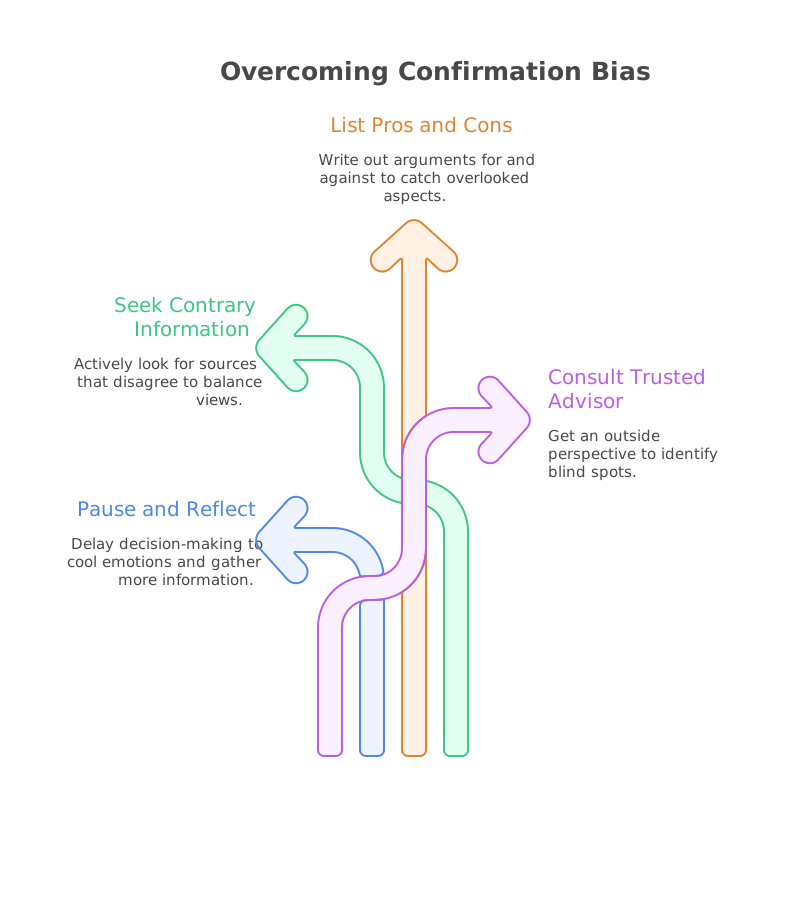
The good news is that once you know about confirmation bias, you can fight back against it. You may not eliminate this bias entirely – we’re all human. But you can certainly reduce its impact on your choices. Here are some strategies to help keep your thinking objective:
Pause and Reflect Before Deciding
When you feel excited or anxious to make a decision – be it an investment move or a big purchase – give yourself a breather. Delay your decision-making process just a bit. This could mean sleeping on it or waiting a few days. Taking time helps you cool off initial emotions and allows more information to surface. Simply put, slowing down prevents your first impression from completely taking over.
Seek Out Contrary Information
Make it a habit to play devil’s advocate with your own ideas. If you only read sources that agree with you, actively look for reputable sources that disagree. For example, say you’re about to buy a particular stock because five sources say it’s great. Try to find a well-reasoned article that argues why it might not be. If you’re excited about purchasing a certain car, go read the 1-star and 2-star reviews, not just the glowing 5-star ones. In finance, this might mean asking, “What could go wrong?” and genuinely seeking the answer. It can feel strange at first – after all, we naturally prefer positive feedback. But hearing the other side of the story gives you a more balanced view.
List the Pros and Cons
This is an old trick but a good one. Writing out a simple pros-and-cons list for an investment or purchase can break the spell of one-sided thinking. Actually seeing the arguments for and against, side by side, helps you catch whether you’re ignoring something important. If you struggle to list any “cons” on your own, try asking a friend to help think of potential downsides.
Consult a Trusted Advisor or Friend
Sometimes an outside perspective makes all the difference. Talk to someone you trust who isn’t afraid to be honest with you. This could be a financially savvy friend, a mentor, or a professional advisor. Explain your reasoning, and then invite them to poke holes in it. Often, we are too close to our own decisions. A neutral party can spot blind spots that we miss, and do so quickly. The idea isn’t to let others decide for you, but to make sure you’ve considered viewpoints beyond your own.
By practicing these strategies, you train yourself to think more critically. Over time, you’ll become more comfortable with information that challenges your views. You’ll start seeing it not as a threat, but as a learning opportunity. Remember, being wrong sometimes is inevitable. What matters is catching it quickly, before a small mistake becomes a big one.
Conclusion
Confirmation bias is a powerful force, but it doesn’t have to control your decisions. We all love feeling like we’re right, and our brains will gladly serve up evidence to keep that feeling going. In areas like investing, however, that cozy echo chamber of agreeable information can lead us astray. The key takeaway is to stay curious and a bit skeptical – especially about your own opinions. When you make an important choice, pause and ask yourself a simple question. “Am I seeing the whole picture, or just the part that makes me comfortable?”
Being aware of confirmation bias is half the battle won. It brings a healthy dose of humility to our decision-making. In finance and in life, that can be the difference between just feeling right and actually being right in the long run.
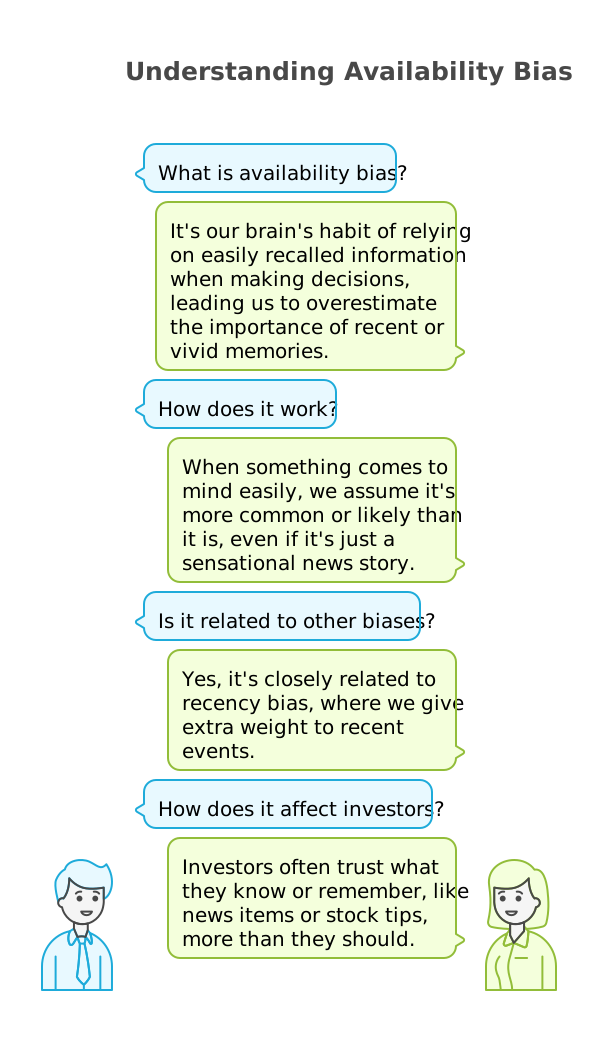
Imagine hearing about a plane crash on the news and suddenly feeling nervous about your upcoming flight. Logically, you know air travel is safe, but that vivid news story makes the risk feel much higher. This is a classic example of availability bias in action – a mental shortcut where our brains give more weight to information that’s easily recalled or recently seen . In investing, availability bias can quietly steer the smartest minds off course. When decisions are based on the most available information or memorable experiences instead of objective facts, our investor psychology can lead us astray.
Let’s explore what availability bias is, how it can distort your financial decisions, and the practical steps you can take to overcome it. Approach this with an open mind—and leave those misleading mental shortcuts behind!
No matter your level of education or success, a lack of financial familiarity can leave you vulnerable to mental blind spots. Even highly accomplished professionals—entrepreneurs, physicians, engineers, and PhDs—can fall prey to cognitive biases like availability bias when making money decisions. This isn’t a reflection of your intelligence; it’s a powerful reminder that awareness is your greatest tool. Recognizing these biases is the first step toward making smarter, more confident choices with your wealth.
What is Availability Bias?
At its core, availability bias is our brain’s habit of leaning on information that comes to mind quickly and easily. We tend to use whatever examples pop into our heads when making decisions. Psychologists Daniel Kahneman and Amos Tversky first described this availability heuristic as a cognitive shortcut. Instead of painstakingly analyzing all data, we rely on immediate examples or memories to judge what might happen next. It’s one of many ingrained biases hardwired into our thinking. The result? We often overestimate the importance or likelihood of things we’ve recently seen or vividly remember, while undervaluing other relevant facts that aren’t as obvious.
Put simply, when something comes to mind easily, we tend to assume it’s more common or likely than it really is. A sensational news story or a vivid personal experience can stick with us, but that doesn’t make it the most probable outcome. This mental shortcut, known as a bias, can lead to errors in judgment because ease of recall doesn’t match actual odds or importance. For example, after hearing about a highly publicized lottery win, people may feel their own chances have improved and buy more tickets. In reality, the odds haven’t changed—it just feels more possible because the story is fresh in our minds.
Availability bias is just one type of behavioral bias that can cloud judgment. It’s closely related to recency bias, where we give extra weight to the most recent events . Both stem from the same mental quirk: our brains love a good story and fresh memories. But those instincts don’t always lead to logical investing decisions. In the context of investor psychology, availability bias often means we trust what we know or remember. The news item, the stock tip, the anecdote – these can weigh more in our minds than they should.
Everyday Examples: How Our Minds Trick Us
Availability bias isn’t just a finance phenomenon – it affects everyday life. Consider our earlier example of fearing a plane ride after seeing a plane crash on TV. Statistically, driving a car is far riskier than flying. But vivid plane crash images stick in our memory and skew our perception of danger. Our brains latch onto the dramatic story we remember, even if it’s a rare event.
Another common example is fear of shark attacks. After a high-profile shark attack is reported, beachgoers often avoid swimming due to an inflated sense of risk. In reality, shark attacks are extremely rare – only a handful occur worldwide each year . Nonetheless, the shocking news makes that danger feel far more probable. People might recall a friend’s bad restaurant experience and decide the whole place is terrible. They ignore dozens of good reviews that aren’t as memorable. These examples show how easily availability bias can warp our judgment in daily decisions.
Availability Bias in Investing: Why Memory Can Mislead Money
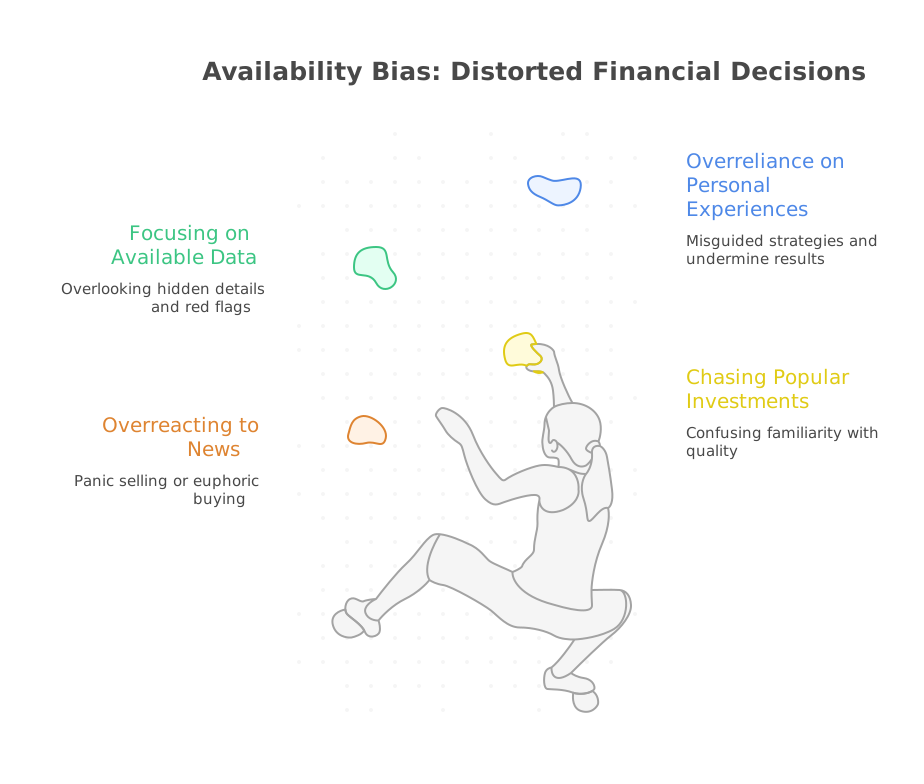
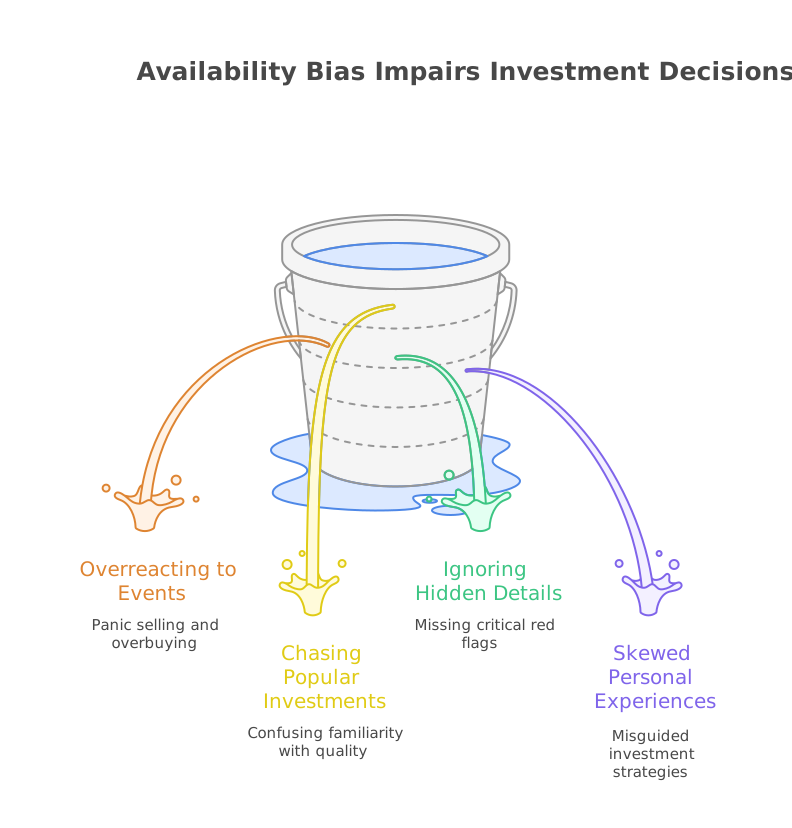
When it comes to your money, availability bias can have real financial consequences. Investor behavior is often driven by what’s in the news, what friends talk about, or personal experiences. These influences can outweigh balanced analysis. Availability bias can affect investors’ decisions in a few major ways:
Overreacting to Recent Market Events
Investors frequently overweight the latest news or market movements, assuming that whatever just happened will keep happening . If stocks plunge this week, an investor with availability bias might believe a crash is coming. They could sell off everything in a panic. On the flip side, after a streak of market gains, an investor might throw caution aside. They may buy more stocks assuming the rally will never end. In reality, short-term events are often just noise. But because a market crash or boom is fresh in memory, it looms large in decision-making. This can lead to panic-selling in bear markets or overenthusiastic buying during bubbles. The outcome is usually suboptimal- You end up selling low out of fear, or buying high from euphoria. And it happens because recent events felt more important than they actually were.
Chasing Familiar and Popular Investments
Another clear sign of availability bias is investing in companies or funds simply because their names keep popping up. Maybe everyone at the office is buzzing about a trendy new tech stock, so it’s top of mind. Or perhaps you’ve seen endless ads for a mutual fund and assume it must be a smart pick. This bias can lead investors to confuse familiarity with quality, putting too much money into what’s in the news or on TV. But popularity doesn’t equal performance — a strong media presence may be carefully cultivated, and may not be a reflection of real value. By chasing the well-known, you risk missing out on better but quieter opportunities, leaving your portfolio less diversified and potentially weaker overall.
Focusing on Available Data and Ignoring the Hidden Details
Availability bias can lead investors to base decisions solely on what’s easy to find, while overlooking what’s less visible. For instance, when researching a stock, you might focus on the glossy annual report and upbeat news coverage—positive, public-facing information—and stop there. Yet important details may be buried in footnotes or obscure filings that few ever read. Because many companies naturally showcase their best news up front and tuck any negatives deep in the fine print, relying only on readily available facts can cause you to miss critical red flags.
As the saying goes, “What everyone knows is rarely worth knowing in investing.” When information is widely available, it’s usually already reflected in a stock’s price. The real edge comes from uncovering insights beyond the headlines. Relying only on obvious data can breed overconfidence—and that often leads to unwelcome surprises down the road.
Letting Personal Experiences Skew Your Strategy
Our own past experiences – especially the dramatic ones – can heavily influence how we invest. If you or someone close to you lost money during a major market downturn, you might become overly conservative for years afterward . The memory of that pain is easily available in your mind, so you assume extreme losses are more likely than they truly are. Conversely, if your first years of investing were during a roaring bull market, you might downplay risks. You could start believing big gains are practically guaranteed. For example, many investors burned by the 2008 mortgage crisis avoided anything related to housing or mortgages for years afterward. But the next market bubble or downturn often comes from a different area entirely . By fixating on the last disaster, they risked missing out on gains – or failing to spot new risks that didn’t resemble the last crisis.
These biases can drive misguided strategies—whether it’s avoiding stocks entirely out of fear or taking on excessive risk due to overconfidence. In both situations, the mental shortcut of drawing sweeping conclusions from a single memorable experience can seriously undermine your long-term results.
Why Do We Fall for Availability Bias?
If availability bias is so misleading, why do our intelligent brains keep falling for it? The answer lies in the way human thinking has evolved. Our minds operate in two modes: a fast, automatic mode and a slow, analytical one. Nobel laureate Daniel Kahneman calls these System 1 — impulsive and emotional — and System 2 — deliberate and logical. Availability bias thrives in the quick, intuitive realm of System 1, where the brain rapidly matches patterns based on whatever comes to mind first. This skill once helped our ancestors respond instantly to danger, but in today’s complex world of modern finance, it can just as easily steer us in the wrong direction.
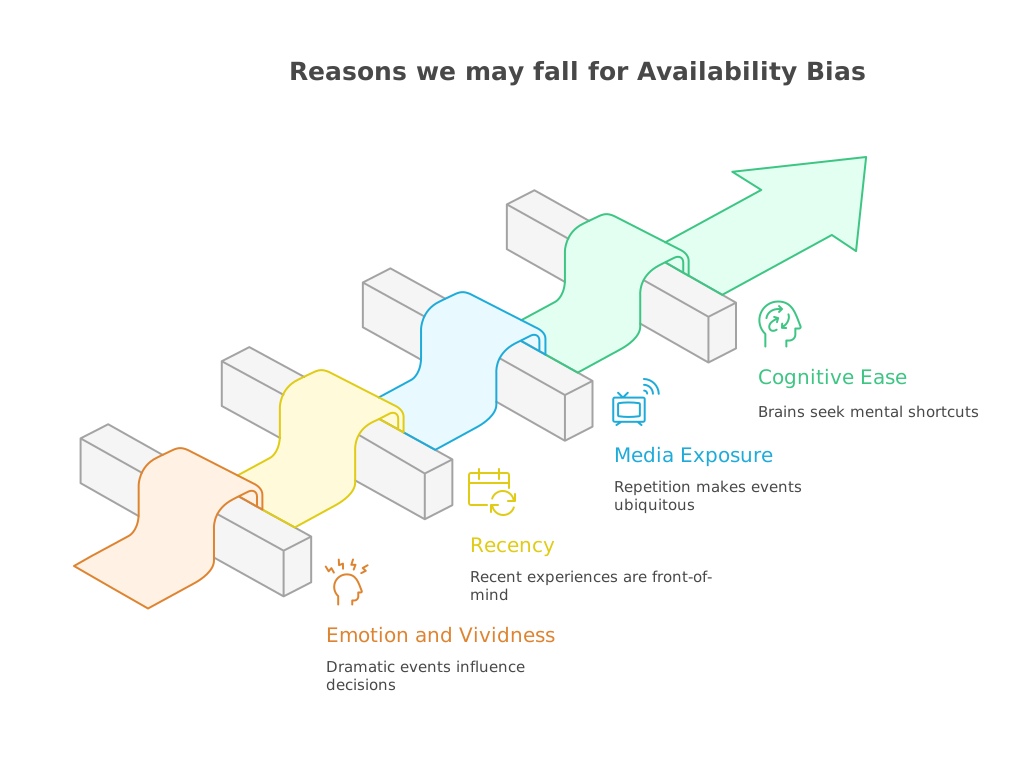
So why do we rely on this shortcut? Here are a few reasons:
Emotion and Vividness:
Dramatic events stick with us emotionally, and emotions influence decision-making. A frightening market crash or an exciting stock boom comes with strong feelings that embed in memory.
Recency:
Recent experiences are front-of-mind. We weight them more because they haven’t faded yet- Last year’s news feels more relevant than historical patterns from decades ago.
Media Exposure:
Media repetition makes an event feel ubiquitous. You start thinking, “everyone’s talking about it, so it must be common.” That misconception fuels availability bias.
Cognitive Ease:
Quite simply, it’s easier. Our brains naturally seek shortcuts to conserve energy, and it requires far less mental effort to recall a familiar example than to dig into base rates or analyze raw data. We instinctively follow the path of least resistance—a path that availability bias readily supplies.
Understanding these causes can help you spot when your mind is drifting into the availability trap. It’s a natural part of investor psychology, not a personal failing. The good news is that once you’re aware of it, you can take steps to engage your slower, rational thinking side when it matters most.
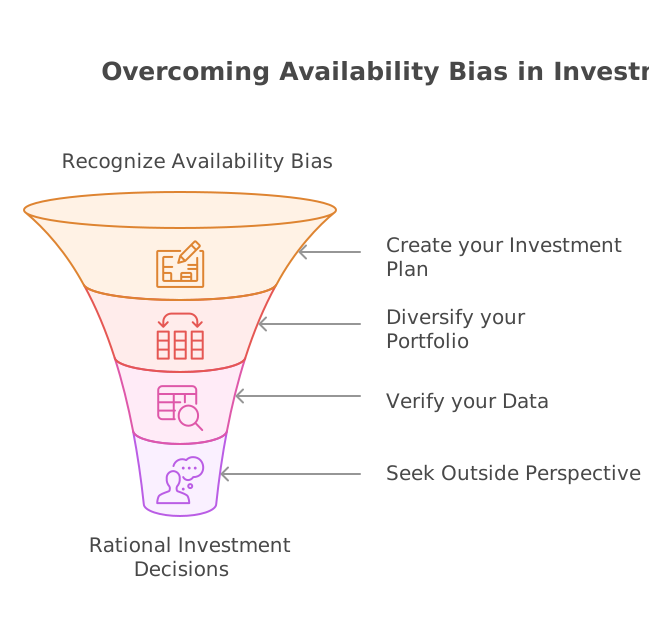
How to Avoid Availability Bias in Your Investments
Awareness is the first step in combating availability bias. Once you recognize this bias in yourself, you can start taking concrete steps to counteract it. Consider these strategies to ensure your aaaadecisions are sound rather than reflexive:
Have a Plan and Stick to It:
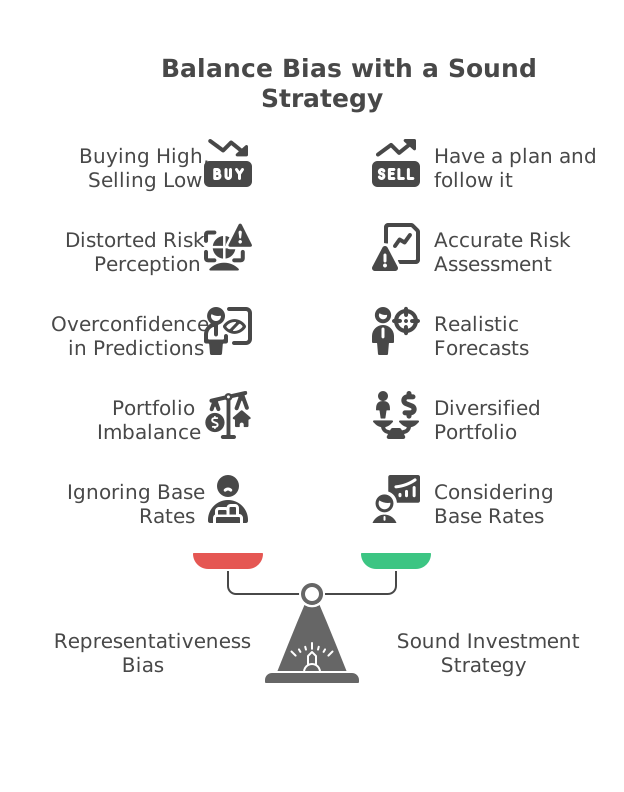
Create your investment plan—including asset allocation, risk tolerance, and long-term goals—when you’re thinking clearly. Pre-commit to following that plan, even when markets turn volatile. By deciding in advance how much risk you’re comfortable with and when to rebalance, you’ll be better equipped to stay the course and avoid reacting to the latest headline or market swing. Automation can be a powerful ally—for example, setting up automatic monthly investments so you stay consistent and confident, no matter what the news brings.
Diversify and Think Long-Term:
A well-diversified portfolio acts as a powerful buffer against bias. By spreading your investments across different assets and sectors, you avoid putting all your confidence—and capital—into the story of the moment. Diversification can help ensure that no single piece of flashy news, whether positive or negative, can derail your overall progress. It also reinforces a long-term mindset, reminding you that you’re in the market for years, even decades, and that short‑term noise should never dictate your strategy.
Verify the Data (Look Beyond the Headlines):
Before taking action, dig a little deeper. If a risk or opportunity is getting a lot of attention, look beyond the hype and seek out real data. Assess how likely and significant it truly is. By grounding your choices in facts and broad evidence, you avoid being swayed by a single dramatic story. In other words, engage your System 2 thinking. Ask yourself: Is this genuinely common or important, or simply in the spotlight right now?
Get an Outside Perspective:
Sometimes our own experiences and social circles can unintentionally create an echo chamber. Seeking input from a financial advisor—or even a well-informed friend—can offer a valuable reality check. They might uncover insights you haven’t considered or challenge assumptions shaped by availability bias. The aim isn’t to have someone tell you what to do, but to ensure you’re not operating in a bubble of limited impressions. An outside perspective can reveal blind spots and help keep your thinking clear, balanced, and objective.
By implementing these practices, you gradually train yourself to make more rational, evidence-based decisions. You’ll still feel the pull of emotional news and salient stories – we all do. But you’ll be better equipped to pause, zoom out, and make choices aligned with your true financial goals, rather than fleeting impulses.
Conclusion
Being human means we’re far from perfectly rational machines. We often rely on mental shortcuts—like availability bias—to make sense of a complex world, usually without even noticing. In investing, however, these shortcuts can quietly steer us off course, prompting us to remember the spectacular but overlook the subtle. The takeaway is simple: awareness and a disciplined process are powerful tools against bias. When you catch yourself leaning on what’s most vivid or recent, pause, gather more facts, and realign with your long-term plan.
Overcoming availability bias—and other cognitive traps—is a vital step toward becoming a stronger, more thoughtful investor. It won’t happen overnight, but each time you catch yourself thinking, “This stock is everywhere in the news, so it must be great,” take a moment to pause and dig deeper. Every bit of extra homework helps tilt the odds in your favor. Stay curious, stay disciplined, and remember: the best investing is often boring—and that’s a good thing. By refusing to let flashy headlines or vivid memories dictate your moves, you give yourself the strongest chance of reaching your long-term financial goals.
After all, knowledge is power – especially when it’s the self-knowledge to recognize your own biases and keep them in check.
Do you think you’re a better-than-average driver? If so, you’re in good company—most people do. It’s human nature to overestimate our abilities, whether behind the wheel or in other parts of life. While a touch of confidence can be helpful, too much can lead us to make decisions based on pride or instinct instead of facts. In investing, that overconfidence can quietly erode your wealth. In this post, we’ll look at what overconfidence bias is, how it influences investor behavior, and practical ways to avoid common trading mistakes.
What Is Overconfidence Bias (And Why It Matters for Investors)
Overconfidence bias is a psychological phenomenon where we overestimate our abilities, knowledge, or chances of success. In everyday life it shows up when everyone thinks they’re an above-average driver or have an above-average IQ (obviously, we can’t all be above average!). In the context of investing, overconfidence often leads people to believe they can consistently beat the market or pick winning investments, even without much evidence. This bias can cloud judgment and cause investors to disregard data or expert advice . For example, a FINRA study found that 64% of investors rated their investment knowledge highly, yet those who were most confident actually answered fewer questions correctly on a financial quiz . In other words, the people who thought they knew the most tended to know less than they believed.
Why does this matter? Because overconfidence can tempt you into taking risks or making moves that aren’t in your best interest. An overconfident investor might trade too frequently, put too much money into a hot stock tip, or stubbornly hold a losing investment because they “just know” it’s going to come back. Recognizing this bias is the first step in countering it. Next, let’s look at a famous example that shows how even very smart people can fall into the overconfidence trap.
The Monty Hall Problem: A Lesson in Overconfidence
To illustrate overconfidence, let’s step away from the markets for a moment and talk about a classic game show puzzle that stumped even PhDs. It’s called the Monty Hall Problem. Imagine you’re on a game show with three doors: behind one door is a big prize (say, a new car), and behind the other two are goats (booby prizes). You pick Door #1, hoping for the car. The host, who knows what’s behind all the doors, then opens Door #3 – and it reveals a goat. Now the host asks: “Do you want to stick with Door #1, or switch to Door #2?”
Most people instinctively assume it doesn’t matter if they switch or stay. After all, two doors are left, so it feels like a 50/50 choice. Even many math professors believed this. But statistically, the odds aren’t 50/50 – if you switch doors, you actually have a 2 out of 3 chance of winning the car, versus only 1 out of 3 if you stick with your original choice . This answer is highly counter-intuitive, and when it was publicized, it ruffled a lot of proud feathers.
Do we listen to reason when overconfident?
In 1990, Marilyn vos Savant — at the time listed as the person with the world’s highest IQ — answered the Monty Hall puzzle in her magazine column. She advised the contestant to switch doors. Her answer was correct. However, she was subsequently flooded with letters — over 10,000 of them — many from PhDs and even math professors, all confidently telling her she was wrong and didn’t understand basic probability. Imagine that: countless experts, utterly certain of their own analysis, but in reality they were the ones who were wrong. It’s a classic case of overconfidence. Highly educated people had an unjustified feeling that they were right and refused to even consider a solution that “felt” wrong to them.
Lessons from Monty Hall
The Monty Hall saga packs several lessons about overconfidence that apply to investing and decision-making in general:
Intuition Can Mislead
What seems “obvious” can be dead wrong. In the Monty Hall game, it felt obvious to so many people that switching doors wouldn’t matter – but that intuition was misleading. In investing, similarly, a stock tip or market trend might seem like a sure thing based on gut feeling, but reality can be more complex. Our intuitions (“this stock has to go up” or “I just know this will be a winner”) can lead us astray, just like intuition misled those professors on the game show puzzle.
Short-Term Outcomes Don’t Prove You Right (or Wrong)
Suppose you ignored Marilyn’s advice and stuck with your original door – you might still win the car occasionally by pure luck. That doesn’t mean staying was the better strategy; it just means you got lucky. Likewise, if you did switch (the statistically smart move), you could still lose in that one round, even though over many repeats you’d win far more often by switching.
The investing parallel is important: you might get a great result from a poor investment decision, or a bad result from a sound decision, due to short-term chance. An overconfident trader might double their money on a risky bet (a bad strategy that got lucky), or a cautious investor might see a temporary loss despite doing everything “right.” Don’t let a few lucky wins trick you into thinking you have a golden touch. And if a good strategy doesn’t pay off immediately, that doesn’t mean it’s wrong – sometimes even the right choice can have a bad outcome, especially in the short run.
Even Experts Are Human
One striking part of the Monty Hall story is that many experts refused to admit their error, even after the correct solution was explained. Being a PhD or a renowned professional didn’t prevent them from falling victim to overconfidence . In investing, this is a humbling reminder that intelligence or experience doesn’t guarantee immunity from bias. Star money managers, famous economists, billionaire investors – they’re all still human. They can be overconfident and make mistakes, too. As legendary investor Warren Buffett quipped, “If you’ve been in the game 30 minutes and you don’t know who the patsy is, you’re the patsy.” Overconfidence can make anyone the patsy in the market, no matter how smart or successful they are.
The Monty Hall example shows how counterintuitive truths can be—and how our confidence in our own intuition can lead us astray. Now, let’s bring this back to investing and look at how overconfidence bias affects investor behavior and results in real life.
Overconfidence in Action: Trading Too Much & Picking Winners
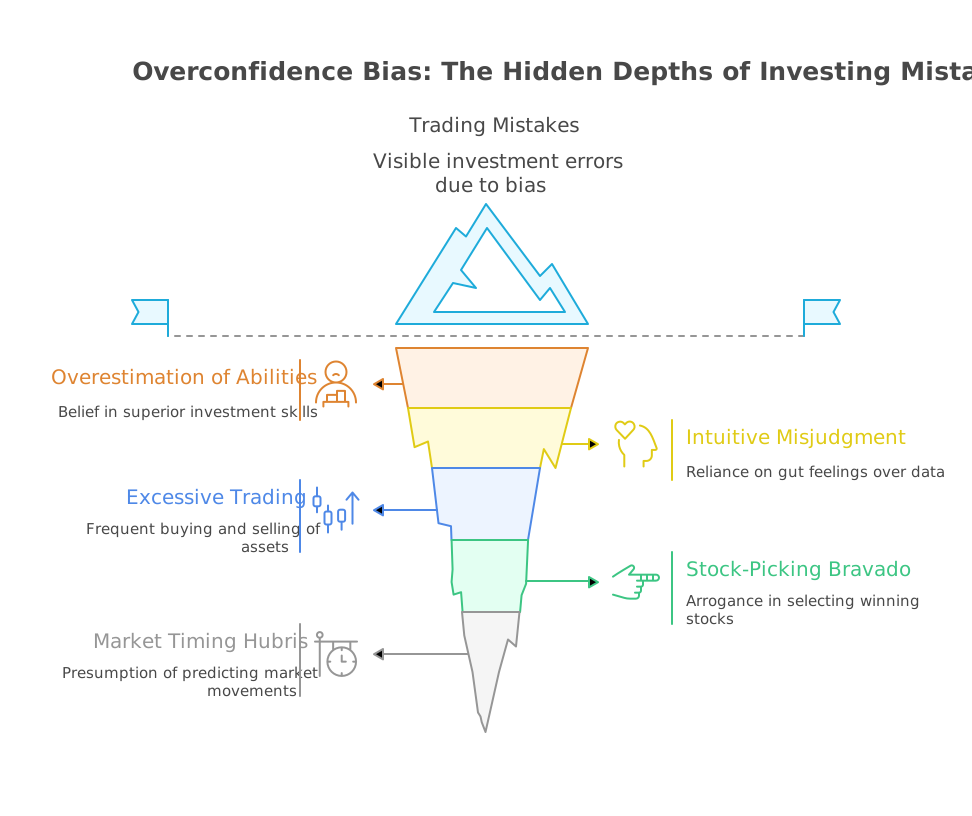
Overconfidence in investing often shows up in two big ways: excessive trading and stock-picking bravado. In short, people think they can outsmart the market. They trade frequently, chase “hot” stocks, try to time when to get in or out – and usually end up worse off for it.
Excessive Trading (and Why It’s Hazardous to Your Wealth)
Imagine an investor who’s constantly fiddling with their portfolio—buying, selling, reacting to every bit of market news. If you ask them why, they might say, “I have a good feeling about these moves” or “I know what I’m doing; I can time this just right.” That’s overconfidence talking. Decades of behavioral finance research have a blunt warning: trading too much is likely to hurt your returns.
One famous study titled “Trading Is Hazardous to Your Wealth” found that the most active traders (those who traded the most often) earned significantly lower returns than those who traded the least . The more they traded, the worse their results. Why? Because frequent trading racks up costs (even with zero commissions, there are bid-ask spreads and taxes) and because it’s very hard to consistently make the right call on when to buy or sell. Often, overconfident traders end up buying high and selling low, thanks to hype and fear driving their decisions .
Men vs. Women
Overconfidence even has a gender twist: in a well-known analysis of thousands of brokerage accounts, researchers Brad Barber and Terrance Odean found that men traded a lot more often than women, and all that extra trading caused men’s returns to suffer more compared to women’s . In short, men’s greater overconfidence led them to trade too much and underperform. The effect was especially pronounced for single men versus single women. Overconfident investors are often sure about facts or insights that just aren’t true, and they act on them to their detriment.
It’s sobering but true: various analyses show that most day traders lose money over time. You might hear about a neighbor or cousin who struck it rich trading stocks in a volatile market, but those stories are the exception. For each big winner, there are many others who quietly lost. If you string together a few winning trades, it’s easy to attribute that success to skill (feeding the feeling you can do no wrong). But markets have a way of humbling people. Every trade has someone on the other side, and if you’re trading on gut feeling, the person taking the opposite side might be a professional with far more information. Overconfidence lures many into a dangerous game they’re unlikely to win consistently.
Stock Picking & Market Timing: The False Allure of Being “Right”
Maybe you’re not a rapid-fire day trader, but you still believe you can hand-pick the best stocks or predict the next market downturn. This is a subtler form of overconfidence. Unfortunately, the track record of even professional investors at stock-picking and market-timing should give us all pause.
Consider stock picking first. There are thousands of smart analysts and fund managers out there, all searching for the next big winner. If a stock is truly a great bargain or poised to soar, chances are a lot of other people have noticed too. The price already reflects much of that collective wisdom. The overconfident investor might think, “Wall Street hasn’t caught on to this company’s genius, but I have.” That’s a tough bet to make repeatedly and be right. Even most Wall Street pros don’t consistently beat the market averages.
Market timing
How about market timing—getting out of stocks before a crash, then back in at the bottom? This is notoriously difficult even for seasoned experts. You have to make two correct calls (when to sell and when to buy back), and the odds of getting both right, repeatedly, are very low. Research on investor behavior shows that the average individual investor often underperforms the market indices. Why? Because many people buy high during euphoric times and sell low during panics, essentially the opposite of a sound strategy. That’s overconfidence and emotion at work. People often think they can dance in and out of the market, but more often they end up tripping themselves.
Even expert fund managers struggle to beat the market, especially after fees. Each year, S&P Global publishes the SPIVA Scorecard, which compares active mutual funds to their benchmark index. Year in and year out, the majority of active funds fail to outperform their benchmarks. For instance, over a 15-year period, roughly 85–90% of actively managed large-cap stock funds earned lower returns than a simple S&P 500 index fund . In essence, almost all those highly paid fund managers with all their analysis and trading ended up doing worse than a low-cost index that just passively follows the market. The reasons are straightforward: high fees and trading costs eat into any gains, and markets are fiercely competitive. As Vanguard founder John Bogle famously said, “In investing, you get what you don’t pay for.” Every dollar you don’t spend on fees or needless trading is a dollar added to your return.
S and P 500 vs. Hedge funds
Warren Buffett has echoed this point for years. In 2007, he even bet $1,000,000 that an S&P 500 index fund would beat a collection of hand-picked hedge funds over the next decade. Sure enough, ten years later, the index fund won by a wide margin . Buffett’s memorable twist on Newton’s laws of motion says it all: “For investors as a whole, returns decrease as motion increases.” In other words, the more frantically you trade (motion), the more you’re likely to hurt your overall returns.
The takeaway: whether you’re an amateur or a professional, overconfidence in your ability to outguess the market can be hazardous to your wealth. So what can you do about it? The goal isn’t to swing to the opposite extreme of never taking any action, but to find a balanced approach. Let’s look at some ways to keep overconfidence in check.
How to Avoid Overconfidence as an Investor
The good news is that once you’re aware of overconfidence bias, there are concrete steps you can take to prevent it from wrecking your portfolio. Here are some strategies to ensure your confidence stays healthy and grounded:
Know Your Limits and Stay Humble
Honest self-reflection is a powerful antidote to overconfidence. Acknowledge that you don’t know what you don’t know. The markets are complex and often unpredictable; even the savviest investors get things wrong. By recognizing that investing isn’t an arena where anyone can have 100% certainty, you remind yourself to double-check assumptions. Before making an investment, ask yourself: “What if I’m wrong about this?” or “Do I really have information others don’t, or am I just feeling sure of myself?” Admitting uncertainty isn’t weakness – it’s the mark of a rational investor who understands the difference between calculated risks and gambles.
Stick to a Plan (Write It Down!)
A powerful way to avoid impulsive, overconfident investment decisions is to create a written investment plan. This plan should outline your target asset allocation—how much you’ll invest in stocks, bonds, and other assets—along with your risk tolerance, so you’re less likely to abandon your strategy when markets fluctuate. Include clear guidelines for rebalancing, which will help you maintain discipline over time. With a plan in place, you’re less swayed by short-term market noise or enticing “hot tips.” For instance, if your plan caps any single stock at 5% of your portfolio, it can prevent you from going all-in on a “can’t-miss” idea shared at a dinner party. Think of your plan as a roadmap: it keeps you on track and shields you from the sway of overconfidence or fear.
Diversify and Keep Costs Low
Rather than trying to pick the next Apple or time the exact top or bottom of the market, focus on broad diversification and low investment costs. Diversification means spreading your money across many investments (e.g. using low-cost index funds or ETFs that give you exposure to hundreds or thousands of stocks and bonds). This ensures that no single bet (no matter how confident you feel about it) can blow up your wealth. It’s a built-in check against overconfidence, because you’re not putting all your faith in one idea.
Keeping costs low is equally important: high fees and frequent trading can act like a leech on your portfolio, sucking away returns. By contrast, a humble, passive approach – say a simple portfolio of index funds with minimal trading – lets you capture the market’s returns without overconfidence getting in the way. It might not be glamorous, but over the long run it tends to outperform the fanciest overconfident bets. Remember the saying: investing is like soap – the more you handle it, the smaller it gets.
Seek Second Opinions and Advice
Before making a big financial move, pause and talk it through with someone you trust. This could be your spouse, a friend with financial savvy, or a professional financial advisor. The act of explaining your reasoning to someone else can quickly reveal if your idea is based on sound logic or just overconfident impulse. An outside observer might gently ask, “Have you considered this risk?” or “Why do you believe you’ll succeed where most others haven’t?” Those kinds of questions can be invaluable. If you find yourself avoiding input from others (“I just know I’m right; I don’t want to hear criticism”), that’s a red flag that overconfidence might be in play. Even the best investors have mentors or colleagues to keep them grounded. Encourage a culture of constructive skepticism in your financial life.
A handy exercise here is the “premortem.” Instead of only envisioning success, also imagine that your investment decision turned out badly and ask, “What could go wrong?” Maybe you’re considering investing heavily in a new tech startup. In a premortem, you might imagine, “It’s three years later and this investment tanked – why? Perhaps a bigger competitor emerged, or the product didn’t catch on.” By visualizing possible failures, you counteract the natural overconfidence that only imagines winning scenarios.
Learn from Mistakes (Yours and Others’)
No investor bats 1.000. Even the greats like Buffett have made mistakes (he readily admits to many). The key is to learn from them. When a trade or investment doesn’t go as expected, resist the temptation to blame it all on bad luck or to double down because of ego. Instead, take a step back and analyze honestly: Were my assumptions wrong? Did I risk too much on one idea? Did overconfidence or wishful thinking lead me to ignore something important? This post-mortem analysis will make you a better investor over time.
Likewise, pay attention to the lessons from others’ mistakes. Market history is full of episodes where overconfidence led to disaster – from the dot-com bubble where investors were sure earnings didn’t matter, to hedge funds like Long-Term Capital Management run by geniuses who took on too much risk because they were certain their models were right. By studying these, you can more readily spot when you might be telling yourself a potentially overconfident story.
Finally, remember that investing is as much about controlling your own behavior as it is about picking the right assets. Being aware of overconfidence (and other biases) doesn’t mean you eliminate them, but it does mean you can catch yourself and take a breath: “Am I doing this because it’s wise, or just because I’m feeling very sure of myself?” At the end of the day, the goal is to be confident but not cocky. You want the optimism and courage to invest for your future, balanced with the humility to know the future is uncertain and to prepare accordingly.
Conclusion
Overconfidence is often called the “mother of all biases” because it can give birth to so many other investing mistakes. It’s the voice that says “I’m different, I know what I’m doing” – tempting you to trade too much, take on too much risk, or ignore good advice. For many wealthy individuals and families who are experts in their own fields (doctors, engineers, entrepreneurs, etc.), it’s natural to approach investing with the same confidence that served you well in your career. But the stock market is a great equalizer – it doesn’t care about your PhD or success in business. In fact, as we saw, some of the most educated people made the worst calls on the Monty Hall problem due to overconfidence. The same can happen in investing.
The antidote is not to be afraid of investing, but to be aware of our human pitfalls. By recognizing overconfidence in yourself, you can take steps to prevent it from harming your financial health. That might mean doing a bit less – trading less, shouting your opinions a little less loudly – and diversifying more. It might mean keeping an investing journal to check yourself, or simply reminding yourself that if an investment is truly great, it will still be great tomorrow (no need to rush in today). In the long run, avoiding the overconfidence trap can lead to better performance and, just as importantly, fewer sleepless nights.
Investing is a marathon, not a sprint. The goal is to reach the finish line of your financial goals intact, not burn out in a burst of misguided bravado. With a dose of humility, a solid plan, and maybe a trusted advisor in your corner, you can invest with confidence – the right kind of confidence – and leave overconfidence bias at the door.
Picture meeting two new companies: one, a flashy tech startup led by a charismatic founder; the other, a century-old utility firm. Which would strike you as the better investment? Many of us might instinctively gravitate toward the startup—it feels more like the success stories we know. That instinct comes from a mental shortcut known as a heuristic. Heuristics let our brains make quick judgments by spotting familiar patterns—like an autopilot for decision-making. They can be helpful, but they don’t always steer us in the right direction.
Overview
In this post, we’ll uncover a common mental shortcut that can mislead investors: the representativeness heuristic. We’ll start by breaking down heuristics in simple, easy-to-grasp terms, then look closely at representativeness—how it works, why our brains are drawn to patterns, and how this bias can quietly influence your investing choices. Along the way, you’ll see relatable examples from everyday life and recent market events, where investors have mistaken patterns for certainty or leaned too heavily on recent trends—especially after dramatic market highs or lows. Most importantly, we’ll share practical strategies to help long-term investors spot and avoid these traps. By the end, you’ll understand why your mind might shout, “This stock looks just like a winner I know!”—and, more importantly, how to pause, think critically, and make confident financial decisions.
What’s a Heuristic?
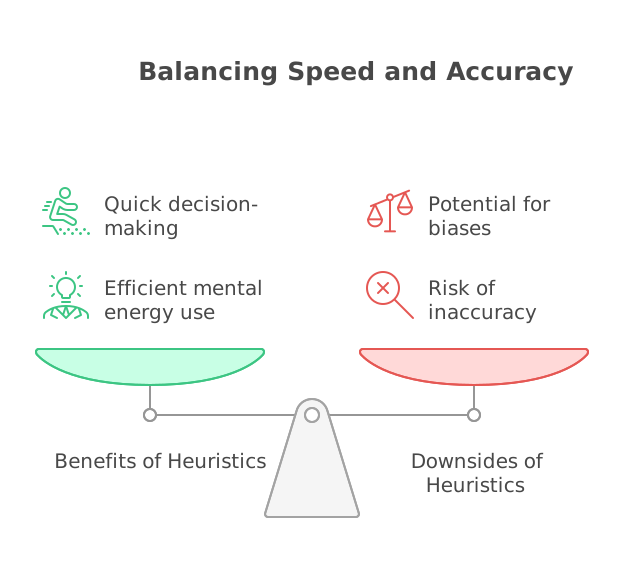
A heuristic is a fancy word for a mental shortcut – basically, a rule-of-thumb your brain uses to make decisions quickly. Think of it like this: if you’re leaving home and see dark clouds, you might grab an umbrella without overthinking. You didn’t calculate the exact chance of rain; you just used a shortcut: “Dark clouds mean rain.” In everyday life, these shortcuts save time and mental energy. Our brains are constantly processing tons of information, so heuristics act like your brain’s automatic filters, helping you get to a “good enough” decision fast .
Benefits
Heuristics can be really handy. For example, a doctor might recognize a common illness in seconds by recalling a familiar pattern of symptoms – that’s a heuristic at work. Similarly, as an investor, you might have a quick rule like “invest in companies I know and trust” to simplify choices. It’s like saying “I’ve seen something like this before, so I’ll base my decision on that.” In fact, behavioral finance theory shows that investors and professionals use heuristics to speed up analysis and decisions.
Downsides
However, there’s a catch: these mental shortcuts aren’t perfect. They’re fast, but they can sometimes be wrong. We might ignore important details or make a bad call because the shortcut oversimplified things. In other words, heuristics can lead to biases – systematic errors in our thinking . That’s what this article is about: one very common bias born from a heuristic.
The Representativeness Heuristic: Why We Love Patterns
A Classic Example: The Gambler’s Fallacy in Disguise
In 18th-century France, a “brilliant” gambling strategy emerged that came to be known as the Martingale Strategy. The premise was simple: bet on a fair 50/50 outcome—such as a coin toss—and double your wager each time you lose. When you eventually win, you recoup all prior losses and gain a profit equal to your original bet.
What does that mean?
Let us consider the following example: Suppose a gambler bets $1 and loses, then doubles the bet each time:
– Bet 1: $1 – lose – Bet 2: $2 – lose – Bet 3: $4 – lose – Bet 4: $8 – lose – Bet 5: $16 – win
The total lost before the win is $31, and the win yields $32 (double the $16 bet), leaving a $1 profit.
If you had infinite money and no table limits, this method might seem foolproof—you would almost certainly win eventually. But in reality, several problems make it risky and impractical.
The Downside to the martingale bet
First, no one has unlimited resources, and losing streaks can be longer than you’d expect. Losing 10 times in a row has odds of 1 in 1,024; losing 11 times is 1 in 2,048. While those probabilities look small before play begins, they are coldly irrelevant once you’re in the middle of a streak—the chance of losing the next toss is still 50%, regardless of prior outcomes. This common misconception, known as the Gambler’s Fallacy, is part of why casinos flourish.
Even worse, the required bets grow exponentially during a losing streak. After 15 losses, your next bet would be $32,768—on top of $32,767 already lost—just to make a $1 profit. Theoretically, you might believe you could “stick it out,” but when faced with such astronomical stakes and mounting losses, most people find it impossible to carry on.
The Martingale may seem like a sure path to winnings, but in reality, it’s often a shortcut to financial disaster. Investors can fall into a similar trap. When a stock keeps dropping, it’s tempting to expect a rebound—or fear an endless fall—but the truth is it can go either way. Likewise, when a fund is surging, it’s easy to believe the rally will continue. Both reactions arise from the same mental bias: assuming streaks will follow a predictable script, whether of reversal or momentum. Like gamblers chasing patterns, investors who follow these impulses often take on far more risk than they recognize.
So What is the representative heuristic?
The representativeness heuristic is our mind’s habit of judging a situation by how much it resembles something we’ve seen before. In other words, we instinctively ask, “Does this feel familiar?” If the answer is yes, we tend to assume the outcome will be the same—mistaking similarity for likelihood.
Think of it like making decisions by stereotype. If you see a person in a lab coat, you might instantly think “doctor” because they fit the image (even though they could be a scientist or an artist in a quirky outfit). Your brain matches them to the closest prototype it recognizes. Likewise, if you hear about a company that’s a garage startup with two college kids, you might recall the story of Apple or Facebook and feel optimistic about its future. The similarity triggers that feeling.
Examples
Let’s look at a classic example psychologists often use: You meet John, a quiet, shy man who loves reading. Which is more likely—John is a librarian or a salesperson? Many people choose librarian because he fits the stereotype. But in reality, there are far more salespeople than librarians, so statistically, John is more likely a salesperson. By focusing on how well John matches our mental image of a librarian, we overlook the base rates—the actual probabilities. This is the representativeness heuristic at work: our brains favor a tidy story (“He seems like a librarian, so he must be one”) over the messier truth of the numbers.
In everyday life, the representativeness heuristic helps us make quick judgments, often landing close to the truth—like assuming dark clouds signal rain. But it can also lead us astray, fueling stereotypes or distorting our sense of probability. A classic example is the gambler’s fallacy: after flipping five heads in a row, many believe the next flip is more likely to be tails to “balance” the pattern, even though the odds remain 50/50 each time. Next, we’ll explore how this instinct for patterns and prototypes plays out in the investing world—and how it can lead to costly mistakes.
Representativeness in Investing: Seeing Patterns That Aren’t Really There
Investing is full of uncertainty, and our brains desperately seek patterns to make sense of it. The representativeness heuristic is like a comfort blanket – if a new situation resembles something we’ve seen before, we assume the same outcome will happen. Here’s how that can trip up investors:
Chasing “Hot” Stocks and Funds
Imagine an investor, Alice, reading about a stock that’s doubled in the last year. She thinks, “This looks just like that other company that exploded in value – I bet it will keep going up!” Alice is using representativeness: the stock’s recent success represents a winner in her mind, so she buys in expecting the trend to continue. Investors often flock to assets that have been doing extremely well, assuming they’ll stay winners simply because they look like winners now. In behavioral finance, research shows this bias can lead people to purchase hot stocks based on recent performance and glowing narratives . They’re matching the current pattern to past success stories, often overlooking whether the price has become overinflated or the situation has changed.
For example, during the big tech boom of 2020–2021, many investors poured money into any stock remotely related to e-commerce, electric vehicles, or “the next big app.” Why? Because those stocks felt like the next Amazon or Tesla – they fit a successful prototype. If a company had buzzwords like “AI-powered” or “blockchain-based”, it ticked the mental box of a future superstar. This representativeness-driven hype contributed to some stocks soaring far beyond what their earnings justified. It’s the classic “looks like a rocket, so it must fly like one” thinking. Unfortunately, buying something just because it has been going up (or resembles something that went up) often means buying high. If expectations prove wrong, the fall can be hard and fast.
Shunning “Losers” and Overreacting to Recent Drops
Consider Bob, who checks his portfolio and notices that his international stock fund is down 30% for the year. Remembering a similar fund he once owned that never bounced back, he quickly decides to sell, thinking, “It’s a loser—I should get out before it gets worse.” In doing so, Bob assumes that recent poor performance means the investment is permanently flawed. Many investors fall into this trap, shunning stocks or sectors that have struggled because they now feel like bad bets. It’s another form of representativeness bias: just as we’re tempted to chase winners, we often abandon investments that seem like losers—sometimes at precisely the wrong moment.
In reality, a stock that’s fallen a lot might be undervalued and due for a rebound, or it might indeed be troubled – but the recent drop alone doesn’t guarantee future failure. By equating short-term performance with long-term fate, investors can end up selling at the bottom. It’s like assuming a student who got a couple of D’s will never get an A again – maybe they had a rough semester, but things could change. In investing, if you sell only because the price fell (and not because your needs changed or you need to rebalance), you might be letting a heuristic panic you.
A word on Recency Bias
Representativeness is closely tied to recency bias – giving more weight to what just happened. After a market high, our brains say “this feels just like the boom times we know,” and we expect the good times to roll on. After a market crash, everything suddenly reminds us of prior crises, and we expect more pain. Let’s break down these scenarios:
After Big Highs (Extrapolating Trends):
After several years of steady market gains, it’s easy for investors to believe the upward trend will continue indefinitely. Recent performance feels familiar, recalling other bullish periods, and that familiarity can be reassuring. But markets, like trees, don’t grow to the sky. A string of 20%+ annual returns in the S&P 500 doesn’t guarantee the same outcome year after year. This is representativeness bias at work—projecting recent patterns into the future—and it can leave investors unprepared when reality takes a different turn.
After Big Lows (Gloom or a “Due” Rebound)
On the flip side, when markets plunge, the mood can swing to extreme pessimism. During a steep downturn (say the market drops 30% in a short time), investors often feel “This downturn reminds me of 2008 – everything is going to collapse!” In early 2020, for example, the rapid COVID-induced crash led some to fear a Great-Depression-level collapse because it looked like the 2008 freefall on charts. Many sold off holdings in panic.
But the 2020 crash, though sharp, was very short-lived – by the end of the year the market had largely recovered, proving the doom forecasts wrong. Those who sold at the bottom because the situation resembled 2008 missed one of the fastest rebounds in history.
There’s also the gambler’s fallacy twist in down markets: sometimes investors think “stocks have fallen five days in a row, so a rebound is due because things should balance out.” This is representativeness playing a different trick – assuming random sequences must look random. Just as a gambler might bet on red after a streak of black numbers in roulette (thinking the streak can’t continue), an investor might prematurely buy a falling stock expecting an automatic bounce. That bounce may not come if there’s no real catalyst. In both cases, the error is believing that short-term patterns are reliable guides. Whether it’s expecting continuation or reversal of a trend, the common thread is a focus on patterns rather than concrete analysis.
Beware of “I’ve seen this before”
The representativeness heuristic basically makes market patterns into a kind of Rorschach test – we see what we want or expect to see. If we’re feeling optimistic, we find signs that this boom = past boom (so full steam ahead!). If we’re scared, we find signs that this crash = past crash (so brace for disaster). In reality, each market cycle has unique factors. It’s not that history is useless – understanding past cycles is very valuable – but no two events are exactly the same. Relying on surface similarity (“it looks just like last time”) can lead us astray if we ignore deeper differences.
Let’s look at how this bias concretely affects investors’ decisions and perceptions of risk.
How Biases Skew Portfolio Choices and Risk Perception
Why does all this matter? Because falling for the representativeness heuristic can seriously mess with your investment strategy and how you judge risk. Let us explore a few key impacts.
Buying High, Selling Low
The most immediate impact is that investors often end up buying assets at elevated prices—drawn in by strong recent performance or a compelling story—and selling them at depressed prices when recent results look poor. This runs counter to the timeless “buy low, sell high” principle. For instance, an investor influenced by the representativeness bias might pour money into a hot tech fund after it has already surged, believing it’s a sure winner, only to sell during a downturn when it appears broken. This pattern of behavior, known as performance chasing, frequently leads to subpar results. Research shows that by chasing winners and abandoning losers, many investors inadvertently underperform the very funds they invest in—largely because mistimed entries and exits, driven by bias, erode returns.
Distorted Risk Perception
Representativeness bias can distort how we judge risk. When an investment has been stable or steadily rising, it’s easy to assume it’s safer than it really is—essentially thinking, “Nothing bad has happened recently, so how risky can it be?” This false sense of security can lead to overconcentrating in that asset.
For example, a tech stock that has climbed every quarter for two years may feel like a “safe bet” because of its consistent pattern, yet it could still be volatile or overvalued, with risks hidden behind the reassuring trend. Conversely, when an investment has fallen or been volatile, we may see it as “too risky” and avoid it, even if much of the bad news is already priced in. In early 2023, for instance, many investors shunned bonds after their rare, sharp decline in 2022. The drop felt like a warning sign, making bonds seem unusually dangerous, even though new bonds were offering higher yields and arguably lower risk of further large losses. In both cases, focusing on recent patterns can lead to overestimating or underestimating the true level of risk.
Overconfidence in Predictions
The representativeness heuristic can give both amateur and professional investors a misleading sense of certainty in their forecasts. When current conditions resemble a memorable past scenario, it’s tempting to assume the same outcome will follow—while overlooking how circumstances might differ this time.
For example, at the start of 2023, the U.S. yield curve (which plots interest rates against bond maturities) had inverted, with long-term rates falling below short-term rates—a pattern that historically has often preceded recessions. Because this mirrored past pre-recession periods, many forecasters treated a downturn as inevitable. Some models even put the odds at 100%, prompting investors and fund managers to adopt highly defensive positions. Yet, as late 2023 turned into 2024, the expected recession had not arrived and the economy performed far better than anticipated. Those who were overconfident in the analogy may have missed out on gains or made unnecessary adjustments. The takeaway: relying too heavily on a single familiar pattern can cause you to overestimate your predictive abilities and ignore alternative outcomes.
Portfolio Imbalance and Herding
When a large group of investors share the same representativeness-driven belief, the effects can ripple across the entire market. Take, for example, the notion that “Tech stocks are the future, just like in the 1990s.” Such sentiment can trigger massive inflows into the sector, inflating valuations and concentrating market weight in a handful of companies.
By mid-2025, Wall Street’s reliance on a few high-flying tech giants had reached record levels. This “just like the ’90s boom” mindset helped those stocks dominate the S&P 500. The risk, of course, is that if the pattern breaks, the reversal can be swift and painful, as history has shown. The same bias can fuel herding during downturns, when investors rush to sell because conditions “look like” a past crisis, often driving markets lower than fundamentals justify. In both rallies and selloffs, our tendency to act collectively on perceived patterns can intensify the extremes. The reality is we just don’t know what the future holds!
Ignoring Base Rates and Diversification
When you focus too closely on the story or pattern of a single investment, it’s easy to overlook the base rate—the broader statistics and probabilities that truly shape the odds. Imagine a venture capitalist meeting a young, brilliant, hoodie-wearing founder who feels like the next Mark Zuckerberg. Excited by the resemblance, the investor might pour in capital, convinced they’ve found the next Facebook. But in reality, the chances of any startup reaching that level of success are vanishingly small. By focusing on the similarity, the investor risks ignoring just how rare such outcomes are. The same bias can creep into personal portfolios—overweighting a single stock or a hot trend while forgetting the value of diversification. Even if something shares traits with a past winner, most similar ventures still fail. Overlooking those base rates is a classic representativeness mistake.
In short, the representativeness heuristic can lead investors to concentrate too much in what looks familiar or successful, trade too emotionally on recent outcomes, and generally deviate from a sound long-term strategy. It’s like driving while looking only in the rear-view mirror – you’re steering based on where you’ve been, not where you’re going. Now, let’s ground this in some real-world scenarios from the past few years to see how these biases played out and what we can learn from them.
Recent Real-World Examples (2020–2025) – Lessons in Bias
It’s been an eventful few years in the markets, providing plenty of examples of investors leaning on patterns – sometimes to their detriment. Here are a few notable cases:
The Pandemic Crash and Rebound (2020)
When COVID-19 hit and markets plummeted in March 2020, the speed of the crash was breathtaking. Many investors panicked. It felt like 2008 all over again – a global crisis, markets in freefall – so the natural reaction for a lot of people was sell everything, expecting a drawn-out collapse. Indeed, by late March 2020, some were likening it to the Great Depression.
But then an unexpected thing happened: thanks in part to massive stimulus and other factors, the market bottomed in late March and began a rapid recovery, recouping losses quickly. Those who assumed the crash pattern guaranteed a multi-year downturn missed one of the quickest rebounds ever. The representativeness heuristic led many to overestimate the duration of the crash (“this looks like a long nightmare, so it will be”), when in fact the situation, while dire, wasn’t a repeat of 2008’s protracted financial seize-up. Lesson: Even if two crises share some similarities, the outcomes can differ vastly. Staying flexible and staying true to a long term plan often helps.
Meme Stock Mania (2021)
In early 2021, “meme stocks” like GameStop and AMC captured headlines as their share prices soared, driven by social media buzz and waves of enthusiastic retail investors. GameStop’s meteoric rise from around $20 to $400 inspired many to search for “the next GameStop,” assuming that any stock with high short interest and a devoted online following would follow the same trajectory.
In some cases, shares of struggling companies spiked simply because people declared, “This one’s just like GameStop—let’s jump in!” This was representativeness bias in action, amplified by confirmation bias and herd behavior. While a few of these stocks enjoyed brief surges, many quickly fizzled, leaving latecomers—who bought in solely because a stock looked like a meme stock—facing steep losses when market fundamentals reasserted themselves. The lesson is clear: even if two companies share surface similarities, each stock has its own unique story, and outcomes can be very different.
Tech Bubble Fears vs. “This Time is Different” (2021–2023)
By the end of 2021, tech stocks had been on a tear. Then 2022 brought a harsh bear market, especially for tech and growth stocks. Coming into 2023, there were two competing narratives among investors, both influenced by representativeness in different ways.
Narrative 1: “Tech is in a 2000-like Bubble”
After seeing speculative fervor in crypto, electric vehicle startups with no profits, and meme stocks, some veteran investors said “we’ve seen this movie before” and expected a dot-com style crash. They pointed to companies with sky-high valuations and no earnings as evidence. Indeed, as interest rates rose in 2022, many high-flyers did crash hard. By mid-2023, however, the market, especially big tech, started recovering. Companies like Apple, Microsoft, and NVIDIA hit all-time highs again, propelled by excitement around artificial intelligence. This led to new bubble warnings: headlines asked if the AI boom was the next dot-com bubble . The similarity was hard to ignore – soaring tech valuations, frenzied investor enthusiasm. Investors who assumed a perfect repeat of 2000 might have stayed out of the market entirely in 2023, missing significant gains, as the anticipated collapse did not mirror the past exactly.
Narrative 2: “This Time is Different – Tech Can’t Fail”
On the flip side, some investors, especially newer ones, saw giants like Apple and Google as unbeatable and viewed the 2022 dip as a buying opportunity much like every dip in the 2010s had been. To them, the script was: “After every pullback, tech comes roaring back even stronger.” By mid-2023, this camp felt vindicated as Nasdaq rallied. However, by late 2024 into 2025, questions arose whether the market was overly complacent. Optimism that “it’s not like 2000, because companies now have real earnings” (which is true to an extent) might lead to ignoring genuine risks (like high valuations or overreliance on a few stocks).
While many fundamentals differ from 2000, thinking massive tech growth will continue without hiccups is exactly the kind of complacency that has hurt investors before . Whether you lean towards doomsday analogies or rosy “new era” narratives, recognize those are both pattern-based stories. Reality can land somewhere in between. It’s wise to keep an open mind – maybe it’s not a 2000 repeat, but that doesn’t guarantee smooth sailing either.
Each of these examples shows how easy it is to get swept up by a compelling pattern or analogy. We’re all human – even economists and fund managers fall prey to these biases, because recognizing familiar shapes in the chaos is comforting. The key takeaway is that similarity isn’t certainty. As investors, we need to continuously remind ourselves to test the story (“Is this situation truly the same as that past one? What’s different?”) and to base decisions on evidence and broad data, not just one or two resemblances.
A note on Randomness
As human beings, we have a natural aversion to randomness. We crave patterns and meaning, often searching for connections that don’t actually exist. This tendency drives us to sift through data—sometimes obsessively—in the hope of finding evidence that past events had a clear cause. For example, you might track every news headline and monitor the stock market daily, convinced that a pattern will emerge to guide your decisions.
The problem is that patterns can appear purely by chance, especially when looking at short periods of time. Consider flipping a coin and getting 10 heads in a row. It might be tempting to think heads are now “due” or more likely on the next toss—but in reality, the odds remain 50-50. This is the essence of hindsight bias: seeing meaning in a pattern after the fact and mistakenly believing it holds predictive power for the future.
This same thinking appears in investing. We’ve all heard of bubbles—the dot-com bubble, the housing bubble—where prices soared, then crashed. While it’s easy to spot the pattern after it happens, that doesn’t mean you can use it to reliably predict what comes next. Similarly, slot machine players often assume that after many losses, a win is “due”—the same flawed logic as expecting heads after a streak of heads.
In investing, this bias can cause people to sell winning stocks too soon out of fear, yet cling to losing ones in the hope they’ll rebound—sometimes with the opposite outcome. The reality is that not every pattern carries meaning; those born from random chance offer no insight into the future. Recognizing this truth is key to making smarter, more disciplined decisions.
Don’t just stand there… do something? or Just stay with your plan!
Another common behavioral bias is known as action bias—the tendency to prefer doing something over doing nothing, even when inaction might be the wiser choice.
Think about driving on the highway. Have you ever felt your lane was moving too slowly, so you switched lanes to get ahead—only to realize you didn’t actually get there any faster? Research by Donald Redelmeier found that lane-switching often doesn’t improve travel time and can even increase the risk of an accident. Still, waiting patiently behind a slow car can feel uncomfortable because we dislike prolonged inaction. That itch to “do something” can push us toward decisions that aren’t beneficial.
This behavior shows up in other fields too. In a fascinating study, researcher Michael Bar-Eli analyzed 286 soccer penalty kicks. The data showed that goalkeepers had the best chance of saving a shot by staying in the center of the goal. Yet, over 93% of the time, they jumped to one side—driven by the instinct to act, even when stillness was more effective.
The same principle applies to investing. Often, the smartest move is to do nothing and remain calm. Acting on short-term market swings or unpredictable events usually leads to unpredictable—and costly—outcomes. The real challenge is emotional: watching friends or neighbors get rich from a lucky investment can tempt you to follow the crowd. But this “herding” behavior can be disastrous. Even Isaac Newton fell victim to it, losing a fortune in the South Sea Bubble. Reflecting on the experience, he famously remarked that he could “calculate the motion of heavenly bodies, but not the madness of people.”
In the next section, we’ll highlight that any investor can slip into this cognitive trap – and then we’ll arm you with concrete tips to counteract it.
Different Investors, Same Bias (Who Can Fall for It?)
No matter how smart or experienced you are, the representativeness heuristic can sneak into your decision-making. Here’s a look at how various types of investors might fall prey to this bias:
New Investor(e.g. busy professional new to markets)
Relies on recent performance as a guide. For example, after seeing a stock fund return +30% last year, assumes it’s a “winner” and will keep performing well, so they pile in. Conversely, avoids investments that have recently dropped, labeling them “bad” without further analysis. Essentially, they judge investments by short-term success or failure, since they have little else to go on.
Seasoned Investor(investing for years)
May become overconfident in patterns they’ve seen before. For instance, an experienced investor might say “This looks just like the 2008 crisis; I’m getting out now,” possibly too early or in the wrong areas, because they’re fighting the last war. Or if they had great success with a certain strategy (say, buying Silicon Valley tech stocks in the 2010s), they might keep doing so in the 2020s – assuming the old pattern of success still holds.
Trend Chaser(momentum trader or fad follower)
Explicitly uses representativeness: they jump from one hot trend to another. If solar energy stocks are surging, they’re in – because “solar is the new oil, just like tech was the new finance!” If last quarter’s best-performing sector was healthcare, they rotate into healthcare, basically chasing whatever has a winning pattern. Their portfolio might lack any anchor because it’s constantly mimicking last month’s success stories. This approach can work for short bursts but often ends up buying high and selling low when the momentum shifts.
Contrarian or Value Investor(bargain-hunter who goes against the crowd)
You’d think contrarians are safe from this bias – they intentionally go opposite of trends – but they have their own version of it. A contrarian might assume a stock must rebound because it reminds them of past overreactions. For example, “Stock XYZ fell 40% in a market panic, just like Stock ABC did last year; ABC bounced back 50%, so XYZ will too.” This is representativeness in the sense of expecting a mean-reversion pattern just because it happened before. If XYZ’s fundamentals are truly broken, it might not come back, and the contrarian could be catching a falling knife. In essence, they stereotype all sell-offs as overreactions, which isn’t always true.
May become too hesitant after seeing scary market patterns. For instance, if they lived through a crash, they might see any minor downturn as the start of another big crash and drastically cut exposure to stocks. Say a retiree saw the market drop 10% – they recall 2008, get nervous that “this looks like the beginning of a meltdown,” and move a large chunk to cash. The market might recover the next month, and they’ve locked in a loss and missed the rebound. Their long-term plan gets derailed by short-term pattern anxiety.
Professional Fund Manager or Analyst
Even with lots of data and models, they are still human. A fund manager could stick with a losing investment too long because it fits their thesis of a turnaround (they’ve seen similar companies turn around before, so they expect this one to follow the script – sometimes called confirmation bias, related to representativeness). Or an analyst might issue a bold forecast – “We’re definitely heading into a high-inflation era like the 1970s” – because certain indicators resemble the ’70s, leading them to position their portfolio for that scenario and possibly miss out when the future turns out different. Professionals also face pressure to “not miss out” on trends clients are excited about, so they might buy popular stocks mainly because everyone else is (a bit of herd mentality fueled by representativeness: “we should own this, it’s what a successful portfolio looked like last year”).
As you can see, no one is immune. Biases are part of being human. The key is not to feel bad about having these instincts, but to recognize them and put speed bumps in place so you don’t automatically act on them. Next, let’s talk about those speed bumps – concrete ways to catch yourself and make better investing choices despite what your gut might be screaming at you.
Overcoming the Representativeness Heuristic: Smart Strategies for Investors
Knowing about a bias is a great first step – you’re already ahead of many investors just by being aware of the representativeness heuristic and how it operates. Now, how can you counter it? Here are some practical, friendly tips to keep your brain’s pattern-love in check:
Think “Probability” Not “Similarity”
Train yourself to ask, “What are the odds really?” instead of “What does this remind me of?” For example, if a biotech stock reminds you of “the next Moderna” because it’s working on a hot new vaccine, step back and research: how many biotech startups actually achieve that kind of success? (Answer: very few.) This doesn’t mean you can’t invest in the exciting stock; it means you do so with a realistic understanding that the base-rate probability of matching that success is low.
When you catch yourself making a quick judgment based on resemblance, follow up with data. The more you can quantify things – even roughly – the better you can resist a rosy or gloomy narrative that isn’t justified. Remember, a coin coming up heads five times in a row is rare but possible; the probability of heads on the next toss is still 50%. In investing terms, a stock doubling in one year is unusual, and doing it again next year might be just as unlikely, no matter how much it feels like “a rocket ship.”
Broaden Your Frame of Reference
One sneaky effect of representativeness is that it narrows our focus to the most salient example(recency bias). Counter that by deliberately looking at a wider set of information. If a particular stock or fund has had stellar returns lately, look at at least its 10-year track record if available (even 30 years in short in investing…). Often you’ll find that performance reverts to the mean over time. In short, zoom out. A pattern that’s clear on a short timeline might disappear or reverse on a longer timeline. By widening your view, you might discover, for instance, that the “stellar” fund that beat the market for three years actually lagged in the previous seven, so its long-term performance is just okay. Such context prevents you from placing too much weight on a short streak.
Avoid Knee-Jerk Decisions on Recent Trends
This is easier said than done, but incredibly important: resist the urge to immediately act on recent performance alone. If you find yourself thinking, “I’m going to buy X because it’s been going up (or sell Y because it’s been going down),” put a pin in that decision. Take a day to revisit why the asset has moved. Sometimes there are valid reasons (fundamental news, changes in outlook), but other times it’s just noise or temporary sentiment. A good practice is to write down your reasoning (more on diaries in a second) or articulate it to someone: “I’m considering selling this fund because it dropped 15% this year.” Even just hearing that out loud might spur you to add, “…but I’m investing for 20 years, and 15% swings happen.”
Oftentimes, doing nothing is the right move when the only impetus is short-term performance. Markets are volatile; that’s normal. Don’t let every bump tempt you into a reaction. Consider setting rules for yourself: e.g., “I only rebalance or adjust my portfolio on a set schedule or if my investment thesis fundamentally changes, not just because of performance.” This structured approach can guard you against being swayed by the latest pattern.
Use a Checklist or “Investment Diary”
Think of this tip like flossing: everyone knows it’s good for you, but few actually do it—yet the benefits can be significant. Take a moment to write down the reasons behind each investment decision, especially when buying or selling. Keep it simple: jot a few bullet points on why you’re taking the action, what you expect to happen, and what would make you change course. Include how you feel—are you excited because the stock is making headlines, or uneasy after a bad earnings report? Over time, this record will uncover patterns in your behavior.
You might notice, for example, that chasing the latest “hot” stock rarely paid off. Seeing that in black and white can be a powerful reminder not to repeat mistakes. This habit also forces you to pause, do your homework, and reflect before acting—helping you avoid impulsive decisions. Documenting your thinking and later comparing it to results builds accountability and sharpens your judgment. If keeping a diary feels like too much, try a quick pre-trade checklist: Have I researched this? Am I acting on fundamentals or just a trend? Does it align with my goals? Even this brief step can help keep your investing thoughtful and disciplined.
Diversify and Rebalance
Boring? Perhaps. Effective? Mostly! . Diversification is often called the only free lunch in investing – by spreading your money across different types of assets (stocks, bonds, real estate, etc., and across different industries and regions), you reduce the impact of any one bet going wrong. It also implicitly guards against representativeness bias because you won’t have all your eggs in the basket that was just glittering with recent gains. If you were 100% in tech stocks in 2021, you had a great year then a rough 2022. A diversified portfolio wouldn’t have soared as high, but also wouldn’t have fallen as hard. More importantly, diversification forces you to think in terms of a whole portfolio, not individual winners or losers. It’s easier to avoid obsessing over patterns in one stock when you’re managing a collection of assets that balance each other.
Set Long-Term Goals and Stick to a Plan
Having a clear investment plan can act as your North Star when short-term biases try to push you off course. If you determine, for example, that given your age and risk tolerance, you should be invested about 70% in equities (stocks) and 30% in fixed income (bonds), and within stocks you want a mix of, say, 50% U.S., 30% international, 20% emerging markets – then you have a framework to refer back to. When the next hot thing comes along, you can ask: “Does this fit my plan or am I just chasing shiny objects?” It doesn’t mean you can’t ever alter the plan – plans should be revisited if your life circumstances or fundamental market assumptions change – but it prevents whimsical shifts based on passing trends.
Learn and Embrace Contradictory Information
One way to combat any bias is actively seeking information that challenges your assumptions. If you’re feeling very certain that a current trend will continue, try to find analyses or opinions that say it won’t, and vice versa. For example, if you’re convinced “XYZ industry is the future; it can’t fail,” look up historical cases of booming industries that later busted, or find a skeptic’s take on XYZ. Not to be a downer, but to ensure you’re seeing the full picture. By exposing yourself to different viewpoints, you reduce the risk of echo-chamber pattern confirmation. It can be as simple as following a few investors or analysts with a variety of perspectives. If you predominantly read bullish takes, also read a bearish one occasionally (and vice versa). Sometimes the truth is in between, but you won’t see it if you’re only looking one way.
Use Tools and Advice, but Stay Self-Aware
If you work with a human financial advisor, a big part of their job (though it’s not always advertised) is being a behavioral coach – stopping you from making rash decisions and keeping you aligned with your plan. Don’t hesitate to lean on that expertise. Just remember, ultimately you call the shots for your money, so it’s wise to cultivate your own awareness. When you find yourself rationalizing a decision heavily (“It has to work because it’s just like that other success…” or “I’m sure this will fail because we’ve seen this story before…”), pause and label that thought: “Am I falling into the representativeness trap here?” That little check – mentally calling out the bias by name – can snap you into a more analytical mode.
By applying these strategies, you create a crucial pause between your first instinct and your final decision. Think of it as installing an extra circuit breaker in your mind—when a surge of “This looks like X, so I’ll do Y!” hits, it trips and prompts you to reconsider. Over time, this habit not only leads to more rational decisions but also builds confidence in your approach. You’ll start to say, “I recognize that feeling, but I’ve double-checked my facts and plan, so I’m confident in my choice.” That’s a powerful position to be in as an investor.
Conclusion: Patterns vs. Principles
Human brains are pattern-recognition machines. It’s one of our greatest strengths – it helped our ancestors identify edible plants, predict weather changes, and avoid dangers. In the investing arena, recognizing patterns can sometimes lead to profit (like spotting an emerging industry early). But as we’ve explored, it can also lead us into illusion – seeing certainty where there is none, and making decisions on autopilot when we really should be hitting the brakes and engaging manual control.
Representative heuristic- a double edged sword
The representativeness heuristic is essentially a double-edged sword. It gives us quick intuition by comparing to what we know, but it also can deceive us. A stock isn’t guaranteed to be the next Apple just because it reminds you of Apple. A market downturn isn’t guaranteed to become the next lost decade just because a few metrics look similar. History rhymes more often than it repeats verbatim. Small sample sizes, recency, and vivid examples can mislead our judgment of what’s likely.
For you, as a long-term investor (whether you’re a physician, an engineer, a PhD, or an entrepreneur – a busy professional making important financial decisions), the key message is: be aware of your brain’s shortcuts. You don’t need to become a psychologist, but recognizing “Ah, I feel strongly about this investment because it resembles something familiar” is a powerful insight. That’s your cue to step back and verify. Rely on principles, not just patterns. Principles like diversification, patience, and attention to fundamental value might not be as exciting as chasing the latest trend, but they have a much better track record of preserving and growing wealth.
Also, don’t beat yourself up for having these biased impulses. We all have them. The difference between a rash investor and a wise investor isn’t who has fewer biases (we all have them), but who has strategies to manage them. Think of it like sailing: you can’t eliminate the wind (sometimes it’s with you, sometimes against), but you can adjust your sails. By learning about behavioral finance biases, you’re effectively learning to trim the sails of your investing approach so you can navigate through calm and storm alike.
What the future holds…
As of 2025, markets continue to evolve in unexpected ways – there will be new manias, new panics, new “unprecedented” scenarios, and then everyone saying “we’ve seen this before” or “this time is different.” When you hear those phrases, smile to yourself, because now you know the trick your mind is trying to play. Instead of jumping with the crowd or running with fear, you can approach each decision with a balanced perspective. In practice, that means making sure your portfolio aligns with your goals and risk tolerance, rebalancing periodically, and not getting swept away by each new story the market tells.
In the end, successful investing often feels boring. It’s sticking to a plan, not checking your portfolio every hour, and not reacting to every headline. And it turns out, boring beats exciting but erratic in the long run for most people. So, the next time your gut insists “This investment feels right because I recognize the pattern,” give your gut a polite nod, then double-check with your brain, your plan, and maybe that investment diary entry you wrote. You’ll be glad you did.
Even the most accomplished professionals—doctors, engineers, lawyers, entrepreneurs—are not immune to the psychology of money. You might excel in the operating room or boardroom, yet still hesitate over an investment or second-guess a purchase. Why? Our brains are wired with biases that deeply influence how we handle money. Pioneers in behavioral finance like Daniel Kahneman, Amos Tversky, and Richard Thaler have shown that we often relate to money in surprisingly emotional and irrational ways.
In this post, we’ll unpack one of the most powerful biases—loss aversion—along with two related concepts: Weber’s Law (why a $100 difference can feel monumental or insignificant) and the Endowment Effect (why we overvalue the things we own). Instead of dry charts or complex formulas, we’ll use relatable examples—from buying a home to indulging in a luxury splurge—to make these concepts easy to grasp.
The goal is simple: to help you spot these biases at work in your decisions. Let’s dive in.
Feeling the Pain of Loss (Loss Aversion in Everyday Life)
Picture this: you stumble upon a $100 bill on the sidewalk—instant joy. Now picture opening your wallet later and realizing you’ve lost $100. For most of us, that sinking feeling would far outweigh the earlier thrill despite the same amount being gained or lost. This is loss aversion in action: the pain of losing is about twice as powerful as the pleasure of an equivalent gain. In short, losses loom larger than gains—it feels better to avoid losing $100 than to find $100.
Losses Loom Larger Than Gains
Psychologists Daniel Kahneman and Amos Tversky demonstrated this in their famous Prospect Theory research. They found that if given a fair 50/50 gamble – say a coin flip to either win $ 50,000 or lose $ 50,000 – many people (even wealthy folks) will reject it, even if the odds are slightly in their favor. The fear of losing $ 50,000 looms so large that the potential pleasure of gaining $ 50,000 barely registers . Mathematically, turning down such a gamble might seem irrational (the expected value is is in their favor after all), but emotionally it makes perfect sense due to loss aversion. As Kahneman and Tversky observed, the torment of a loss often outweighs an equivalent gain’s satisfaction.
Consider a real-life scenario: You invest in two stocks; one goes up $10,000 and the other down $10,000. Objectively, you’ve broken even. But subjectively, the loss feels like a punch in the gut, while the gain is just a pat on the back. You might brood over the losing stock for weeks (or kick yourself for buying it), whereas the winning stock’s good vibes fade in days. This imbalance can lead to decision regret – we tend to second-guess and regret actions that lead to losses much more than inactions that miss gains. For instance, selling a stock that later skyrockets might cause some regret, but holding a stock that crashes often feels far worse. That pain can push us into defensive financial behaviors. We may become overly conservative, preferring the status quo or safe bets to avoid any chance of loss . Ironically, that very caution can cause missed opportunities.
Loss Aversion in Everyday Life
Loss aversion shows up in everyday money decisions, big and small. Have you ever bought an expensive item, then felt a wave of buyer’s remorse thinking “I’ve wasted money” more than “I got something great”? That’s loss aversion whispering in your ear – focusing on the money gone rather than the item gained. Or maybe you’ve held onto a struggling business or an underperforming investment for too long because selling it would mean locking in a loss. The rational move might be to cut your losses, but emotionally you just can’t stomach making the loss “real.” This common trap, sometimes called the “disposition effect,” is deeply tied to loss aversion – we’d rather not lose in the first place than admit a loss and move on.
The key insight: Our brains treat losses as more urgent than gains. From an evolutionary standpoint, this makes sense – early humans who focused on avoiding losses (like injury or starvation) probably survived longer than those chasing every gain. But in modern personal finance, this instinct can lead us astray. We might pass up a great investment opportunity because “what if it goes wrong?” echoes louder than “what if it succeeds?”. We might hoard cash or stick to familiar assets, inadvertently shrinking our long-term returns due to fear of any short-term dip. Recognizing loss aversion in yourself doesn’t mean you eliminate it – but it helps you take a step back and ask, “Am I avoiding this financial move for sound reasons, or just because I hate the idea of a loss?” Often, just naming that fear can put it in perspective.
Weber’s Law: Why $100 Is “Small Change” or a Big Deal
Have you ever noticed how a $50 discount feels huge on a $200 purchase, but hardly noticeable on a $20,000 purchase? Objectively, it’s the same $50, but our minds perceive it differently based on context. This is a classic case of Weber’s Law at work in personal finance. Weber’s Law (a principle from 19th-century psychology) says that the just noticeable difference between two amounts depends on the size of the initial amount . In plain English: we judge changes relatively, not absolutely . A small change on a small base stands out, but the same change on a large base might barely register.
For example, imagine you’re shopping for a new suit. Store A sells it for $500, Store B for $550. Many of us would drive across town to save that $50 – it’s a 10% price difference and feels well worth the effort. Now imagine you’re buying a luxury car for $50,000 and two dealers quote $50,000 vs $50,050. The second car is $50 more expensive – the same $50 difference – but you’d probably consider $50 negligible on such a big purchase (a 0.1% difference) . You might not bother driving to the farther dealership for fifty bucks on a $50k car. Saving $50 feels very different in these two situations, even though it is the exact same amount!
Be Cautious About Upsells During Big Purchases
This relative perception is why upscale retailers and real estate agents tactfully upsell extras during big purchases. If you’re splurging on a high-end vacation or buying a new home, an additional $5,000 for a better view or $1,000 for an upgraded appliance can seem small compared to the six or seven-figure total.
As a new homeowner, you might easily spend a few thousand more on premium fixtures or landscaping – costs you’d balk at if you hadn’t already committed hundreds of thousands to the house. It’s not that the value of $5,000 has changed – it’s that your frame of reference changed. You subconsciously think, “Well, I’m already spending so much, what’s a little more?” In contrast, that same “little more” could have felt like a fortune in other circumstances.
Another illustration: you’d never buy a $3,000 stereo system for your aging $5,000 used car, but you might happily roll it into the financing on a brand-new $100,000 car . The fancy sound system feels like a justifiable add-on when it’s only 3% of the new car’s price, whereas it was 60% of the old car’s entire value! Salespeople know this psychology well. They structure deals so that optional upgrades, warranties, or accessories seem like tiny percentages of a hefty purchase. By piggybacking extras onto a large base price, they leverage Weber’s Law – the added cost blends in with the big number.
A Word On Small Leakages Relative To A Big Reservoir
For high-net-worth individuals, Weber’s Law can be a double-edged sword. On one hand, as your wealth grows, a given expense takes up a smaller slice of your resources – $10,000 might feel like a drop in the bucket if you have a $10 million portfolio (just 0.1%). This can prevent decision paralysis over every small expense, freeing you to focus on big-picture strategy. On the other hand, losing track of relative vs. absolute values can lead to overspending or complacency.
For instance, someone worth $20 million might not flinch at a $100,000 loss on an investment as it’s only 0.5% of their net worth – but $100,000 is still $100,000! The danger is that “small” leakages relative to a huge reservoir can add up to significant absolute losses over time. Just because an amount feels trivial next to a larger sum doesn’t mean it isn’t real money. Many lottery winners and high-earning athletes learned this the hard way – a mindset of “I have plenty, so why not splurge” can snowball and end in huge losses.
Seeing Both The Forest And The Trees in Financial Decisions
So how do you keep Weber’s Law from quietly eroding your wealth? The first step is awareness. Try reframing expenses or savings in absolute terms when it counts. If you catch yourself thinking, “This upgrade is only 2% more”, translate it: 2% of $500,000 is $10,000 – is it truly worth $10k to me?
Conversely, if you’re agonizing over a relatively minor fee on a huge deal (say a 0.1% cost on a transaction), step back and notice the proportion – maybe it’s not worth derailing a major opportunity to save that tiny slice. The trick is to zoom in and out: be able to see both the forest (relative size) and the trees (absolute dollars). Smart financial decisions often require toggling between those perspectives. In sum, Weber’s Law reminds us that our perception of money is elastic – a fact we can use to our advantage by consciously recalibrating our viewpoint as needed.
The Endowment Effect: Why “Mine” Feels More Valuable
Have you ever tried to sell a house, a car, or even a prized collectible, only to be shocked—maybe even a little offended—by how low the offers were? You thought, “They’re not seeing the real value here,” while buyers were convinced you were asking far too much. This gap in perception often comes down to the Endowment Effect—our tendency to place a higher value on things simply because they’re ours. Once we own something, our perspective changes: It’s not just a house, it’s our home. The aging roof and small backyard aren’t flaws—they’re charming quirks we’ve grown fond of. But to buyers, cherished family memories add no market value. All they see is a smaller yard and a costly roof repair.
Mine Is Better!
The endowment effect, a term coined by Nobel Prize–winning behavioral economist Richard Thaler, describes how ownership can distort our perception of value. In one of Thaler’s classic experiments, participants were randomly given a simple item—like a coffee mug—and later offered the chance to sell or trade it. Remarkably, those who already owned the mug demanded about twice as much money to part with it as non-owners were willing to pay to acquire one.
In some cases, sellers’ minimum price was 2.5 times higher than buyers’ maximum offer. Simply possessing the mug inflated its worth in their minds. Once our brain labels something as “mine,” it seems to attach a hidden premium. You’ve probably felt this yourself—holding on to an old phone or watch because it feels more valuable than any trade‑in deal, or refusing to sell a piece of art or jewelry for its market price because, to you, it’s priceless. That’s the voice of your inner owner at work.
Endowment Effect And You
The endowment effect can subtly influence big decisions. Entrepreneurs often overvalue their own companies during negotiations – after all, they’ve poured sweat equity and soul into it. A founder might reject a very fair buyout offer because, to them, their company feels uniquely valuable (far beyond what an objective market analysis might say). In investing, you might hesitate to dump a stock you’ve held for years, even if all indicators say its prospects are dim, because it’s your stock – you’ve grown attached, you recall its past glory, you feel a loyalty or an irrational hope that “it’ll come back.”
This overlaps with loss aversion: selling would lock in a loss, and you value that stock more because it’s in your portfolio (endowment effect), so you hang on. Endowment bias also explains why we accumulate stuff in our personal lives – from luxury handbags to vintage cars – and then struggle to declutter or sell them. Parting with our possessions literally feels like losing a part of ourselves; our identity gets entwined with our things. As Professor Thaler noted, this is an emotional reflex that standard economic theory didn’t account for – in theory, we should be willing to sell for roughly what we’d pay to buy, but in reality, sellers almost always overprice relative to buyers .
Overcoming Endowment Effect
Being Aware
Awareness of the endowment effect can help temper its impact. Next time you’re on the selling side – whether it’s your home, your business, or even negotiating which project to pursue – take a moment to step into the buyer’s shoes. Try to view the item or decision as if you didn’t already own it or weren’t already involved. If this weren’t your house/business/idea, would you still value it as much? What would a neutral third-party say it’s worth?
Some savvy individuals actually bring in outside appraisals or trusted advisors at this stage specifically to counteract their own rosy owner’s bias. For example, real estate agents often have to gently recalibrate a home seller’s expectations by showing comparable sales – essentially providing an external reality check to compete with the homeowner’s sentimental price tag. In investing, a rule-based strategy can curb the endowment effect: for instance, deciding in advance that “if a stock drops 20%, I’ll sell it” can override the attachment you’ll feel in the moment as the owner of that losing stock.
Switch Sides
It’s also illuminating to flip the scenario. If you wouldn’t buy an asset today at its current price, why are you holding it? This question can smoke out endowment-driven irrationality. Say you have a vacation property you rarely use. If you didn’t already own it, would you pay the current market price to acquire it? If not, then emotionally you might be overvaluing it just because it’s yours. This doesn’t mean you must immediately sell everything you wouldn’t buy again – there are other factors at play – but it’s a neat mental exercise to adjust perspective.
In summary, the endowment effect reminds us how deeply ownership skews our viewpoint. It’s an extension of loss aversion in many ways – giving up something you own feels like a loss, so you demand extra compensation for that emotional hit . By recognizing this bias, you can strive to be a bit more objective, whether you’re pricing your home to sell or pruning your investment portfolio. You might still price your belongings or businesses higher than an outside observer would – we’re only human – but at least you’ll understand why and can adjust if needed.
A real-life fork in the road (tying it all together):
Consider the following example that many people encounter during their work lives:
You’re a high-performing provider in a salaried role. Whether you sprint or stroll, the paycheck barely changes—and lately the work feels joyless. A private practice across town dangles autonomy and growth, but it’s owned by one person. The owner thinks they’re already “overpaying.” You feel the number is “too low.” No obvious villain—just two smart people seeing the same puzzle differently.
Here’s how the four concepts show up—and how to move forward:
Loss Aversion (the pull of the status quo)
Staying put avoids the felt loss of stability, team, and routine—so your brain inflates the cost of leaving. On the owner’s side, raising comp feels like a sure loss of margin. Name those losses aloud (“I’m afraid of losing predictability”; “I’m afraid of losing profit room”) so they stop steering from the shadows.
Prospect Theory (frame the choice, don’t let it frame you)
Right now you’re comparing a sure thing (same pay, low joy) to a risky thing (uncertain ramp, possibly higher meaning). When choices are framed as potential losses, people get conservative even if the upside is compelling. Reframe explicitly: “What does a good year look like here vs. there? What does a rough year look like?” Make two narratives—best-plausible and worst-plausible—for each path.
Weber’s Law (make changes legible in real life, not just as %)
Our brains judge differences relative to the starting point. In compensation talks, a small change can feel invisible next to a large base, so we shrug and say “it’s only a tiny percent.” But that same change, translated into your daily reality, can be huge.
Convert to human units. Instead of “small % more/less,” ask: What does this buy or cost me each week?Does it mean one fewer clinic session, fewer call nights, more protected time, more control over templates, better staffing, or faster MA/RN support?
Beware the mirror image. A flashy one-time perk can feel big because it’s presented alone, yet barely matter across a year. Meanwhile, a quiet clause—like true scheduling autonomy or no productivity penalty for admin time—can compound in value.
Normalize the offers. Compare on the same unit (per clinic half-day, per call night, per month of admin time) and then decide. If the base number were hidden, would you still take this trade? That question cuts through the “tiny percent” illusion and shows you the lived impact.
Endowment Effect (Overvaluing “mind”)
You likely overvalue your current seniority, workflows, and reputation because they’re yours. The owner likely overvalues their brand, policies, and offer structure because they’re theirs. Run two outsider tests:
If I didn’t already have this current job, would I take it today as written?
If I didn’t already own this practice, would I hire this role on these terms?If either answer is “no,” adjust.
A Practical Approach
Write a one-page decision charter: List non-negotiables (values, schedule guardrails, autonomy), nice-to-haves, and true deal-breakers. Keep numbers light; focus on lived experience.
A trial if possible: Big changes feel scary because your brain screams, “What if I lose what I have?” A short, no-strings test shrinks the risk. You’re not leaping; you’re taking one careful step.
Swap frames in negotiation. You present the owner’s value story by thinking like the owner and consider this in addition to your own thoughts. May be play it out with them if they are open to it.
Tie upside to milestones you both believe in. Not a leap of faith but a ladder. Define what “growth” means operationally and link step-ups to those markers. This might help both the owner and the employee!
Do a pre-mortem. “It’s a year from now and this move failed—what went wrong?” Now design safeguards against those specific risks.
You’re not choosing courage over caution; you’re choosing clarity over reflex. Name the losses, reframe the gamble, scale it in human terms, and step outside your “ownership” bias. Then decide—and commit.
Conclusion: Taming the Emotional Biases in Your Financial Life
Money may be numeric, but financial decisions are anything but purely logical. Loss aversion makes the pain of losing money cut deeper than the pleasure of earning more. Weber’s Law tricks our sense of scale, so we sweat some differences and ignore others, not always in proportion. The Endowment Effect wraps our ego and memories around things we own, clouding what we’d objectively pay or accept for them. These behavioral finance concepts – pioneered by greats like Kahneman, Tversky, and Thaler – prove that even rational, educated people have blind spots in their money psychology.
The good news is that knowing about these biases is more than half the battle. By putting names to these gut feelings, you create a little distance between you and the instinct. The next time you find yourself overly afraid of a financial loss, ask whether loss aversion might be magnifying your dread. When considering a major purchase (or negotiating one), remember Weber’s Law – a small percentage of a big number is still real money – and decide if you’d treat that add-on the same way in isolation. When selling or rebalancing assets, watch for the endowment effect – don’t let “mine” syndrome lead you to cling to underperformers or overprice your valuables beyond reason.
Making Your Emotions Serve You
None of this is to say emotions are “bad.” On the contrary, emotions give meaning to our financial goals – like buying a home for security or investing in causes we care about. The aim of understanding these biases isn’t to become a cold, calculating robot; it’s to ensure your feelings about money serve you, instead of subtly sabotaging you. High-net-worth individuals often work with financial planners or behavioral coaches who help provide that outside perspective – essentially acting as a gentle check on these biases. Whether or not you enlist professional help, you can practice self-reflection. Before making a big decision, take a breath and run through a mental checklist: Am I fearing loss too much? Am I framing this in relative vs. absolute terms wisely? Am I too attached to the status quo because it’s mine?
By integrating a bit of rational analysis with a healthy awareness of your human quirks, you’ll be better positioned to make sound, confident financial decisions. In the end, managing wealth isn’t just about markets and math – it’s about managing ourselves. And as you continue to build your financial acumen, never be embarrassed by the mind tricks you discover – even Nobel-winning economists admit to having these biases! The goal is not to eliminate our human feelings (an impossible task), but to balance them with clear-eyed strategy. Armed with the knowledge of loss aversion, Weber’s Law, and the endowment effect, you can approach your next big financial move with a little more insight – and a lot more confidence that you’re seeing the full picture, emotional and rational, before you act.
In his novel David Copperfield, Charles Dickens wrote: “Annual income twenty pounds, annual expenditure nineteen pounds nineteen and six, result happiness. Annual income twenty pounds, annual expenditure twenty pounds nought and six, result misery.” In simple terms:
spend slightly less than you earn and you’ll be fine
spend just a bit more than you earn and you’re headed for trouble.
This 19th-century wisdom holds a key insight into building wealth that still applies today. Living below your means and saving money is the first step toward financial success. But there’s another ingredient that turns those savings into true wealth: time, and the power of compounding.
We’ve all heard the saying, “time is money.” In investing, that’s more than a figure of speech—it’s a powerful truth. The longer your money stays invested, the more it can grow, not just from the returns you earn but from those returns generating their own earnings. Compound interest is the quiet force that builds great fortunes, steadily growing wealth like a snowball rolling downhill. It’s how small, consistent investments can grow into substantial wealth over time. It’s why a single dollar today can multiply in value if you put it to work. Let us explore how time and compounding build wealth, with relatable examples and a touch of science to bring the concept to life. Whether you’re a seasoned professional or just starting your financial journey, you’ll see why starting early can make all the difference in shaping your financial future.
The Time Value of Money: Why Time Matters
Time can be a friend or a foe to your money, depending on what you do with it. The time value of money is a core financial concept that says a dollar today is worth more than a dollar tomorrow. Why? Because a dollar today can be invested or earn interest, growing to more than a dollar by tomorrow. Conversely, if you just hold onto that dollar without investing, over time it actually loses value. Enter inflation – the gradual rise in prices of goods and services. Inflation is like a silent thief in your wallet, making the purchasing power of a fixed sum of money shrink as years go by.
Let’s talk Inflation
To understand the impact of inflation, consider this:
In 1913, just nine cents would buy you a full quart of milk.
By 1963, that same amount would cover only a small glass
Today, it would barely pay for a few spoons.
Over the past century, inflation has steadily chipped away at the purchasing power of that coin until it became a fraction of what it once was. While you’re not likely to save money for 100 years, the same principle applies over just a few decades as well—unchecked, inflation can quietly erode your wealth. Keeping cash under the mattress or in a zero-interest account all but guarantees a loss in buying power. Even historically “mild” inflation of just a few percent per year has been enough to cut the real value of money by more than half in a single generation.
Doing nothing with money you won’t need in the near future is rarely a safe choice. If you stash it in a safe or let it sit in a checking account for years, inflation will quietly erode its purchasing power, leaving you with less in real terms than you started with. To preserve – and ideally grow – your wealth, you need to turn time into an ally by putting your money to work. This is where investing and compounding come in. By putting your savings into assets that have historically outpaced inflation, such as stocks, you can harness time to increase your wealth instead of letting it diminish.
The Power of Compounding: How Little Seeds Become Mighty Trees
So how exactly does compound interest work? Often called “interest on interest,” compounding is a simple concept with profound implications. Imagine you have $100 and invest it at a 5% annual interest rate. After one year, you earn $5 in interest – giving you $105. If you leave that $105 invested for another year at 5%, you’ll earn interest not just on the original $100, but also on the $5 interest from the first year. So you’d gain about $5.25 in the second year, ending up with $110.25.
That extra 25 cents may not sound like much, but here’s the key: every year, your money can earn a little more, in an ever-increasing snowball. Given enough years, that snowball can grow surprisingly large. No one can predict what any single year will bring for an investment. However, over the long term, the odds are firmly in favor of those who invest rather than sit on the sidelines.
Compound growth may seem modest at first, but its power builds dramatically over time. Imagine planting a tiny acorn— for a while, it shows little change, but given time, it grows into a towering oak. As Albert Einstein is often quoted as saying, “Compound interest is the eighth wonder of the world. He who understands it, earns it… he who doesn’t, pays it.” Why would one of history’s greatest minds say that? Because compounding follows an exponential pattern: the longer it works, the more potent it becomes—until it reaches a tipping point where the pace of growth can be truly astonishing.
The rule of 72
A simple way to grasp the power of compounding is with the “Rule of 72.” This handy guideline lets you estimate how long it will take for an investment to double: just divide 72 by your annual rate of return. For example, at 8% growth per year, your money would double in about 9 years (72 ÷ 8 = 9). At 6%, it would take roughly 12 years. While not perfectly precise, the rule offers a quick, intuitive snapshot of exponential growth. Here’s the big takeaway: if your investment doubles in 9 years at 8%, in 18 years it could be worth about four times as much, and in 27 years around eight times. That’s the magic of compounding—growth that accelerates over time.
This is why someone who begins investing early—and allows their money to compound over 30 or 40 years—can end up with far greater wealth than someone who starts much later, even if the latecomer saves more each year. Compounding rewards patience. Like the timeless tale of the tortoise and the hare, steady, consistent growth ultimately outpaces short bursts of effort.
Before we move on, it’s important to consider the other side of Einstein’s famous insight: “He who doesn’t understand it, pays it.” If you’ve ever carried a credit card balance, you’ve experienced this firsthand—the interest on unpaid debt compounds, turning a small balance into a much larger burden over time.Compounding itself is neutral; it simply amplifies the outcome, whether good or bad. The key is to position your money so you’re earning from it, not paying for it.
Start Early or Pay Later: The Cost of Waiting
When it comes to investing, time isn’t just money – time can be a lot of money. The difference between starting now and starting ten years from now can be staggering, even if you invest the exact same amounts. Let’s illustrate with a tale of two savers, Dr. Jack and Dr. Jill, both 30-something physicians with healthy incomes.
Jack vs. Jill, Part 1 – Invest or Not Invest
Jack and Jill are both disciplined savers, each setting aside $100,000 per year—a remarkable feat achieved by living well below their means. They keep this up for 35 years, saving a total of $3.5 million each.
Jack, ever cautious, keeps all his savings in cash, stored safely but never invested in anything riskier. Jill takes a different approach, putting her savings into a diversified portfolio earning an assumed average of 8% per year.
At the end of 35 years, Jack has the $3.5 million he saved—worth less in real terms after inflation. Jill, on the other hand, ends up with roughly $18 million, about five times more than Jack. The difference isn’t luck; it’s the power of compounding. Jill’s investments generated returns on both her contributions and on previous returns, creating decades of exponential growth. Jack’s cash, meanwhile, sat idle and lost purchasing power over time. Now, not everyone needs $18 million—$3.5 million might be more than enough for some. But the point isn’t the exact figure; it’s the staggering impact of letting your money work for you. With her larger portfolio, Jill has choices Jack may not: retiring earlier, funding passions, enjoying luxuries, or leaving a meaningful legacy.
The lesson is simple—investing can open doors and create financial freedom, while keeping money out of the market is almost certain to leave substantial wealth untapped.
Jack vs. Jill, Part 2 – The Early Bird Gets the Worm
Let’s adjust the scenario: This time, both Jack and Jill invest and earn the same hypothetical 8% annual return. The difference? Jack starts 10 years earlier. Jack invests $100,000 per year for 35 years, while Jill invests the same amount annually for 25 years. Over time, Jack contributes a total of $3.5 million, and Jill contributes $2.5 million—meaning Jack puts in just $1 million more of his own money. But after decades of growth, Jack’s portfolio isn’t just $1 million larger—it’s nearly twice the size of Jill’s. By contributing only 40% more, Jack ends up with almost 100% more wealth, thanks to the extra decade of compounding. That’s the incredible force of time: every additional year your money works for you can add disproportionately to your final wealth. In most cases, starting earlier—even with smaller contributions—beats starting later with larger ones.
Jack vs. Jill, Part 3 – The Price of Procrastination
One powerful way to understand the cost of waiting is to ask: for a specific financial goal, how much must you save depending on when you start?
Imagine Jack and Jill both aim to retire with $10 million (ignoring inflation for simplicity) and can earn about 8% annually on investments. Jack, starting at age 25, would need to save roughly $36,000 per year to hit the target. Jill, delaying until age 35, would need about $82,000 per year. Wait until 45, and the annual savings requirement soars to over $200,000. The takeaway is clear: time lost is nearly impossible to recover. It can be far easier to invest around $3,000 a month in your twenties than to scrape together more than $15,000 a month in your forties. In personal finance, procrastination carries a steep—and often insurmountable—price.
The good news is it’s never truly “too late” – even starting in mid-career is better than never – but the optimal time to start investing is always now. Your future self will almost certainly thank you. And if you’re helping your kids or grandkids, one of the best gifts you can give is to encourage (or help) them to start investing early, however modestly. They have the one asset you can’t give them later in life – a long runway.
Long-Term Investing: Time, Not Timing, Is What Matters
We know that starting early and staying invested over the long term can be incredibly rewarding. Still, it’s natural to wonder: What about market ups and downs? Isn’t investing risky? What if I invest at the wrong time? In the short term, markets can be unpredictable, and there will be years when investments lose value—sometimes sharply. But history shows that, over time, these fluctuations tend to even out. Viewed through a long-term lens, investing is far less risky than it might seem in the moment. Do note that the risk never fully goes away, especially during a time frame relevant to you!
The broad U.S. stock market, often represented by the S&P 500—an index of 500 leading U.S. companies—offers a telling example of the power of long-term investing. Over any single year, results can vary widely: since the 1920s, roughly one out of every four years has ended in a loss. Yet when you extend the lens to 10- or 20-year periods, the picture improves dramatically.
The long-term averages are far more compelling. From 1926 through 2025, U.S. large-cap stocks returned roughly 10% per year, with inflation averaging about 3%, producing a real return of around 7% annually. Thanks to the power of compounding, every $1 invested in 1926 would have grown into a substantial fortune today. By contrast, keeping that same dollar in cash—not invested—would have seen its value eroded by inflation to the equivalent of just a few cents in 1926 dollars, a stark reminder of the cost of standing still.
Patience is a virtue
While most individuals do not live or invest for a full century, history tells a clear story: patient, long-term investors have typically been rewarded, while those who avoided productive assets often watched their wealth lose value. Past performance is no guarantee of future results, and the next 30 years remain uncertain. Still, human innovation and the steady growth of economies have, over time, tended to push asset values higher in the long run.
The key to capturing long-term growth is simple: stay invested. As the saying goes, “Time in the market beats timing the market.” Even the most seasoned professionals can’t consistently predict the perfect moments to buy or sell—and attempts to do so often backfire. Selling after a downturn locks in losses, while sitting on the sidelines can mean missing the market’s strongest rebound days. Missing just a few of the best-performing days can drastically reduce your long-term returns. The twist? Those big “up” days often happen during the most turbulent periods, when many investors have already pulled out. The lesson is clear: remain steadfast, keep your focus on the long term, and let time work in your favor.
Time is your most valuable asset
John Bogle, founder of Vanguard and a legendary advocate for everyday investors, summed it up best: “Time is your friend; impulse is your enemy.” He believed the power of compounding over time is one of our greatest allies, while impulsive reactions to market swings or hot trends often lead to poor decisions. Bogle’s approach was simple yet powerful: invest in broad, low-cost index funds—then hold them for the long run, tuning out the noise. Over time, the natural upward trajectory of the markets, combined with reinvested earnings, can do the heavy lifting. It’s not flashy in the short term, but it has delivered lasting results for countless investors.
The importance of compounding over time
Another real-world testament to long-term compounding is the story of Warren Buffett, one of the world’s most successful investors. Buffett famously started investing as a child and kept at it his whole life. The result? The vast majority of his wealth came after his 65th birthday. In fact, roughly 98% of Buffett’s fortune was accumulated after he turned 65 . It sounds crazy, but that’s the nature of compounding – keep doubling a snowball and it gets enormous in later rounds.
Buffett himself credits “being alive a long time” and the power of compound interest for his wealth, saying “my life has been a product of compound interest.” Of course, being a savvy investor helped, but even Buffett points out that starting early and sticking to it was crucial. If he had started investing in his 30s instead of as a kid, or if he had retired and pulled out his money at 65, he’d be nowhere near as rich as he is. The takeaway for us: you don’t have to be Warren Buffett to benefit from this – you just need to give your money time to grow, and not cut that growth short unnecessarily.
Finally, long-term investing doesn’t mean you never adjust your strategy or that you ignore risk. It simply means your core approach is oriented toward patience. You still want to diversify (so that your compounding isn’t tied to just one company or one asset), and you want to periodically check that your plan aligns with your goals. But once you set a reasonable plan, the biggest favor you can do for yourself is stick with it over the years.
Behavior Matters: Patience, Discipline, and Your Financial Behavior
If compounding is so magical and time is readily available to all who seize it, why doesn’t every smart person end up wealthy? The truth is, knowledge alone isn’t enough – behavior plays a huge role. Finance isn’t just a numbers game; it’s a psychology game. We are human, after all, and humans are not always patient or rational.
One classic illustration is the Stanford Marshmallow Experiment. In this study, young children were given a choice: eat one marshmallow now, or wait 15 minutes and get two marshmallows later. Follow-up studies found that the kids who resisted temptation and waited tended to have better outcomes in various areas of life, including possibly finances. Investing is the ultimate grown-up marshmallow test: can you delay some consumption today (not buy that shiny new gadget or luxury car, and invest the money instead) for a potentially much larger reward later? It sounds simple, yet it’s hard in practice – we’re wired to value immediate gratification.
Instant gratification can be a wealth destroyer
Society doesn’t make it easier either. We live in a “buy now, pay later” culture where credit is easy and there’s constant encouragement to upgrade lifestyles. Sticking to a plan of spending less than you earn requires conscious effort. Remember Dickens’ quote about spending twenty pounds versus nineteen and six – it highlights how living below your means is the cornerstone of being able to save and invest. If you never have savings, you’ll never have capital to compound. It might help to reframe saving not as depriving yourself, but as paying your future self. When you invest $1 today, you’re giving a gift to Future You – potentially $2, $5, or more, depending on your time horizon and returns.
Don’t just do something…
Another behavioral pitfall is how we react to market fluctuations. It’s tough to watch your account value drop during a market downturn and do nothing – our instincts scream at us to do something (usually that “something” is selling in panic). Likewise, when markets are euphoric, we feel the fear of missing out and want to pile in at the top.
These emotional impulses can lead to buying high and selling low, which is exactly opposite of what successful investors do. Controlling these impulses – or better yet, setting up systems so that you don’t act on them – is crucial. This is why many people automate their investments (so they don’t second-guess each month) and set rules for themselves not to touch long-term funds based on short-term news. As John Bogle said, impulse is the enemy. A cool head and a long view will beat a hot head and a short view in the investing world.
Control what you can
It’s essential to choose investments that align with your goals and comfort level, so you can stay committed over the long term. If a strategy causes you stress or feels too complicated to grasp, it can be hard to stick with it. Many successful investors favor straightforward approaches they understand—whether that’s a blend of index funds, rental properties, or running a business—and then rely on time and steady discipline to generate results. While the specifics differ, the common ingredients are consistency and patience.
A useful mindset is to focus on what you can control: your saving rate, your asset allocation (how you spread investments), and your behavior. You can’t control market returns or inflation in any given year, but you can control how much you set aside and how you react. For example, if you know compounding is powerful, you can set up an automatic monthly transfer to an investment account – essentially putting your wealth-building on autopilot. You can also make a rule that you’ll always think in terms of long-term goals (5, 10, 20 years or more!), not this week’s gains or losses. Some of the world’s best investors credit not their IQ, but their temperament, for their results. They aren’t necessarily making brilliant moves all the time; often, they’re just not doing the foolish moves that others do in moments of greed or fear.
For Compounding to work, you’ve got to let it!
In short, financial behavior – our habits, emotional responses, and discipline – is the bridge between knowing and doing. Compounding only works if we actually stick money in and leave it to grow. The concept of “buy low, sell high” only works if we resist the herd mentality that often causes the opposite. The good news is that with self-awareness and maybe some systems (like automation or having an advisor or accountability partner), we can cultivate better financial behaviors. And once you see the fruits of compounding – even on a small scale – it can become positively reinforcing. Watching your net worth grow because of choices you made years ago is a gratifying feeling that can strengthen your resolve to keep going.
Conclusion: Make Time Your Ally
By now, you’ve seen that the real secret to building wealth isn’t a secret at all – it’s simply the combination of time and compound interest. There’s no gimmick, no magic investment that only Wall Street knows about. It’s available to anyone willing to start saving smartly and investing wisely, and to let the years do their work. The challenge is mostly internal: finding the patience, foresight, and discipline to stick with it. As we discussed, start as early as you can, save as much as you reasonably can, invest in things with expected solid long-term prospects, and then hang on tight through the journey. Your money will handle the rest, compounding on itself over time.
Let’s recap a few key takeaways:
Start Early
Whether it’s investing or any wealth-building activity, the earlier you begin, the more time is on your side. Compounding has a snowball effect – a small snowball rolled from the top of a long hill can become a giant boulder by the bottom. Even if you felt you’ve started late, start now. You can’t go back in time, but you can avoid further delay. As an old proverb says, “The best time to plant a tree was 20 years ago. The second best time is today.”
Be Consistent and Patient
Treat investing like planting a garden. You water it regularly and give it time to grow. Set up automatic contributions to your investment accounts if possible – it ensures consistency and removes the temptation to skip or mistime the market. When markets are turbulent, remember that volatility is normal. Zoom out on a long-term chart and often, those jagged short-term drops smooth into an upward slope. Successful investors trust the process and stay the course.
Let Compounding Work its Magic
Remind yourself that small amounts add up. $1 today can become $2, $4, or $10 down the line with the right conditions. Celebrate progress: the first $100K of gains may take a while, but the next $100K often comes faster as your base is larger, and so on. Over decades, compounding can lead to eye-popping results – but only if you reinvest earnings and resist draining the pot early. It’s like watching a tree grow; nothing seems to happen at first, then suddenly you have shade and fruit.
Mind Your Behavior
A sound plan can be torpedoed by rash decisions. Try not to let fear or exuberance dictate your strategy. If you find yourself panicking during market downturns, revisit the reasons you invested in the first place and recall that downturns are usually temporary. If you’re tempted by a hot tip or trendy asset, make sure it fits your long-term approach before leaping. It can help to write down an investment policy or a simple set of rules for yourself when you’re calm, and refer back to it when emotions run high. And always live below your means – it’s hard to invest if you spend every penny. Wealth isn’t about how much you make; it’s about how much you keep and grow.
In closing, remember that building wealth is a marathon, not a sprint. The wealthy families and individuals you admire likely didn’t get there overnight – they saved, invested, and waited, often for many years or generations. The power of compounding has been called the eighth wonder of the world for good reason. It can transform ordinary financial habits into extraordinary outcomes given enough time. Even Albert Einstein and Warren Buffett sing its praises, and these are folks who know a thing or two about making big things out of small things.
Lastly, if you’re feeling inspired to put these principles into action, take a moment to evaluate your own plan. Do you have money sitting idle that could be working for you? Are you on track with your goals or should you start investing a bit more each month? It’s never too late to improve your trajectory. And if you need guidance, don’t hesitate to seek advice from a financial professional who understands the value of long-term, compounding-based investing (and who won’t push you into get-rich-quick schemes).
Many accomplished professionals and entrepreneurs eventually wrestle with this question. Years of hard work have built remarkable careers and steady incomes, yet personal finances often receive only occasional attention. It’s understandable—balancing work, family, and life leaves little room for money management.
The irony? A few focused hours spent shaping a clear financial strategy can open the door to extraordinary results. Over time, that clarity and planning could create gains in the seven figures. That is far more than what an extra shift, contract, or side venture could deliver.
When the blueprint is right, your money can work harder than you do!
In this first installment, we’ll explore the fundamentals of building wealth. These straightforward, proven principles can help you grow and protect your finances. We’ll examine:
Why even accomplished professionals sometimes make costly mistakes
how human instincts can work against us in investing, and
what truly drives lasting financial success.
The goal is to equip you with a practical, science-backed game plan that respects both your intelligence and your time. Let’s get started, shall we!
Why Your Wealth Needs Your Attention (Even If You’re Successful)
If you’re a doctor, entrepreneur, or other high-income professional, it’s natural to question whether personal finance truly needs your focus. You’ve worked hard, achieved success, and built an impressive income. But wealth doesn’t manage itself—and ignoring it can quietly erode what you’ve earned. On top of everything else, there’s the very real concern that the odds can stack up surprisingly fast. The obvious question- what exactly are these concerns?
Late Start to High Earnings
Many professionals don’t reach substantial earnings until around age 30 (and so have lost time when money could compound). They often carry six-figure student debt from medical or graduate school. Their highest earning years may span only a few decades. Much of that income is taxed in the higher brackets. That means every year matters. Simply put, time is not on your side. The sooner you take control of your money, the more freedom, flexibility, and security you can build for the years ahead.
Lack of formal Training
Many high-net-worth individuals have little to no formal training in finance. Medical, law, and engineering programs rarely cover how markets work or how to manage a portfolio, yet suddenly you’re navigating a world where a substantial income attracts endless streams of financial “advice”—not all of it trustworthy.
Changing Landscape and Vulnerability
Professionals often become targets for costly investment schemes or salespeople whose interests may not align with theirs. The landscape has also shifted dramatically from a generation ago: the era of guaranteed pensions is largely gone. Today, retirement security depends on your own investing skills—managing 401(k)s, IRAs, and other self-directed plans. The responsibility for funding a comfortable retirement now rests squarely on your shoulders.
Limited Time to take advantage of certain perks
Because earnings start late, there is only a finite window in which they can maximize contributions to tax-advantaged accounts such as Individual Retirement Accounts (IRAs) and 401(k) plans. These accounts offer valuable benefits like tax-deferred growth or, in the case of Roth accounts, tax-free withdrawals. Any additional savings must be directed into taxable investment accounts. Unlike retirement accounts, taxable accounts do not provide special tax sheltering. Dividends, interest, and realized capital gains may trigger tax liabilities in the year they are earned.
In summary, even extremely smart and busy people need to prioritize their personal finances. It’s not just about clipping coupons or dabbling in the stock market – it’s about ensuring that the years of hard work translate into lasting financial freedom. Spending a bit of time to craft a solid financial strategy is like preventive care for your wealth (something any physician can appreciate). As one physician quipped, many colleagues will moonlight for $2,000 in a weekend – so why not spend a few hours on your finances when the payoff could be 100x greater over the long run ?
From Evidence-Based Professional to Evidence-Based Investor
High-achieving professionals are no strangers to evidence-based thinking. In medicine, for example, you rely on peer-reviewed research and randomized trials to make decisions . You don’t prescribe treatments just because of a hunch or a slick TV ad – you demand data and proven outcomes. Engineers and entrepreneurs likewise use prototypes, A/B tests, and empirical evidence when stakes are high. We trust the scientific method and understand that one anecdote or gut feeling doesn’t outweigh years of data .
Yet when it comes to investing, even the most logical professionals often leave their evidence-based mindset at the door. Instead of acting like a researcher, it’s all too easy to behave like a fortune-teller. We’ve spoken with countless physicians and executives who invest by instinct, making moves based on personal opinions or industry “feel.” For example, a doctor might pour money into healthcare stocks because they feel “I know the field, so I can pick winners there” even if no data confirms that expertise translates to outperformance . Or an entrepreneur might sit on cash because “the market feels overvalued and due for a drop.” Of course, everyone is entitled to an opinion on the market’s direction . But the crucial question is: does your opinion help you make better investment decisions?
Can most investors beat the average market returns?
The evidence says no. Markets are largely unpredictable in the short run, and even finance professionals and fund managers struggle to consistently beat simple index funds. In fact, over a 10-year period, most of professional fund managers underperformed the S&P 500 index. This striking statistic shows how tough it is to outguess the market. If the brightest minds on Wall Street can’t reliably time markets or pick winning stocks, it’s doubtful that your or my “hunches” will fare much better.
Data shows that common behavioral mistakes come with a real price. Research, including studies by Dalbar Associates, reveals that the average individual investor consistently underperforms market indices—largely due to poor timing decisions like buying at highs and selling at lows. Even professional fund managers often fare no better, with most failing to beat simple index benchmarks over the long term. The lesson is clear: successful investing is simple, but not instinctive. It demands the discipline to resist gut reactions and the hype of the headlines.
Academic research strongly supports a more systematic, evidence-based approach to investing – one that emphasizes diversification, long-term planning, and data over gut feelings.
What Does a good Investment Philosophy mean?
It means building a plan on evidence, not hearsay. It means accepting that markets involve randomness and uncertainty, and resisting the temptation to see patterns where none exist. Just because a stock market index has risen for five years straight doesn’t mean the sixth year will do the same. Think of it like flipping a coin: landing on heads five times in a row doesn’t make tails “due” on the next flip. Each outcome is independent of the last. Past streaks don’t promise future results — in investing, as in life, patterns can break without warning.
It also means staying alert to conflicts of interest. In medicine, you might view a pharmaceutical rep’s pitch with healthy skepticism. The same applies to financial guidance—especially when the person offering it profits from your choices. Worse is when you don’t know how you are paying (when the advice comes “free.”) In those cases, the real cost can be hidden in the recommendations themselves. Thoughtful planning begins with asking: Who benefits most from this advice—you, or the person giving it?
If you’re not paying for the product, you are the product!
– Andrew Lewis
Bottom line: Bring the same rigor to your personal finances that you bring to your profession. Combine your analytical skills with the wealth of financial research available. Understand that if something sounds too good to be true, it probably is! By treating investing as a discipline – one that can be studied and improved – you’ll be less prone to costly mistakes and more likely to reach your goals.
Common Investing Pitfalls (Even Smart People Fall For These)
Despite their intelligence, many high-net-worth individuals fall prey to classic investing pitfalls. Our brains are wired in ways that often work against us in financial markets. Recognizing these traps is the first step to avoiding them. Do any of these sound familiar?
Predicting the Unpredictable
Whether it’s “I have a system to pick winning stocks” or “Tech stocks will boom next year,” many investors act like weather forecasters – often with little success . In reality, consistently predicting short-term market moves or the next hot sector is nearly impossible. Acting on unproven predictions can lead to wrong-way bets.
Impulsive reactions to market swings
In moments of market stress, our fight-or-flight instinct kicks in. Remember 2008? 2020? When portfolios plunged, plenty of folks panicked and sold everything at the bottom. Conversely, when markets are euphoric, fear of missing out (FOMO) leads people to jump in at peaks. As one saying goes, “It stinks to not make money – but it stinks even more when your friends are getting rich and you’re not”. That envy can tempt you to buy whatever your buddy bragged about over dinner . Impulsive moves driven by fear or greed often backfire, causing you to sell low and buy high.
Chasing Past Performance
It’s common to choose investments by looking in the rear-view mirror – e.g. picking the mutual fund that had the highest return in the last year or five years . Unfortunately, yesterday’s winners can easily become tomorrow’s laggards. There’s a reason every fund ad disclaims that “past performance does not predict future results.” Switching to whatever’s hot now usually just means you’re late to the party.
Listening to hot tips and media noise
We’re awash in financial news and opinions. One minute the news says buy, the next article says sell. A neighbor or colleague mentions a “can’t-miss” investment (crypto, anyone?). It’s human nature to seek shortcuts and insider info, but acting on tips or headlines is often a mistake. Public information is public – if you heard it, so did millions of others, meaning it’s likely already baked into prices. And truly insider information? If it’s real and not public, trading on it is illegal. Don’t let sensational magazine covers or charismatic gurus dictate your strategy – by the time news is out, it’s usually too late to trade on .
Being Swayed by Expert Disagreements
Ever notice how even top analysts frequently contradict each other? For every bullish forecast, there’s a bearish one. As an investor, this can be paralyzing – or worse, lead you to follow the wrong guru. Here’s a humbling truth: for every seller in the market, there’s a buyer on the other side. One of them will be wrong, but in real time you can’t be sure who . Accepting that uncertainty is part of investing will save you from chasing “expert” predictions.
Why are these Pitfalls so pernicious?
The human psyche evolved for survival on the savanna, not the stock exchange. The urge to follow the herd is hardwired into us. For our ancestors, it meant survival. In markets though, panic-selling at the first sign of trouble often locks in losses, increases taxes and interrupts the powerful effect of compounding.
Our brains dislike randomness and crave patterns. We tend to see meaning where there may be none—like spotting shapes in clouds and mistaking them for signals. This instinct can lure us into false certainty about when to buy or sell.
We’re also swayed by what’s fresh in our memory. After a few good years, it’s easy to believe the climb will continue forever. Yet history reminds us: downturns are inevitable, and preparation matters more than prediction.
How to avoid these pitfalls: Slow down and think in a long-term, disciplined way. Create a written investment plan that sets rules for how you allocate assets and when (if ever) you make changes – so you’re not swayed by every gust of emotion. Remind yourself that doing nothing is often the best course. As we’ll discuss next, focusing on controllable factors in your financial life will both improve results and calm your nerves.
Focus on What You Can Control
One of the smartest moves in wealth management (like in other facets of life) is to focus your energy on the variables you can control, rather than worrying about those you can’t. You can’t control the stock market’s daily moves, interest rate swings, or geopolitical shocks. However, High-net-worth individuals often have more control than they realize – and by maximizing those levers, you set yourself up for success regardless of market whims .
Think of it this way: a surgeon can’t control whether a patient experiences a rare complication, but she can control how thoroughly she prepares, the quality of her technique, and her adherence to best practices to reduce risks. The same applies to investing—focus on the process and the decisions within your control, trusting that a sound approach will, over time, lead to strong results.
Humility works wonders
Cultivating the humility to distinguish between success earned through disciplined effort and success influenced by luck is essential. This awareness keeps you grounded and sharpens your decision-making. For instance, securing a major deal after months of research, preparation, and strategic follow-through reflects skill and perseverance. By contrast, winning a lottery is largely luck—an opportunity worth celebrating, but one not born from your process.
When you truly examine where your real successes come from, you can double down on the habits and strategies that work consistently. Luck will sometimes step in—a surprise opportunity, a timely connection—but it’s important to recognize these for what they are: welcome, yet unpredictable moments. They’re not proof that your entire approach is flawless. By keeping this perspective, you focus on strengthening what’s reliably within your control, while still appreciating the role of chance without confusing it for skill.
What elements are controllable?
Define your why
Before you begin your financial wellness journey, take time to define what truly matters most to you—and why. This isn’t just about numbers. It’s about aligning your wealth with your values, vision, and the life you want to live. The process is a marathon, not a sprint, and having a clear reason will help you stay committed. Your “why” becomes your anchor—it keeps you focused, motivated, and confident in your decisions. Whether your goal is more freedom, security for your family, or the ability to give generously, knowing your deeper purpose greatly increases your chance of long-term success.
Boost your earnings (invest in yourself early)
Your income is the fuel for your wealth engine – the more you earn , the more you can save and invest. For many professionals and entrepreneurs, the highest ROI might come from investing in your own skills, education, and career opportunities . Whether that means gaining a specialization, growing your business, or networking to land higher-paying clients, don’t underestimate the value of human capital.
Early-career hustle and strategic skill-building can significantly increase your lifetime earnings. High income alone won’t make you rich (plenty of big earners mis-manage money), but it’s a lot easier to build wealth with a big shovel of income. Just remember to channel those earnings wisely into the next points.
Save aggressively (control your expenses)
How much you save is the number one predictor of building wealth . If you make $500K and spend $490K, you won’t get ahead. If you make $150K and consistently invest $50K of it, you’ll likely become financially independent in time. Living below your means (especially early in life so your money has time to compound) is crucial – for high earners, that often requires resisting the urge to inflate your lifestyle as your income grows.
Set an ambitious savings rate (20%, 30%, or more of income, depending on your goals) and treat it like a non-negotiable “bill” you pay to yourself first each month. By aggressively saving and investing the surplus, you put your money to work for you. Over years and decades, compound interest works its magic (assuming the markets deliver a positive return—something that can never be guaranteed, especially in the short run), turning those savings into exponentially growing wealth. (Think of each dollar saved as a seed that can grow into a tree of its own – the sooner you plant it, the larger it can grow.)
Invest wisely with an evidence-based approach
This principle encompasses many sub-choices, but the core idea is to deploy your savings into assets that will grow your wealth (ideally with evidence-backed strategies). When you have money to invest, you generally have a few choices.
Park it in cash (under the proverbial mattress or low-yield accounts)
While safe from market swings, your money is likely to lose value after inflation.
Spend it on luxuries
Buy a bigger house, a fancy car, etc. Enjoyable, perhaps, but these often cost you money in upkeep and depreciation rather than making you money.
Speculate
Bank on something like gold, crypto, or any asset hoping its price will go up – this is essentially betting on market sentiment, which can just as easily go against you.
Invest in productive, income-generating assets
For example, buy a rental property that yields rent or purchase a part of a business (stocks). You could also lend to businesses/governments (bonds), or invest in your own business ventures. These assets actually create value or cash flow, so your wealth grows as the enterprise grows.
Clearly, the last category is where most long-term wealth is built. Within that, an evidence-based investing strategy means using diversification and research-driven allocation rather than trying to pick the next unicorn stock. For instance, instead of concentrating your portfolio in a few stocks or sectors you happen to like, you might hold a broad mix of asset classes (U.S. stocks, international stocks, real estate, bonds, etc.) tailored to your goals and risk tolerance. Broad index funds or ETFs are popular vehicles since they usually deliver close to market returns at low cost.
A well-diversified Portfolio
Historically, a well-diversified portfolio held with discipline has delivered robust returns for patient investors. Even the legendary investor Warren Buffett advises that for most people, simply investing in low-cost index funds and staying the course is the smart move . Remember that time in the market beats timing the market – once you set an appropriate investment plan, stick with it through the market’s ups and downs.
Manage taxes and fees
High-net-worth individuals, in particular, need to be savvy about taxes. You can keep more of your investment returns by:
Using tax-advantaged accounts such as an IRA or a 401k
Maximizing employer retirement plan matches, and
considering strategies like tax-loss harvesting or asset location (holding tax-inefficient assets in tax-sheltered accounts).
Also be mindful of investment fees and expenses – they act as a drag on your wealth. Opt for low-cost funds and be wary of products with layers of fees. Over decades, minimizing taxes and fees can mean hundreds of thousands more in your pocket.
Asset Protection
Part of controlling what you can is planning for worst-case scenarios. This means having adequate insurance – health, disability, life, liability, possibly umbrella insurance – to prevent a lawsuit or tragedy from derailing your finances. However, insurance comes with a price, and it’s important to carefully weigh its benefits against the costs. As your wealth grows, so does the need to safeguard what you’ve built. The strategies that worked when you started out may no longer offer enough protection. That’s when more complex asset protection mechanisms may need to be considered. By planning ahead, you can reduce exposure, preserve what matters, and give yourself greater peace of mind.
Estate Planning
You worked hard to build your wealth, so ensure you direct where it goes in the long run. A basic estate plan is a must for many. Many high-net-worth folks will also want to set up trusts or other vehicles to efficiently pass wealth to heirs or charities while minimizing estate taxes (when applicable). This is another aspect firmly in your control – it’s just a matter of proactive planning with qualified advisors. The peace of mind it provides is well worth the effort.
Managing Debt
It also means managing debt wisely. Not all debt is bad – a low-interest mortgage can be a lever for growth – but high-interest consumer debt is toxic. If you carry any credit card or high-rate debt, make it a priority to pay that down. Finally, approach debt and leverage with care.
Leverage—using borrowed money to invest—can be a powerful tool. When things go well, it can amplify your gains and help you grow wealth faster. But the same force that can build fortunes can also erase them quickly when markets turn. If an investment drops in value, leverage magnifies the losses, sometimes beyond the amount you invested. That’s why understanding how it works—and the risks it brings—is essential before using it.
In the right circumstances and with careful planning, leverage can help you pursue opportunities you might otherwise miss. However, it can also easily put your financial future at risk. In short: leverage is powerful, but it demands respect.Like playing with fire, it can be exciting and even rewarding, but the risk of being burned is never far away.
By focusing on these controllable aspects – earnings, savings rate, investment choices, costs, risk management, and planning – you create a strong foundation. You’re effectively doing for your finances what you do in your career: following best practices. The beauty is that when you handle the inputs, the outputs (net worth growth) often take care of themselves over time.
The Simple (But Not Easy) Secret to Long-Term Wealth
At this point, you might be thinking: “Okay, I get it – save diligently, invest wisely, stay patient. Easier said than done!” And you’d be right. The formula for building wealth is simple—save, invest, and let time compound—but simple doesn’t mean easy. Discipline and consistency are what turn those principles into lasting results.
Why Consistency Matters
Life and markets will test you. Downturns can make you question your plan. Booms tempt you to chase quick gains. Career shifts, family needs, or health challenges may interrupt your progress. These aren’t exceptions; they’re part of the journey. A solid strategy is built with these ups and downs in mind. If your plan is evidence-based and your habits are steady, you’ll navigate detours without losing sight of your destination.
The Real Wealth Killer
Often, it’s not markets that derail wealth but our own behavior. Selling in panic or chasing fads usually does more harm than a bad year in the market. Staying the course when others don’t is a true advantage. History shows that investors who simply held on during downturns eventually recovered and prospered—while many who sold missed the rebound. Will this always happen? may be – but the probability of success is likely better with a well implemented plan. Patience and perspective are powerful allies.
Tune Out the Noise
A long-term mindset helps you ignore daily headlines and short-term drama. Think of your portfolio like a bar of soap—the more you handle it, the smaller it gets. Constant tinkering tends to subtract value. Instead, review and rebalance on a schedule—say once a year or two—rather than reacting to every market move. It’s like planting a tree: prepare the soil, water occasionally, and let it grow. Digging it up each week only stunts progress.
Remember Your “Why”
Wealth-building isn’t about bragging rights or a scoreboard. It’s about freedom—retiring early, pursuing passion projects, or securing your family’s future. Keeping that vision in mind makes discipline easier. It also helps you celebrate milestones along the way, instead of obsessing over each market blip.
Bringing It All Together
Wealth for high-achieving professionals comes from a humble approach: control what you can, ignore what you can’t, and stay consistently invested. The math of compounding and the structure of markets will do their work if given time.
This article is the first step in our series. Ahead, we’ll dive deeper into strategies that support these core principles. For now, take one small step—whether it’s automating savings, setting a review date, or clarifying your “why.” Your future self will thank you.