
In his novel David Copperfield, Charles Dickens wrote: “Annual income twenty pounds, annual expenditure nineteen pounds nineteen and six, result happiness. Annual income twenty pounds, annual expenditure twenty pounds nought and six, result misery.” In simple terms:
- spend slightly less than you earn and you’ll be fine
- spend just a bit more than you earn and you’re headed for trouble.
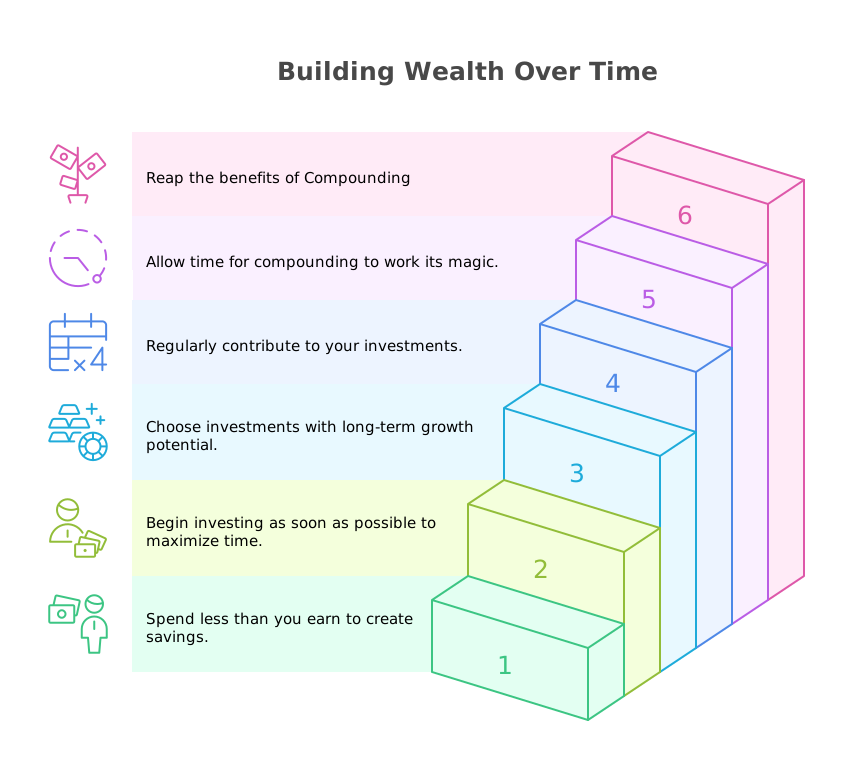
This 19th-century wisdom holds a key insight into building wealth that still applies today. Living below your means and saving money is the first step toward financial success. But there’s another ingredient that turns those savings into true wealth: time, and the power of compounding.
We’ve all heard the saying, “time is money.” In investing, that’s more than a figure of speech—it’s a powerful truth. The longer your money stays invested, the more it can grow, not just from the returns you earn but from those returns generating their own earnings. Compound interest is the quiet force that builds great fortunes, steadily growing wealth like a snowball rolling downhill. It’s how small, consistent investments can grow into substantial wealth over time. It’s why a single dollar today can multiply in value if you put it to work. Let us explore how time and compounding build wealth, with relatable examples and a touch of science to bring the concept to life. Whether you’re a seasoned professional or just starting your financial journey, you’ll see why starting early can make all the difference in shaping your financial future.
The Time Value of Money: Why Time Matters
Time can be a friend or a foe to your money, depending on what you do with it. The time value of money is a core financial concept that says a dollar today is worth more than a dollar tomorrow. Why? Because a dollar today can be invested or earn interest, growing to more than a dollar by tomorrow. Conversely, if you just hold onto that dollar without investing, over time it actually loses value. Enter inflation – the gradual rise in prices of goods and services. Inflation is like a silent thief in your wallet, making the purchasing power of a fixed sum of money shrink as years go by.
Let’s talk Inflation
To understand the impact of inflation, consider this:
- In 1913, just nine cents would buy you a full quart of milk.
- By 1963, that same amount would cover only a small glass
- Today, it would barely pay for a few spoons.
Over the past century, inflation has steadily chipped away at the purchasing power of that coin until it became a fraction of what it once was. While you’re not likely to save money for 100 years, the same principle applies over just a few decades as well—unchecked, inflation can quietly erode your wealth. Keeping cash under the mattress or in a zero-interest account all but guarantees a loss in buying power. Even historically “mild” inflation of just a few percent per year has been enough to cut the real value of money by more than half in a single generation.
Doing nothing with money you won’t need in the near future is rarely a safe choice. If you stash it in a safe or let it sit in a checking account for years, inflation will quietly erode its purchasing power, leaving you with less in real terms than you started with. To preserve – and ideally grow – your wealth, you need to turn time into an ally by putting your money to work. This is where investing and compounding come in. By putting your savings into assets that have historically outpaced inflation, such as stocks, you can harness time to increase your wealth instead of letting it diminish.
The Power of Compounding: How Little Seeds Become Mighty Trees
So how exactly does compound interest work? Often called “interest on interest,” compounding is a simple concept with profound implications. Imagine you have $100 and invest it at a 5% annual interest rate. After one year, you earn $5 in interest – giving you $105. If you leave that $105 invested for another year at 5%, you’ll earn interest not just on the original $100, but also on the $5 interest from the first year. So you’d gain about $5.25 in the second year, ending up with $110.25.
That extra 25 cents may not sound like much, but here’s the key: every year, your money can earn a little more, in an ever-increasing snowball. Given enough years, that snowball can grow surprisingly large. No one can predict what any single year will bring for an investment. However, over the long term, the odds are firmly in favor of those who invest rather than sit on the sidelines.
Compound growth may seem modest at first, but its power builds dramatically over time. Imagine planting a tiny acorn— for a while, it shows little change, but given time, it grows into a towering oak. As Albert Einstein is often quoted as saying, “Compound interest is the eighth wonder of the world. He who understands it, earns it… he who doesn’t, pays it.” Why would one of history’s greatest minds say that? Because compounding follows an exponential pattern: the longer it works, the more potent it becomes—until it reaches a tipping point where the pace of growth can be truly astonishing.
The rule of 72
A simple way to grasp the power of compounding is with the “Rule of 72.” This handy guideline lets you estimate how long it will take for an investment to double: just divide 72 by your annual rate of return. For example, at 8% growth per year, your money would double in about 9 years (72 ÷ 8 = 9). At 6%, it would take roughly 12 years. While not perfectly precise, the rule offers a quick, intuitive snapshot of exponential growth. Here’s the big takeaway: if your investment doubles in 9 years at 8%, in 18 years it could be worth about four times as much, and in 27 years around eight times. That’s the magic of compounding—growth that accelerates over time.
This is why someone who begins investing early—and allows their money to compound over 30 or 40 years—can end up with far greater wealth than someone who starts much later, even if the latecomer saves more each year. Compounding rewards patience. Like the timeless tale of the tortoise and the hare, steady, consistent growth ultimately outpaces short bursts of effort.
Before we move on, it’s important to consider the other side of Einstein’s famous insight: “He who doesn’t understand it, pays it.” If you’ve ever carried a credit card balance, you’ve experienced this firsthand—the interest on unpaid debt compounds, turning a small balance into a much larger burden over time. Compounding itself is neutral; it simply amplifies the outcome, whether good or bad. The key is to position your money so you’re earning from it, not paying for it.
Start Early or Pay Later: The Cost of Waiting
When it comes to investing, time isn’t just money – time can be a lot of money. The difference between starting now and starting ten years from now can be staggering, even if you invest the exact same amounts. Let’s illustrate with a tale of two savers, Dr. Jack and Dr. Jill, both 30-something physicians with healthy incomes.
Jack vs. Jill, Part 1 – Invest or Not Invest
Jack and Jill are both disciplined savers, each setting aside $100,000 per year—a remarkable feat achieved by living well below their means. They keep this up for 35 years, saving a total of $3.5 million each.
Jack, ever cautious, keeps all his savings in cash, stored safely but never invested in anything riskier. Jill takes a different approach, putting her savings into a diversified portfolio earning an assumed average of 8% per year.
At the end of 35 years, Jack has the $3.5 million he saved—worth less in real terms after inflation. Jill, on the other hand, ends up with roughly $18 million, about five times more than Jack. The difference isn’t luck; it’s the power of compounding. Jill’s investments generated returns on both her contributions and on previous returns, creating decades of exponential growth. Jack’s cash, meanwhile, sat idle and lost purchasing power over time.
Now, not everyone needs $18 million—$3.5 million might be more than enough for some. But the point isn’t the exact figure; it’s the staggering impact of letting your money work for you. With her larger portfolio, Jill has choices Jack may not: retiring earlier, funding passions, enjoying luxuries, or leaving a meaningful legacy.

The lesson is simple—investing can open doors and create financial freedom, while keeping money out of the market is almost certain to leave substantial wealth untapped.
Jack vs. Jill, Part 2 – The Early Bird Gets the Worm
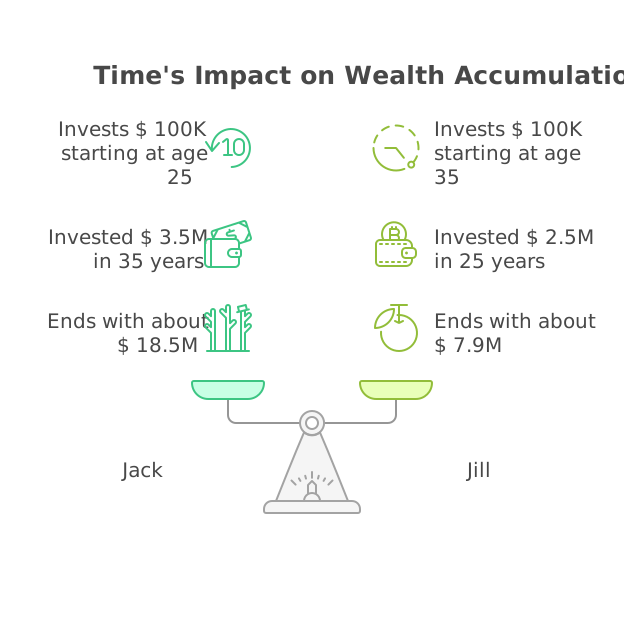
Let’s adjust the scenario: This time, both Jack and Jill invest and earn the same hypothetical 8% annual return. The difference? Jack starts 10 years earlier. Jack invests $100,000 per year for 35 years, while Jill invests the same amount annually for 25 years. Over time, Jack contributes a total of $3.5 million, and Jill contributes $2.5 million—meaning Jack puts in just $1 million more of his own money. But after decades of growth, Jack’s portfolio isn’t just $1 million larger—it’s nearly twice the size of Jill’s. By contributing only 40% more, Jack ends up with almost 100% more wealth, thanks to the extra decade of compounding. That’s the incredible force of time: every additional year your money works for you can add disproportionately to your final wealth. In most cases, starting earlier—even with smaller contributions—beats starting later with larger ones.
Jack vs. Jill, Part 3 – The Price of Procrastination
One powerful way to understand the cost of waiting is to ask: for a specific financial goal, how much must you save depending on when you start?
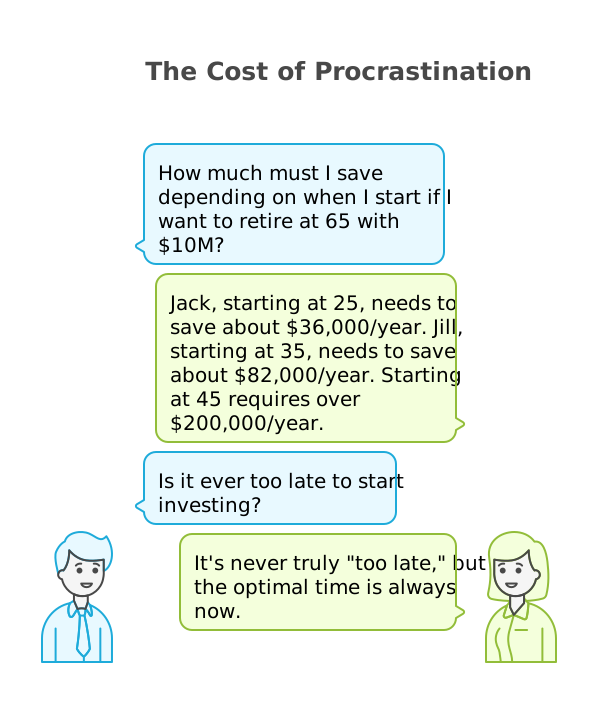
Imagine Jack and Jill both aim to retire with $10 million (ignoring inflation for simplicity) and can earn about 8% annually on investments. Jack, starting at age 25, would need to save roughly $36,000 per year to hit the target. Jill, delaying until age 35, would need about $82,000 per year. Wait until 45, and the annual savings requirement soars to over $200,000. The takeaway is clear: time lost is nearly impossible to recover. It can be far easier to invest around $3,000 a month in your twenties than to scrape together more than $15,000 a month in your forties. In personal finance, procrastination carries a steep—and often insurmountable—price.
The good news is it’s never truly “too late” – even starting in mid-career is better than never – but the optimal time to start investing is always now. Your future self will almost certainly thank you. And if you’re helping your kids or grandkids, one of the best gifts you can give is to encourage (or help) them to start investing early, however modestly. They have the one asset you can’t give them later in life – a long runway.
Long-Term Investing: Time, Not Timing, Is What Matters
We know that starting early and staying invested over the long term can be incredibly rewarding. Still, it’s natural to wonder: What about market ups and downs? Isn’t investing risky? What if I invest at the wrong time? In the short term, markets can be unpredictable, and there will be years when investments lose value—sometimes sharply. But history shows that, over time, these fluctuations tend to even out. Viewed through a long-term lens, investing is far less risky than it might seem in the moment. Do note that the risk never fully goes away, especially during a time frame relevant to you!
The broad U.S. stock market, often represented by the S&P 500—an index of 500 leading U.S. companies—offers a telling example of the power of long-term investing. Over any single year, results can vary widely: since the 1920s, roughly one out of every four years has ended in a loss. Yet when you extend the lens to 10- or 20-year periods, the picture improves dramatically.
The long-term averages are far more compelling. From 1926 through 2025, U.S. large-cap stocks returned roughly 10% per year, with inflation averaging about 3%, producing a real return of around 7% annually. Thanks to the power of compounding, every $1 invested in 1926 would have grown into a substantial fortune today. By contrast, keeping that same dollar in cash—not invested—would have seen its value eroded by inflation to the equivalent of just a few cents in 1926 dollars, a stark reminder of the cost of standing still.
Patience is a virtue
While most individuals do not live or invest for a full century, history tells a clear story: patient, long-term investors have typically been rewarded, while those who avoided productive assets often watched their wealth lose value. Past performance is no guarantee of future results, and the next 30 years remain uncertain. Still, human innovation and the steady growth of economies have, over time, tended to push asset values higher in the long run.
The key to capturing long-term growth is simple: stay invested. As the saying goes, “Time in the market beats timing the market.” Even the most seasoned professionals can’t consistently predict the perfect moments to buy or sell—and attempts to do so often backfire. Selling after a downturn locks in losses, while sitting on the sidelines can mean missing the market’s strongest rebound days. Missing just a few of the best-performing days can drastically reduce your long-term returns. The twist? Those big “up” days often happen during the most turbulent periods, when many investors have already pulled out. The lesson is clear: remain steadfast, keep your focus on the long term, and let time work in your favor.
Time is your most valuable asset
John Bogle, founder of Vanguard and a legendary advocate for everyday investors, summed it up best: “Time is your friend; impulse is your enemy.” He believed the power of compounding over time is one of our greatest allies, while impulsive reactions to market swings or hot trends often lead to poor decisions. Bogle’s approach was simple yet powerful: invest in broad, low-cost index funds—then hold them for the long run, tuning out the noise. Over time, the natural upward trajectory of the markets, combined with reinvested earnings, can do the heavy lifting. It’s not flashy in the short term, but it has delivered lasting results for countless investors.
The importance of compounding over time
Another real-world testament to long-term compounding is the story of Warren Buffett, one of the world’s most successful investors. Buffett famously started investing as a child and kept at it his whole life. The result? The vast majority of his wealth came after his 65th birthday. In fact, roughly 98% of Buffett’s fortune was accumulated after he turned 65 . It sounds crazy, but that’s the nature of compounding – keep doubling a snowball and it gets enormous in later rounds.
Buffett himself credits “being alive a long time” and the power of compound interest for his wealth, saying “my life has been a product of compound interest.” Of course, being a savvy investor helped, but even Buffett points out that starting early and sticking to it was crucial. If he had started investing in his 30s instead of as a kid, or if he had retired and pulled out his money at 65, he’d be nowhere near as rich as he is. The takeaway for us: you don’t have to be Warren Buffett to benefit from this – you just need to give your money time to grow, and not cut that growth short unnecessarily.
Finally, long-term investing doesn’t mean you never adjust your strategy or that you ignore risk. It simply means your core approach is oriented toward patience. You still want to diversify (so that your compounding isn’t tied to just one company or one asset), and you want to periodically check that your plan aligns with your goals. But once you set a reasonable plan, the biggest favor you can do for yourself is stick with it over the years.
Behavior Matters: Patience, Discipline, and Your Financial Behavior
If compounding is so magical and time is readily available to all who seize it, why doesn’t every smart person end up wealthy? The truth is, knowledge alone isn’t enough – behavior plays a huge role. Finance isn’t just a numbers game; it’s a psychology game. We are human, after all, and humans are not always patient or rational.
One classic illustration is the Stanford Marshmallow Experiment. In this study, young children were given a choice: eat one marshmallow now, or wait 15 minutes and get two marshmallows later. Follow-up studies found that the kids who resisted temptation and waited tended to have better outcomes in various areas of life, including possibly finances. Investing is the ultimate grown-up marshmallow test: can you delay some consumption today (not buy that shiny new gadget or luxury car, and invest the money instead) for a potentially much larger reward later? It sounds simple, yet it’s hard in practice – we’re wired to value immediate gratification.
Instant gratification can be a wealth destroyer
Society doesn’t make it easier either. We live in a “buy now, pay later” culture where credit is easy and there’s constant encouragement to upgrade lifestyles. Sticking to a plan of spending less than you earn requires conscious effort. Remember Dickens’ quote about spending twenty pounds versus nineteen and six – it highlights how living below your means is the cornerstone of being able to save and invest. If you never have savings, you’ll never have capital to compound. It might help to reframe saving not as depriving yourself, but as paying your future self. When you invest $1 today, you’re giving a gift to Future You – potentially $2, $5, or more, depending on your time horizon and returns.
Don’t just do something…
Another behavioral pitfall is how we react to market fluctuations. It’s tough to watch your account value drop during a market downturn and do nothing – our instincts scream at us to do something (usually that “something” is selling in panic). Likewise, when markets are euphoric, we feel the fear of missing out and want to pile in at the top.
These emotional impulses can lead to buying high and selling low, which is exactly opposite of what successful investors do. Controlling these impulses – or better yet, setting up systems so that you don’t act on them – is crucial. This is why many people automate their investments (so they don’t second-guess each month) and set rules for themselves not to touch long-term funds based on short-term news. As John Bogle said, impulse is the enemy. A cool head and a long view will beat a hot head and a short view in the investing world.
Control what you can
It’s essential to choose investments that align with your goals and comfort level, so you can stay committed over the long term. If a strategy causes you stress or feels too complicated to grasp, it can be hard to stick with it. Many successful investors favor straightforward approaches they understand—whether that’s a blend of index funds, rental properties, or running a business—and then rely on time and steady discipline to generate results. While the specifics differ, the common ingredients are consistency and patience.
A useful mindset is to focus on what you can control: your saving rate, your asset allocation (how you spread investments), and your behavior. You can’t control market returns or inflation in any given year, but you can control how much you set aside and how you react. For example, if you know compounding is powerful, you can set up an automatic monthly transfer to an investment account – essentially putting your wealth-building on autopilot. You can also make a rule that you’ll always think in terms of long-term goals (5, 10, 20 years or more!), not this week’s gains or losses. Some of the world’s best investors credit not their IQ, but their temperament, for their results. They aren’t necessarily making brilliant moves all the time; often, they’re just not doing the foolish moves that others do in moments of greed or fear.
For Compounding to work, you’ve got to let it!
In short, financial behavior – our habits, emotional responses, and discipline – is the bridge between knowing and doing. Compounding only works if we actually stick money in and leave it to grow. The concept of “buy low, sell high” only works if we resist the herd mentality that often causes the opposite. The good news is that with self-awareness and maybe some systems (like automation or having an advisor or accountability partner), we can cultivate better financial behaviors. And once you see the fruits of compounding – even on a small scale – it can become positively reinforcing. Watching your net worth grow because of choices you made years ago is a gratifying feeling that can strengthen your resolve to keep going.
Conclusion: Make Time Your Ally
By now, you’ve seen that the real secret to building wealth isn’t a secret at all – it’s simply the combination of time and compound interest. There’s no gimmick, no magic investment that only Wall Street knows about. It’s available to anyone willing to start saving smartly and investing wisely, and to let the years do their work. The challenge is mostly internal: finding the patience, foresight, and discipline to stick with it. As we discussed, start as early as you can, save as much as you reasonably can, invest in things with expected solid long-term prospects, and then hang on tight through the journey. Your money will handle the rest, compounding on itself over time.
Let’s recap a few key takeaways:
Start Early
Whether it’s investing or any wealth-building activity, the earlier you begin, the more time is on your side. Compounding has a snowball effect – a small snowball rolled from the top of a long hill can become a giant boulder by the bottom. Even if you felt you’ve started late, start now. You can’t go back in time, but you can avoid further delay. As an old proverb says, “The best time to plant a tree was 20 years ago. The second best time is today.”
Be Consistent and Patient
Treat investing like planting a garden. You water it regularly and give it time to grow. Set up automatic contributions to your investment accounts if possible – it ensures consistency and removes the temptation to skip or mistime the market. When markets are turbulent, remember that volatility is normal. Zoom out on a long-term chart and often, those jagged short-term drops smooth into an upward slope. Successful investors trust the process and stay the course.
Let Compounding Work its Magic
Remind yourself that small amounts add up. $1 today can become $2, $4, or $10 down the line with the right conditions. Celebrate progress: the first $100K of gains may take a while, but the next $100K often comes faster as your base is larger, and so on. Over decades, compounding can lead to eye-popping results – but only if you reinvest earnings and resist draining the pot early. It’s like watching a tree grow; nothing seems to happen at first, then suddenly you have shade and fruit.
Mind Your Behavior
A sound plan can be torpedoed by rash decisions. Try not to let fear or exuberance dictate your strategy. If you find yourself panicking during market downturns, revisit the reasons you invested in the first place and recall that downturns are usually temporary. If you’re tempted by a hot tip or trendy asset, make sure it fits your long-term approach before leaping. It can help to write down an investment policy or a simple set of rules for yourself when you’re calm, and refer back to it when emotions run high. And always live below your means – it’s hard to invest if you spend every penny. Wealth isn’t about how much you make; it’s about how much you keep and grow.
In closing, remember that building wealth is a marathon, not a sprint. The wealthy families and individuals you admire likely didn’t get there overnight – they saved, invested, and waited, often for many years or generations. The power of compounding has been called the eighth wonder of the world for good reason. It can transform ordinary financial habits into extraordinary outcomes given enough time. Even Albert Einstein and Warren Buffett sing its praises, and these are folks who know a thing or two about making big things out of small things.
Lastly, if you’re feeling inspired to put these principles into action, take a moment to evaluate your own plan. Do you have money sitting idle that could be working for you? Are you on track with your goals or should you start investing a bit more each month? It’s never too late to improve your trajectory. And if you need guidance, don’t hesitate to seek advice from a financial professional who understands the value of long-term, compounding-based investing (and who won’t push you into get-rich-quick schemes).