
Even the most accomplished professionals—doctors, engineers, lawyers, entrepreneurs—are not immune to the psychology of money. You might excel in the operating room or boardroom, yet still hesitate over an investment or second-guess a purchase. Why? Our brains are wired with biases that deeply influence how we handle money. Pioneers in behavioral finance like Daniel Kahneman, Amos Tversky, and Richard Thaler have shown that we often relate to money in surprisingly emotional and irrational ways.
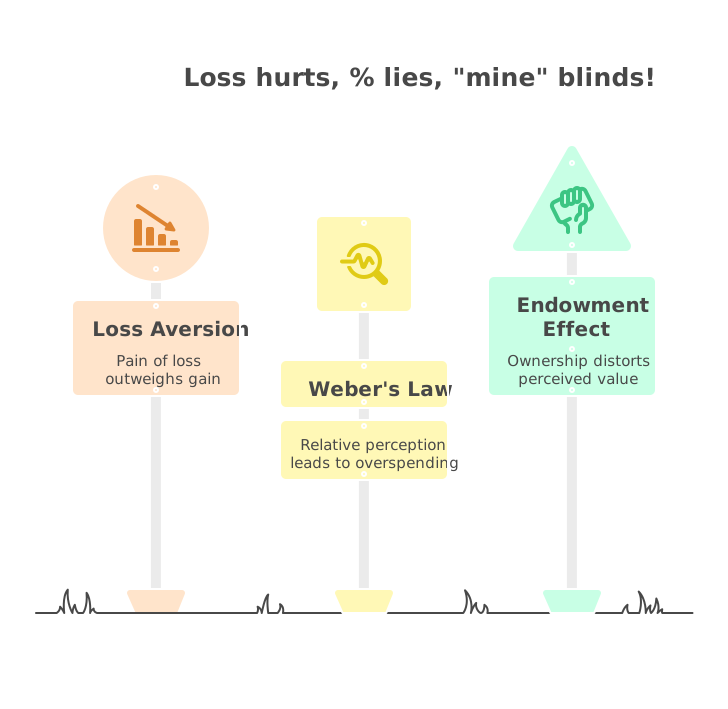
In this post, we’ll unpack one of the most powerful biases—loss aversion—along with two related concepts: Weber’s Law (why a $100 difference can feel monumental or insignificant) and the Endowment Effect (why we overvalue the things we own). Instead of dry charts or complex formulas, we’ll use relatable examples—from buying a home to indulging in a luxury splurge—to make these concepts easy to grasp.
The goal is simple: to help you spot these biases at work in your decisions. Let’s dive in.
Feeling the Pain of Loss (Loss Aversion in Everyday Life)
Picture this: you stumble upon a $100 bill on the sidewalk—instant joy. Now picture opening your wallet later and realizing you’ve lost $100. For most of us, that sinking feeling would far outweigh the earlier thrill despite the same amount being gained or lost. This is loss aversion in action: the pain of losing is about twice as powerful as the pleasure of an equivalent gain. In short, losses loom larger than gains—it feels better to avoid losing $100 than to find $100.
Losses Loom Larger Than Gains
Psychologists Daniel Kahneman and Amos Tversky demonstrated this in their famous Prospect Theory research. They found that if given a fair 50/50 gamble – say a coin flip to either win $ 50,000 or lose $ 50,000 – many people (even wealthy folks) will reject it, even if the odds are slightly in their favor. The fear of losing $ 50,000 looms so large that the potential pleasure of gaining $ 50,000 barely registers . Mathematically, turning down such a gamble might seem irrational (the expected value is is in their favor after all), but emotionally it makes perfect sense due to loss aversion. As Kahneman and Tversky observed, the torment of a loss often outweighs an equivalent gain’s satisfaction.
Consider a real-life scenario: You invest in two stocks; one goes up $10,000 and the other down $10,000. Objectively, you’ve broken even. But subjectively, the loss feels like a punch in the gut, while the gain is just a pat on the back. You might brood over the losing stock for weeks (or kick yourself for buying it), whereas the winning stock’s good vibes fade in days. This imbalance can lead to decision regret – we tend to second-guess and regret actions that lead to losses much more than inactions that miss gains. For instance, selling a stock that later skyrockets might cause some regret, but holding a stock that crashes often feels far worse. That pain can push us into defensive financial behaviors. We may become overly conservative, preferring the status quo or safe bets to avoid any chance of loss . Ironically, that very caution can cause missed opportunities.
Loss Aversion in Everyday Life
Loss aversion shows up in everyday money decisions, big and small. Have you ever bought an expensive item, then felt a wave of buyer’s remorse thinking “I’ve wasted money” more than “I got something great”? That’s loss aversion whispering in your ear – focusing on the money gone rather than the item gained. Or maybe you’ve held onto a struggling business or an underperforming investment for too long because selling it would mean locking in a loss. The rational move might be to cut your losses, but emotionally you just can’t stomach making the loss “real.” This common trap, sometimes called the “disposition effect,” is deeply tied to loss aversion – we’d rather not lose in the first place than admit a loss and move on.
The key insight: Our brains treat losses as more urgent than gains. From an evolutionary standpoint, this makes sense – early humans who focused on avoiding losses (like injury or starvation) probably survived longer than those chasing every gain. But in modern personal finance, this instinct can lead us astray. We might pass up a great investment opportunity because “what if it goes wrong?” echoes louder than “what if it succeeds?”. We might hoard cash or stick to familiar assets, inadvertently shrinking our long-term returns due to fear of any short-term dip. Recognizing loss aversion in yourself doesn’t mean you eliminate it – but it helps you take a step back and ask, “Am I avoiding this financial move for sound reasons, or just because I hate the idea of a loss?” Often, just naming that fear can put it in perspective.

Weber’s Law: Why $100 Is “Small Change” or a Big Deal
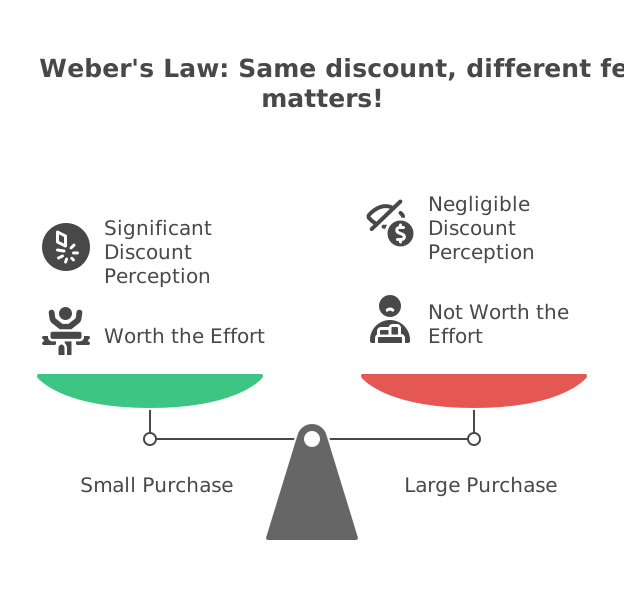
Have you ever noticed how a $50 discount feels huge on a $200 purchase, but hardly noticeable on a $20,000 purchase? Objectively, it’s the same $50, but our minds perceive it differently based on context. This is a classic case of Weber’s Law at work in personal finance. Weber’s Law (a principle from 19th-century psychology) says that the just noticeable difference between two amounts depends on the size of the initial amount . In plain English: we judge changes relatively, not absolutely . A small change on a small base stands out, but the same change on a large base might barely register.
For example, imagine you’re shopping for a new suit. Store A sells it for $500, Store B for $550. Many of us would drive across town to save that $50 – it’s a 10% price difference and feels well worth the effort. Now imagine you’re buying a luxury car for $50,000 and two dealers quote $50,000 vs $50,050. The second car is $50 more expensive – the same $50 difference – but you’d probably consider $50 negligible on such a big purchase (a 0.1% difference) . You might not bother driving to the farther dealership for fifty bucks on a $50k car. Saving $50 feels very different in these two situations, even though it is the exact same amount!
Be Cautious About Upsells During Big Purchases
This relative perception is why upscale retailers and real estate agents tactfully upsell extras during big purchases. If you’re splurging on a high-end vacation or buying a new home, an additional $5,000 for a better view or $1,000 for an upgraded appliance can seem small compared to the six or seven-figure total.
As a new homeowner, you might easily spend a few thousand more on premium fixtures or landscaping – costs you’d balk at if you hadn’t already committed hundreds of thousands to the house. It’s not that the value of $5,000 has changed – it’s that your frame of reference changed. You subconsciously think, “Well, I’m already spending so much, what’s a little more?” In contrast, that same “little more” could have felt like a fortune in other circumstances.
Another illustration: you’d never buy a $3,000 stereo system for your aging $5,000 used car, but you might happily roll it into the financing on a brand-new $100,000 car . The fancy sound system feels like a justifiable add-on when it’s only 3% of the new car’s price, whereas it was 60% of the old car’s entire value! Salespeople know this psychology well. They structure deals so that optional upgrades, warranties, or accessories seem like tiny percentages of a hefty purchase. By piggybacking extras onto a large base price, they leverage Weber’s Law – the added cost blends in with the big number.
A Word On Small Leakages Relative To A Big Reservoir
For high-net-worth individuals, Weber’s Law can be a double-edged sword. On one hand, as your wealth grows, a given expense takes up a smaller slice of your resources – $10,000 might feel like a drop in the bucket if you have a $10 million portfolio (just 0.1%). This can prevent decision paralysis over every small expense, freeing you to focus on big-picture strategy. On the other hand, losing track of relative vs. absolute values can lead to overspending or complacency.
For instance, someone worth $20 million might not flinch at a $100,000 loss on an investment as it’s only 0.5% of their net worth – but $100,000 is still $100,000! The danger is that “small” leakages relative to a huge reservoir can add up to significant absolute losses over time. Just because an amount feels trivial next to a larger sum doesn’t mean it isn’t real money. Many lottery winners and high-earning athletes learned this the hard way – a mindset of “I have plenty, so why not splurge” can snowball and end in huge losses.
Seeing Both The Forest And The Trees in Financial Decisions
So how do you keep Weber’s Law from quietly eroding your wealth? The first step is awareness. Try reframing expenses or savings in absolute terms when it counts. If you catch yourself thinking, “This upgrade is only 2% more”, translate it: 2% of $500,000 is $10,000 – is it truly worth $10k to me?
Conversely, if you’re agonizing over a relatively minor fee on a huge deal (say a 0.1% cost on a transaction), step back and notice the proportion – maybe it’s not worth derailing a major opportunity to save that tiny slice. The trick is to zoom in and out: be able to see both the forest (relative size) and the trees (absolute dollars). Smart financial decisions often require toggling between those perspectives. In sum, Weber’s Law reminds us that our perception of money is elastic – a fact we can use to our advantage by consciously recalibrating our viewpoint as needed.
The Endowment Effect: Why “Mine” Feels More Valuable
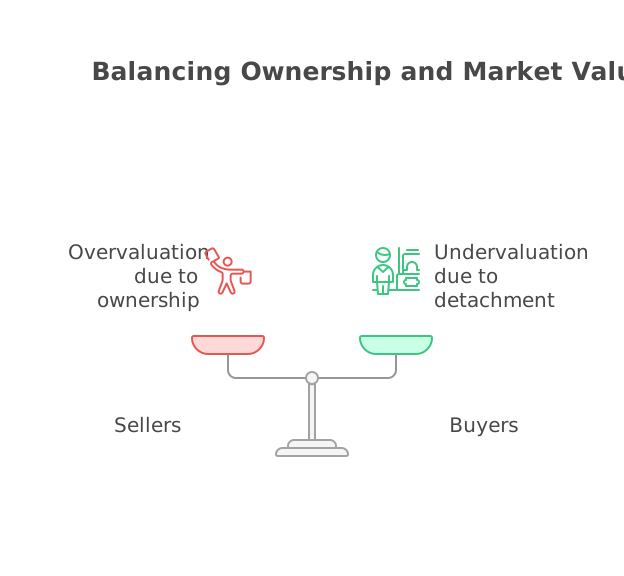
Have you ever tried to sell a house, a car, or even a prized collectible, only to be shocked—maybe even a little offended—by how low the offers were? You thought, “They’re not seeing the real value here,” while buyers were convinced you were asking far too much. This gap in perception often comes down to the Endowment Effect—our tendency to place a higher value on things simply because they’re ours. Once we own something, our perspective changes: It’s not just a house, it’s our home. The aging roof and small backyard aren’t flaws—they’re charming quirks we’ve grown fond of. But to buyers, cherished family memories add no market value. All they see is a smaller yard and a costly roof repair.
Mine Is Better!
The endowment effect, a term coined by Nobel Prize–winning behavioral economist Richard Thaler, describes how ownership can distort our perception of value. In one of Thaler’s classic experiments, participants were randomly given a simple item—like a coffee mug—and later offered the chance to sell or trade it. Remarkably, those who already owned the mug demanded about twice as much money to part with it as non-owners were willing to pay to acquire one.
In some cases, sellers’ minimum price was 2.5 times higher than buyers’ maximum offer. Simply possessing the mug inflated its worth in their minds. Once our brain labels something as “mine,” it seems to attach a hidden premium. You’ve probably felt this yourself—holding on to an old phone or watch because it feels more valuable than any trade‑in deal, or refusing to sell a piece of art or jewelry for its market price because, to you, it’s priceless. That’s the voice of your inner owner at work.
Endowment Effect And You
The endowment effect can subtly influence big decisions. Entrepreneurs often overvalue their own companies during negotiations – after all, they’ve poured sweat equity and soul into it. A founder might reject a very fair buyout offer because, to them, their company feels uniquely valuable (far beyond what an objective market analysis might say). In investing, you might hesitate to dump a stock you’ve held for years, even if all indicators say its prospects are dim, because it’s your stock – you’ve grown attached, you recall its past glory, you feel a loyalty or an irrational hope that “it’ll come back.”
This overlaps with loss aversion: selling would lock in a loss, and you value that stock more because it’s in your portfolio (endowment effect), so you hang on. Endowment bias also explains why we accumulate stuff in our personal lives – from luxury handbags to vintage cars – and then struggle to declutter or sell them. Parting with our possessions literally feels like losing a part of ourselves; our identity gets entwined with our things. As Professor Thaler noted, this is an emotional reflex that standard economic theory didn’t account for – in theory, we should be willing to sell for roughly what we’d pay to buy, but in reality, sellers almost always overprice relative to buyers .
Overcoming Endowment Effect
Being Aware
Awareness of the endowment effect can help temper its impact. Next time you’re on the selling side – whether it’s your home, your business, or even negotiating which project to pursue – take a moment to step into the buyer’s shoes. Try to view the item or decision as if you didn’t already own it or weren’t already involved. If this weren’t your house/business/idea, would you still value it as much? What would a neutral third-party say it’s worth?
Some savvy individuals actually bring in outside appraisals or trusted advisors at this stage specifically to counteract their own rosy owner’s bias. For example, real estate agents often have to gently recalibrate a home seller’s expectations by showing comparable sales – essentially providing an external reality check to compete with the homeowner’s sentimental price tag. In investing, a rule-based strategy can curb the endowment effect: for instance, deciding in advance that “if a stock drops 20%, I’ll sell it” can override the attachment you’ll feel in the moment as the owner of that losing stock.
Switch Sides
It’s also illuminating to flip the scenario. If you wouldn’t buy an asset today at its current price, why are you holding it? This question can smoke out endowment-driven irrationality. Say you have a vacation property you rarely use. If you didn’t already own it, would you pay the current market price to acquire it? If not, then emotionally you might be overvaluing it just because it’s yours. This doesn’t mean you must immediately sell everything you wouldn’t buy again – there are other factors at play – but it’s a neat mental exercise to adjust perspective.
In summary, the endowment effect reminds us how deeply ownership skews our viewpoint. It’s an extension of loss aversion in many ways – giving up something you own feels like a loss, so you demand extra compensation for that emotional hit . By recognizing this bias, you can strive to be a bit more objective, whether you’re pricing your home to sell or pruning your investment portfolio. You might still price your belongings or businesses higher than an outside observer would – we’re only human – but at least you’ll understand why and can adjust if needed.
A real-life fork in the road (tying it all together):
Consider the following example that many people encounter during their work lives:
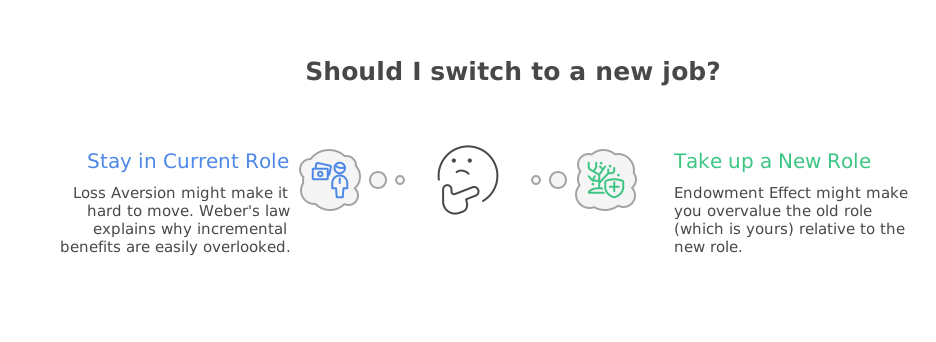
You’re a high-performing provider in a salaried role. Whether you sprint or stroll, the paycheck barely changes—and lately the work feels joyless. A private practice across town dangles autonomy and growth, but it’s owned by one person. The owner thinks they’re already “overpaying.” You feel the number is “too low.” No obvious villain—just two smart people seeing the same puzzle differently.
Here’s how the four concepts show up—and how to move forward:
Loss Aversion (the pull of the status quo)
Staying put avoids the felt loss of stability, team, and routine—so your brain inflates the cost of leaving. On the owner’s side, raising comp feels like a sure loss of margin. Name those losses aloud (“I’m afraid of losing predictability”; “I’m afraid of losing profit room”) so they stop steering from the shadows.
Prospect Theory (frame the choice, don’t let it frame you)
Right now you’re comparing a sure thing (same pay, low joy) to a risky thing (uncertain ramp, possibly higher meaning). When choices are framed as potential losses, people get conservative even if the upside is compelling. Reframe explicitly: “What does a good year look like here vs. there? What does a rough year look like?” Make two narratives—best-plausible and worst-plausible—for each path.
Weber’s Law (make changes legible in real life, not just as %)
Our brains judge differences relative to the starting point. In compensation talks, a small change can feel invisible next to a large base, so we shrug and say “it’s only a tiny percent.” But that same change, translated into your daily reality, can be huge.
- Convert to human units. Instead of “small % more/less,” ask: What does this buy or cost me each week?Does it mean one fewer clinic session, fewer call nights, more protected time, more control over templates, better staffing, or faster MA/RN support?
- Beware the mirror image. A flashy one-time perk can feel big because it’s presented alone, yet barely matter across a year. Meanwhile, a quiet clause—like true scheduling autonomy or no productivity penalty for admin time—can compound in value.
- Normalize the offers. Compare on the same unit (per clinic half-day, per call night, per month of admin time) and then decide. If the base number were hidden, would you still take this trade? That question cuts through the “tiny percent” illusion and shows you the lived impact.
Endowment Effect (Overvaluing “mind”)
You likely overvalue your current seniority, workflows, and reputation because they’re yours. The owner likely overvalues their brand, policies, and offer structure because they’re theirs. Run two outsider tests:
- If I didn’t already have this current job, would I take it today as written?
- If I didn’t already own this practice, would I hire this role on these terms?If either answer is “no,” adjust.
A Practical Approach
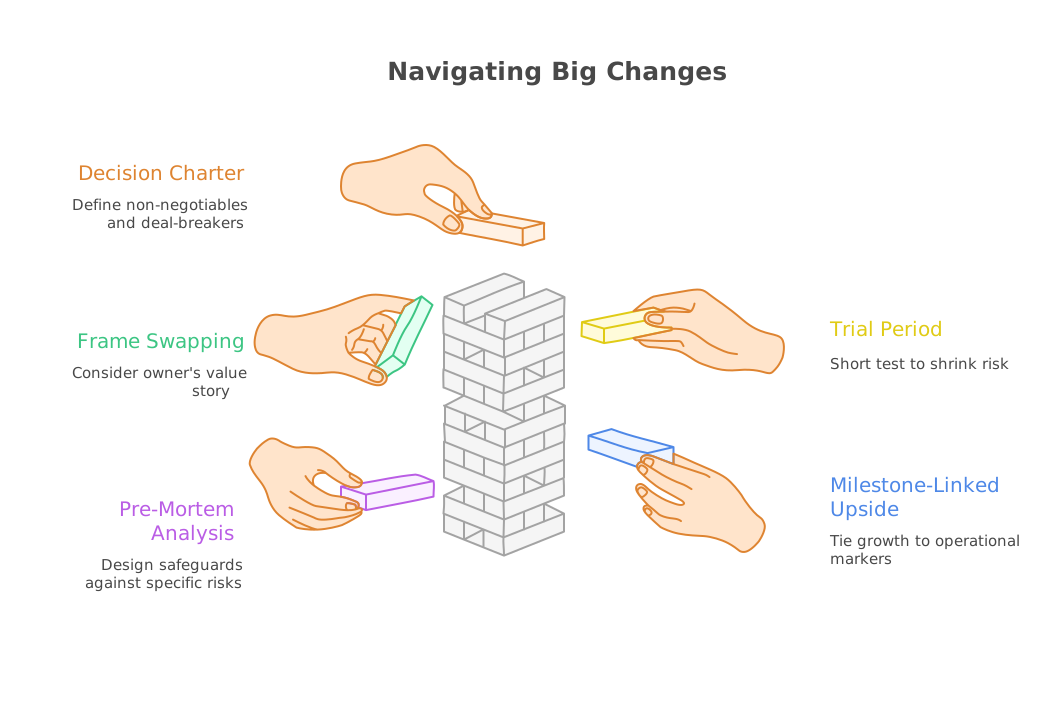
- Write a one-page decision charter: List non-negotiables (values, schedule guardrails, autonomy), nice-to-haves, and true deal-breakers. Keep numbers light; focus on lived experience.
- A trial if possible: Big changes feel scary because your brain screams, “What if I lose what I have?” A short, no-strings test shrinks the risk. You’re not leaping; you’re taking one careful step.
- Swap frames in negotiation. You present the owner’s value story by thinking like the owner and consider this in addition to your own thoughts. May be play it out with them if they are open to it.
- Tie upside to milestones you both believe in. Not a leap of faith but a ladder. Define what “growth” means operationally and link step-ups to those markers. This might help both the owner and the employee!
- Do a pre-mortem. “It’s a year from now and this move failed—what went wrong?” Now design safeguards against those specific risks.
You’re not choosing courage over caution; you’re choosing clarity over reflex. Name the losses, reframe the gamble, scale it in human terms, and step outside your “ownership” bias. Then decide—and commit.
Conclusion: Taming the Emotional Biases in Your Financial Life
Money may be numeric, but financial decisions are anything but purely logical. Loss aversion makes the pain of losing money cut deeper than the pleasure of earning more. Weber’s Law tricks our sense of scale, so we sweat some differences and ignore others, not always in proportion. The Endowment Effect wraps our ego and memories around things we own, clouding what we’d objectively pay or accept for them. These behavioral finance concepts – pioneered by greats like Kahneman, Tversky, and Thaler – prove that even rational, educated people have blind spots in their money psychology.
The good news is that knowing about these biases is more than half the battle. By putting names to these gut feelings, you create a little distance between you and the instinct. The next time you find yourself overly afraid of a financial loss, ask whether loss aversion might be magnifying your dread. When considering a major purchase (or negotiating one), remember Weber’s Law – a small percentage of a big number is still real money – and decide if you’d treat that add-on the same way in isolation. When selling or rebalancing assets, watch for the endowment effect – don’t let “mine” syndrome lead you to cling to underperformers or overprice your valuables beyond reason.
Making Your Emotions Serve You
None of this is to say emotions are “bad.” On the contrary, emotions give meaning to our financial goals – like buying a home for security or investing in causes we care about. The aim of understanding these biases isn’t to become a cold, calculating robot; it’s to ensure your feelings about money serve you, instead of subtly sabotaging you. High-net-worth individuals often work with financial planners or behavioral coaches who help provide that outside perspective – essentially acting as a gentle check on these biases. Whether or not you enlist professional help, you can practice self-reflection. Before making a big decision, take a breath and run through a mental checklist: Am I fearing loss too much? Am I framing this in relative vs. absolute terms wisely? Am I too attached to the status quo because it’s mine?
By integrating a bit of rational analysis with a healthy awareness of your human quirks, you’ll be better positioned to make sound, confident financial decisions. In the end, managing wealth isn’t just about markets and math – it’s about managing ourselves. And as you continue to build your financial acumen, never be embarrassed by the mind tricks you discover – even Nobel-winning economists admit to having these biases! The goal is not to eliminate our human feelings (an impossible task), but to balance them with clear-eyed strategy. Armed with the knowledge of loss aversion, Weber’s Law, and the endowment effect, you can approach your next big financial move with a little more insight – and a lot more confidence that you’re seeing the full picture, emotional and rational, before you act.